"Edited film describes life on the Navajo Reservation. Scenes include women weaving, grinding corn and caring for children (baby is bound into cradle board) and men herding, hoeing corn, silversmithing, and washing and binding their hair. Also shows Navajo Rodeo (encampments, stinger and bronco riding, wild cow milking and horse racing), trading post at entrance to Monument Valley (exchanging rug for goods), Ganado Mission, workers in uranium mine and scenic views of Monument Valley and Canyon de Chelly. Efforts to deal with lack of water is discussed in narration," Human Studies Film Archives, Smithsonian Museum.
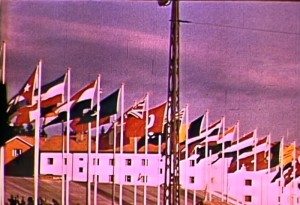
"Olympic summer games Helsinki, Finland, 1952." UC San Diego Library.
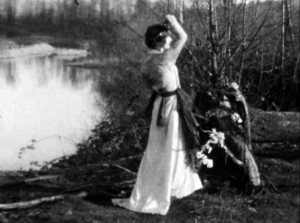
"A parody of William Shakespeare's "Hamlet," produced and directed by James Blue while he was an undergraduate student at the University of Oregon." Knight Library.
"Margaret Conneely's film So Long Ago (c. 1950s) intercuts footage of children reading about dinosaurs with special-effects shots of dinosaurs, borrowed from a commercial film (perhaps The Lost World, 1925)" (Tepperman 335).
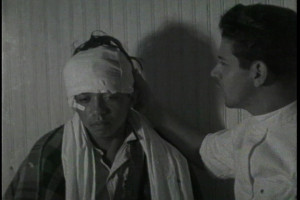
The film chronicles the struggles of young medical interns who had to perform compulsory rural service as part of their medical training.
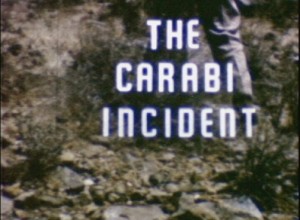
"Once again Harry W. Atwood has used the desert locales of the Southwest and his mastery of outdoor color filming to mount a dramatic and exciting action picture. Although The Carabi Incident is truly an incident rather than a full-fledged photoplay, it does manage to include an abandoned mine, a lost prospector, a worried young girl and her companion — and both a happy and a tragic ending! The production is enriched with Mr. Atwood's usually fine selection of camera angles and suspenseful editing. For these reviewers, however, an excess of dialog subtitles was a drag on the film's development." Movie Makers, Dec. 1952, 341.
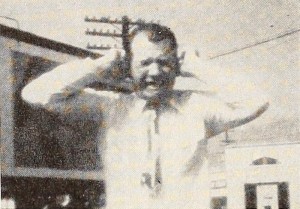
"Believing that he has been betrayed by his wife, the slightly Milquetoast lead character of Near Miss tries all imaginable methods of committing suicide — but without success. In presenting this simple saga of frustration, Barry W. Dance exhibits effective camera viewpoints, uniform exposures, convincing acting and a progression from one scene into the next which is done with precision and pace. Above all he preserves good taste in his plot episodes — a gracious accomplishment all too often slurred over in the strain for comic effect. Near Miss is a pleasant and entertaining farce." Movie Makers, Dec. 1952, 340.
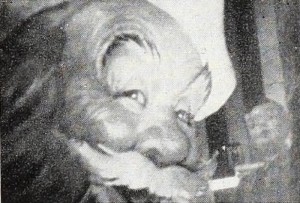
"Most Christmas films seem to be concerned with only one aspect of this December holiday — the gaiety of family life around the tree, opening presents and a festive dinner. Grace Lindner has recorded the material side of the season in the early footage of her film, Xmas Time, as she shows gleaming shop windows, hurrying shoppers, decorated doorways and members of her family around the hearthside. But in a smooth transition from a creche under the tree to the children saying their prayers, she ends her film with a series of architectural studies of the spires and bell towers of churches, filmed through bleak branches against a winter sky. This moving climax, accompanied by a choir recording of The Lord's Prayer, admirably fulfills her aim to portray the triumph of the spirit of Christmas over the baser observances." Movie Makers, Dec. 1951, 412.
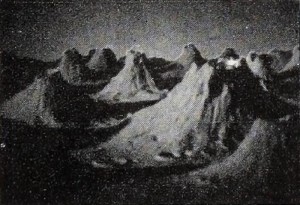
"Jack E. Gieck's film is a fanciful abstract study delineating the aspect and activity of the planet Uranus. In it he has wisely kept his footage brief. His lighting effects on models of the mountains and the color patterns of liquids reflect an imaginative concept. A rather too soft focus toward the end of Uranus is somewhat unexplainable, but his choice of an excellent musical score contributes to a fascinating creative experiment." Movie Makers, Dec. 1951, 412.
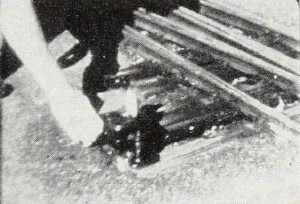
"The Southwestern and Centerville Railroad boasts a roadbed of less than two miles and runs only on Saturdays — and then to "nowhere." But it undoubtedly provides the favorite ride of all the kids (as well as their equally enthusiastic parents) from the surrounding countryside. In The Fresh Milk Line, Roy Fulmer, jr., records the operation of this narrow gauge railroad on a dairy farm in New Jersey, run as a hobby by the owner of the farm. Closeups of the working of the Diesel engine, the switches and signals add technical interest; while the sequence of laying a new piece of track by presumably adult employees on the farm makes it apparent that the men enjoy "working on the railroad" as much as would any youngster. Here is one film whose interest would have been heightened by a musical accompaniment with sound effects." Movie Makers, Dec. 1951, 412.
Total Pages: 299
 Amateur Cinema