"Al Londema's 'The Black Satchel,' is a pretentious photoplaylet in 8mm color, showing good camera work and direction." American Cinematographer, May. 1952, 224.
"Joseph Fischer's 'Goldilocks And The Three Bears' is an unusual amateur accomplishment in which the filmer and his associates staged the age old nursery tale in miniature, building all the sets, props and the marionette figures themselves. A drawback is the lack of sound narration or continuity titles." American Cinematographer, May 1952, 224.
"William Hahn's 'Emerald Stairway - Sulu Seas' is a 16mm Kodachrome documentary of life and scenes in the Philippines, and notable for its consistent color quality and expert photographic treatment." American Cinematographer, May 1952, 224.
"Newell Tune's 'A Midsummer Night's Dream' has some outstanding photography in which distortion lens attachments were used for some fantastic effects." American Cinematographer, May 1952, 224.
"Harold Ramser's 'Acapulco—Mexican Riviera' is a beautiful Kodachrome documentary of the colorful Mexican resort city." American Cinematographer, May 1952, 224.
"Waters Of Lodore - Unlike most letter carriers who go for a hike on their vaction, letter-carrier Morton and a party of friends set out on a boating adventure down the Colorado river during his 1950 summer vacation. Morton recorded the adventure from start to finish, and edited the footage into an absorbing documentary having many thrilling moments. Although the picture is a little slow getting started -the preparation and get-away sequences being somewhat overly- lenghty -the picture, once the boats get underway, is packed with interest and not a few thrills. It must have been a monumental job making movies on such an arduous journey, for it was often a tough enough job just to keep the boats afloat. Staging the boat action in the rougher waters required infinite patience and camera skill, but Morton has been rewarded with some excellent shots of his fellow-boatmen navigating the dangerous rapids. Morton shot the picture on 16mm Kodachrome at 24 f.p.s., hoping later to combine the narration on a sound print. At present, the narration is recorded on wire and synchronized with the picture." American Cinematographer, May 1952, 224.
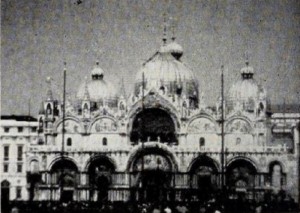
"Venezia, Pearl Of The Adriatic - Oscar Horovitz, in his recent world travels, gives us the benefit of his discerning eye with a studied and beautiful account on color film of the beauties of Venice, Italy. In this picture, he especially demonstrates his uncanny knack for searching out the most dramatic points of interest and for capturing them with his camera in such a manner that even without a running commentary, the picture has an unusual appeal. The secret, of course, is Horovitz's trick of following up his shots with more descriptive shots, in order to tell the complete story. Every sequence, no matter how brief or what the subject, is complete -sufficient. His compositions are artful, adding much to the interest of the picture. Considering that he spent two days in Venice, he has achieved a remarkable documentary of this beautiful and interesting city." American Cinematographer, May 1952, 224.
"Venice, with the misted Italian sun glowing softly on her mosaic domes and sparkling spires, is truly gem-like in her pearly beauty. And Oscar H. Horovitz has succeeded to an extraordinary measure in capturing the warm opalescence of this ancient capital. Such standard subjects as the Grand Canal and St. Mark's Square, in sequences of rewarding detail, have been blended in with less familiar scenes along the city's less famed waterways and few narrow streets. Such a detailed study belies the widespread belief that one must have unlimited time in which to do full justice to one's subject; Mr. Horovitz reportedly spent but two days here. However, his expert command of the technical elements of movie making, plus a pleasing sense of composition and eye for human interest, combine to make Venezia a memorable travel-film experience." Movie Makers, Dec. 1951, 410-411.
"Spear That Fish - Few professionals have yet brought to theatre screens such scenes as Leon Paddock has captured in this entertaining 16mm color film. Using underwater camera equipment which he designed himself, he and an associate journeyed to the west coast of Mexico where they took the camera underwater and shot scenes of sturdy swimmers with water-goggles and swim-fins exploring the marine life of Mexico's off-shore waters. Shown are divers using spears and spear-guns in hunting game fish, and one diver's encounter with devilfish and other unusual marine life. The climax is marked by a duel between a diver and a shark, with the diver knifing the shark and bringing it to surface. The color photography is some of the best 16mm underseas camerawork yet to be seen. It demonstrates unusual skill as well as the filmer's knack of obtaining excellent exposures with color film in the admittedly difficult conditions which underwater invariably presents. The narration on tape contributes adequately to the screen presentation enhancing the continuity of the slick editing of this picture." American Cinematographer, May 1952, 223-4.
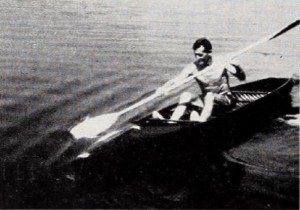
"There are precious few sails in this production which William Messner has called Blades and Sails. But there is a powerful lot of cinema in its smooth 650 feet of Kodachrome. And there is a wealth of flashing blades. The blades are bandied about by Ernest Riedel, a gaunt length of rawhide and muscle, otherwise known as the national, international and Olympic canoe champion. During the smoothly plotted course of Riedel's exposition of canoeing techniques. Mr. Messner demonstrates his own championship calibre behind the camera. His angles are so right as to seem effortless — though you suspect they're not. His follow-through is as deft as a sweeping blade and his cutting as crisp as a speeding birchbark. Blades and Sails is informative, entertaining and sound cinema — which is quite a combination in any man's movie." Movie Makers, Dec. 1951, 410.
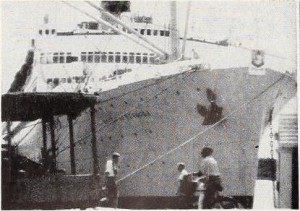
"One rarely thinks of a portrait of a place; but Bermudiana is in essence just that. Helen C. Welsh has a perceptive eye for beauty, an affection for her subject and a trained, technical knowledge of her craft. This triple-threat combination has recorded not only the justifiably famous surface aspects of these enchanting islands, but it has revealed as well much of their inner spirit. The film has all the attractions of a first rate travelog and the informative qualities of an honest documentary. Its accompanying narrative complements perfectly the flow of pictorial material, providing supplementary information without piling up facts and figures simply for their own sake. A happy choice of musical background furnishes the final touch to a rich and well rounded presentation." Movie Makers, Dec. 1951, 410.
Total Pages: 299
 Amateur Cinema