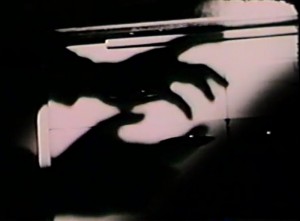
Thriller film about an escaped murderer, and a nearby woman who is home alone.
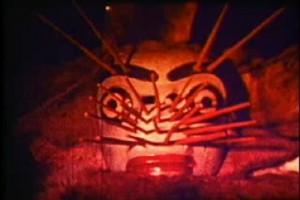
"Mungo Martin demonstrates the making of a Bee Mask. Tony Hunt models the mask and provides a short rendition of the Bee Mask Dance" (Duffy, 140).
This film is also known as Mungo Martin Makes a Mask.
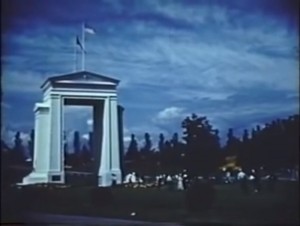
"Local sights and events in the White Rock area, such as parades, celebrations at the International Peace Arch, fashion show, recreational activities, etc." British Columbia Archives.
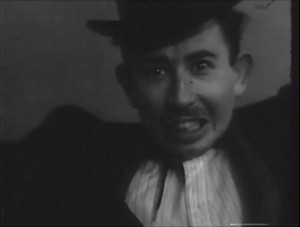
"The Suetonius Version is Stan Fox’s last 16mm amateur film. The story is about a university professor who is fascinated with one of his young female students." (Royal BC Museum)
This film was shot on the UBC campus, including in the closed stacks at the UBC Library.
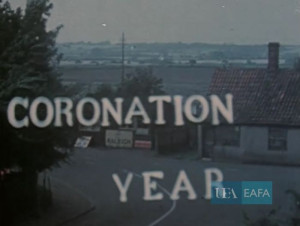
‘Camera pans over cottages in the village of Tolleshunt D’Arcy. Paintings of the coronation are shown followed by a photo of Queen Elizabeth II. A shot of the church with two old men sitting on a bench by the road. Another shot of the church followed by a sign post for the village and the Union Jack flag flying. A man goes into a telephone box in the middle of the village as a bus drives past. Flags and bunting decorate the village. Two women come out of a shop. One woman gets onto a bike and the other walks away. There is a shot of Tolleshunt D’Arcy Post Office and the postmistress, Miss Blaxhall, comes out under the filmmaker Joyce Allingham's direction. The baker puts up coronation decorations outside his shop and people put decorations on string around the village. A little girl waves a Union Jack flag. Close up of a girl and boy decorating pots using red, white and blue ribbon. Shots of people decorating their gardens. Two people come out of a Co-operative store and a little girl walks down the street carrying a basket. Mr and Mrs Emeny come out of the Thatcher’s Arms and another couple walk out of the front door of their cottage and smile at the camera. A woman wraps red, white and blue ribbon around her bird table and another woman carries a crown on a pillow. Camera pans across the street to show the villagers decorating. Children play in the street and a father lifts his little girl up to the camera and they both wave. People stand in a group and look at the camera. Miss Jessie Bacon looks through the window of Salter Lodge. Shot of the decorated D’Arcy Motors garage. The owner stands outside the garage where the Castrol oil and Esso petrol is sold. The proprietor, his wife and dog stand outside the Red Lion pub. Joyce’s sister, Margaret Allingham, and Margaret's husband, Philip Youngman Carter, stand outside their home in the main street. They then pose by the front door of D’Arcy House. Shot of a dog sitting in the garden. Close up of a woman hanging her washing on the line. Various shots of villagers going to church. A woman and her two children stand outside their home looking at the camera. A man climbs up a ladder to put up some bunting. Various villagers pose for the camera outside their homes and shops. One man cuts a rose and smells it. A car drives along the road followed by a shot of people coming out of a village shop. Shot of people looking out of the windows of the Queens Head pub and standing outside the tobacconist shop. Various shots of villagers standing outside shops and houses. A poster introducing the Tolleshunt D’Arcy Coronation Celebrations, June 2nd 1953 at the grounds of D’Arcy House. The poster states that there is a television in the village by Radio Vision, Maldon. It gives the line up of events for the day: Parade meet at The Maypole at 1.40pm followed by 3.45pm Sports; 4:30pm Sit Down Tea For Children; 5.00pm Running Buffet For Everyone; 5.40pm Sports Continued; 7.15pm Presentation of Prizes; 8.30pm Dancing in The Village. The procession of decorated lorries, vans, prams, cycles and fancy dress is shown. Camera pans over the people in the crowd dressed up in costumes. Close ups of the carnival floats driving past the camera. Children participate in various relay races. The film ends with scenes of a pram race with men dressed as women and the adult 'babies' drinking pints of beer’ (EAFA).
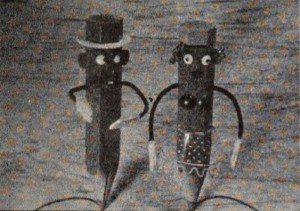
"Muntre Streker, which (we are informed) means "Funny Lines" in a literal translation from the Norwegian, is a wholly delightful tid-bit of animated cartooning. In it, fat colored crayons — one dressed as a boy, the other as a girl — act out a simple story which is as gay in its good humor as the animation is flawless in its technique. Scarcely 100 feet in length, Muntre Streker is a bright and sparkling gem of film fantasy." Movie Makers, Dec. 1952, 339.
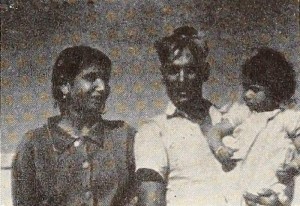
"Oscar H. Horovitz, you may recall, already has told in words (see Israel Invites, March Movie Makers) about his month-long visit of last year to this newest of the world's democracies. In The Israeli Story, with all personal references excised, he now sets forth film a record of this hard-won republic he found it. Covered, in step-by-step reporting, are its polyethnic citizens, its social, economic and educational centers, and, briefly, its hopes for the future. Supplementing this visual reportage there is a technically excellent magnetic recording on film, in which music is used sparingly and the narrative is both written and delivered with restraint. As such, The Israeli Story is a competent documentary record which should serve (and, in fact, has served) the public relations program of the new Jewish state effectively. An objective observer of the film, however, draws from it little if any of the emotional uplift which is eagerly hoped for by every sympathetic viewer." Movie Makers, Dec. 1952, 341.
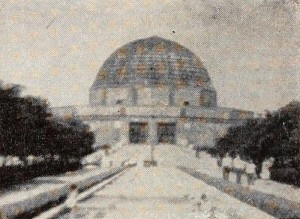
"Attempting to film a large city with its huge skyscrapers and teeming population through the lens of an 8mm. camera would seem to be an almost overwhelming task. However, boldly tackling such a gigantic project, Richard Guetl in his entry, The Big City, proves it can be done. This competent photographic work presents a good, clear coverage of Chicago, where Mr. Guetl resides. His angles are interesting and compositions pleasing. His street shots around the Loop and his camera treatment of the human derelicts on Skid Row are worthy of special commendation. While The Big City is not an epic, it is a capable, factual presentation with just enough skyscraper shots to make it authentic, enough stores and people to give it pulsating life, and enough pathos to arouse the emotion." Movie Makers, Dec. 1952, 340-341.
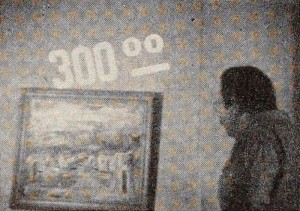
"In Paintings, George E. Canning has hung his story on a simple plot that serves to display an artist's works. A lady makes an appointment with the artist with the intent of making a purchase. The artist, beset by a pile of bills, wonders what he should charge or hope to get; and here figures expressing his thoughts are cleverly superimposed on the scenes of action. The paintings are interesting in themselves for their variety of subject matter and style (this fact rather belies the artist's penury), and the interior lighting throughout the film is excellent. The artist (John S. Arhorn) is well played by himself, the lady by Julia Canning. One could wish that the plot's denouement is not so readily anticipated." Movie Makers, Dec. 1952, 340.
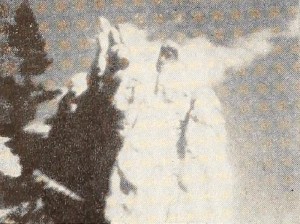
"With a thorough understanding of what constitutes human interest, L. Gordon Darby has produced in Mountain Playground an attractive record of the Banff-Jasper National Park area. Present, to be sure, are the majestic peaks, the Banff Springs Hotel with its surrounding flower gardens, Lake Louise and a picturesque river trip. But there are presented also the darting antics of a chipmunk, the dainty distrust of a cautious deer and the hungry bear within arm's reach of the camera. If camera steadiness had not been sacrificed for the ease of the hand-held camera, this attractive travelog might well have contended for higher honors." Movie Makers, Dec. 1952, 340.
Total Pages: 299
 Amateur Cinema