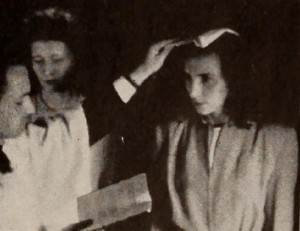
"The pitfalls of sentimentality and bombast have both been avoided in Gateway to Faith, a simple, dignified teaching film of the Roman Catholic baptismal rites, produced by the Reverend Edward Hayes and the Reverend Paul Hayes. With a clarity reminiscent of Thomistic syllogisms, the two priests show precisely what happens during a baptism and explain, with equal precision, the symbolic meaning of each section of the ritual. The film was made for instructional purposes; it fulfills these purposes in a highly intelligent manner. Gateway to Faith was produced at Sacred Heart Church, in Newark, N. J., and received the official imprimatur from Archbishop Thomas J. Walsh. The priest in the film is played with restraint and dignity by the Reverend John Wightman." Movie Makers, Dec. 1947, 537.
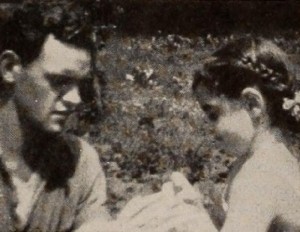
"Terry Manos takes his family and his audience to the country and shows us what Farm Frolics are for those who live rurally and what fun city children can get from participating in them. Against a background of farm life that is shown largely by indirection, the children romp and play little tricks on each other, while the understanding adults take a good humored part in the proceedings. Mr. Manos's camera work is imaginative, making the most of the abundant material at hand. His greatest achievement is the creation of a fine family film that, because of its lively farm background, also holds audience interest." Movie Makers, Dec. 1947, 537.
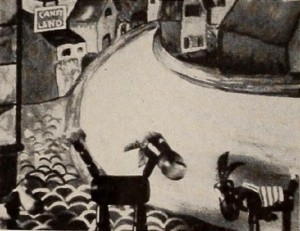
"Using animated puppets and hand painted water color backgrounds, Charles H. Benjamin, in Fantasy in Toyland, takes a curious dog through the horrors usually reserved for white knights, to save a fabulous female canine in distress. The story is old but the treatment is new. The puppets were manipulated from below stage level and filmed frame by frame with a remotely controlled camera. The star of the piece meets cows, dragons and various beasts made of pine cones and other strange raw materials. The film ends on the accepted romantic note." Movie Makers, Dec. 1947, 536-537.
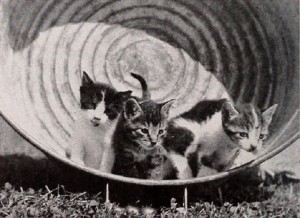
"Recording a modern dairy on 8mm. film is no mean accomplishment, and Helen H. Loeffler deserves special praise for her explicit coverage of the operations involved in running Randall Farms. Miss Loeffler's carefully composed frames and neat subtitles give one a clear picture of the various stages, from milking to bottling. She has overcome the murky interiors of the barns and farm buildings by able lighting, while her pasture sequence at the conclusion of the film shows the sleek cattle at their best. Conducted Tour is a mature record film, tightly edited and presented with polish." Movie Makers, Dec. 1947, 536.
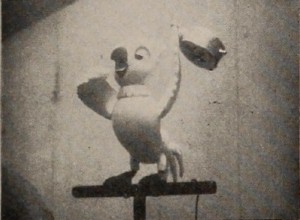
"Animated figures have seldom been presented with such meticulous technique and in such clever situations as are executed by Clifford Bach in Breakfast in Bed. A perfectionist to the last twitch of an eyebrow, Mr. Bach has achieved exceptional realism in the movements of his small figures by painstaking frame by frame exposure and expressive camera viewpoints. His story follows the efforts of a cocky little cockatoo, Windy, to prepare breakfast for his master, Professor Whiffle. Windy's ingenuity overcomes all obstacles in a series of neatly motivated and genuinely amusing "gags." Mr. Bach's persistence and eye for design indicate a bright future in the field of animated movies." Movie Makers, Dec. 1947, 536.
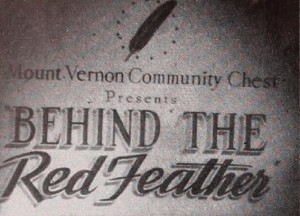
"Made to support a Community Chest campaign, Behind the Red Feather shows how various social welfare agencies in a community help to forestall juvenile delinquency, care for the aged, the sick and the poor and, in general, make a town a better place to live in. As a connecting link between a necessarily episodic series of sequences, a red feather, the Community Chest symbol, floats into the opening scene of the activities of each agency. Walter Bergmann has recorded this community project with understanding and warmth, and Ralph Bellamy contributed his services in recording on disc an excellently written narrative." Movie Makers, Dec. 1947, 536.
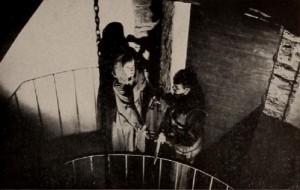
"David Bradley, the dynamic heart of Willow Films, producers of Macbeth, has behind him a long and amazing record of outstanding dramatic pictures. Among these are his productions of The Christmas Carol and Oliver Twist, by Charles Dickens; Emperor Jones, by Eugene O'Neill, and Peer Gynt, by Henrik Ibsen. His Macbeth is the greatest of them all. And in a sense, this moving evocation of the brooding Shakespearian tragedy is the end product of them all — since, in it, Mr. Bradley's creative and cinematic abilities have come fully and splendidly of age. The character of this brilliant achievement may perhaps best be illumined by Mr. Bradley's own words from his plans for the film. "We realized clearly," he has written, "that the strength of our Macbeth must be found in stimulating cinematic treatment, portrayed with such angular camera compositions as to suggest the twisted, supernatural aspects of the drama. We planned our lighting for harsh contrasts and textures, so that, on occasion, the brooding menace of cold, murky stone could almost be felt. For our Macbeth was to be, above all, a movie, depending on atmosphere more than acting, 'punch' more than pomp, for its ultimate success or failure." That it has been success, not failure, is rewardingly the case." Movie Makers, Dec. 1947, 534, 536.
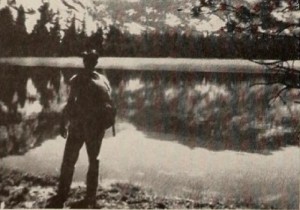
"Filming Yosemite National Park with the same refreshing wit that has made his earlier movie on the Utah parks so popular, Stanley Midgley has even surpassed his previous camera work with spectacular angle shots of the famous waterfalls and brilliantly planned pans which heighten the grandeur of this great glacial valley. In the lighter vein, a fast motion sequence of tourist posturings before the Sequoia trees provides some side splitting satire, while the magnificence of the firefall, the High Country and the mirror like lakes is emphasized by imaginative framing. Always the trail blazer, Mr. Midgley scaled Half Dome with his camera; in other sequences, he apparently conspired with an eagle to get some of the dizzier shots of sheer cliffs and precipitous falls. Yosemite on Two Wheels — and Two Feet is a rare blend of humor and technical skill, an artistic achievement that sets a new high in national park filming." Movie Makers, Dec. 1947, 534.
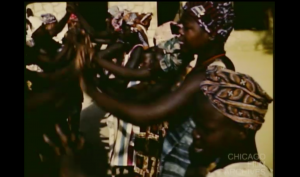
"Silent film set in a small African village. The King takes his young son, the Prince, on a journey to teach him lessons on how to be a great leader by showing appreciation and care for the people they rule. The King guides the Prince to help care for the ill suffering from leprosy, learn skills like farming the land, making clothing and building shelter, and enrolls him in school to get an education and learn religion. The film shows many skills and medical processes of African villagers in detail from start to finish." Chicago Film Archives
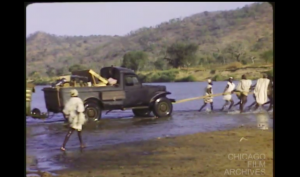
"Details a journey from New York to Lagos and beyond the interior of Nigeria. Footage includes shots of daily traditional life in the village and concludes with a battle scene between two tribes brandishing spears and bows and arrows." Chicago Film Archives
Total Pages: 299
 Amateur Cinema