"Item is a film of a trip to Hawaii taken by Dr. Willinsky and his wife, Sadie. In the form of a travelogue, footage of Hawaii's landscape, vegetation, landmarks and local population is interspersed with captions that were added in by Dr. Willinsky to provide information about the country's culture. Footage includes shots of sites around Honolulu and Waikiki, surfers, Hawaiian flowers, churches and temples, sugar cane farming and singers performing outside a hotel. Sadie is occassionally spotted exploring the sites and interacting with locals."
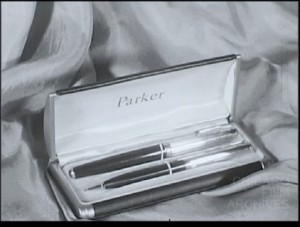
"Short documentary about fountain pen repairs and the process of repairs within a fountain pen hospital. The film begins with a client handing over his pen to the receptionist. From there the pen goes to Robert "Doc" Davis, who performs a nine point check-up on the pen. This is followed by exploded views of various pen models, including the Schaeffer Triumph, Parker 51 and the Eversharp Skyline. Last, the film shows how gold lettering is used on both pends and leather goods. Outtake scenes of the pen hospital and its employees follows the film." Chicago Film Archives.
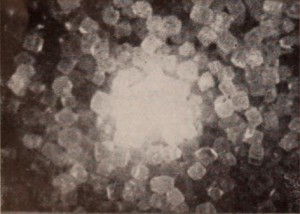
"An experimental exercise with extension tubes, picturing textures in extreme closeup. Such materials as salt, bread, leaves, nylon hose, coffee grounds, book edges, etc., are shown highly magnified, then later identified in medium closeup shots. Idea is similar to quiz feature appearing currently in the Ford Times magazine." Home Movies, Sept. 1947, 586.
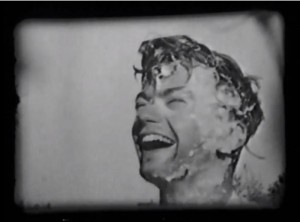
"Members of the National Film Society of Canada (Vancouver Branch) parody the early experimental works of American avant-garde filmmaker Maya Deren [to whom the film is dedicated]." (BC Archives)
The film is subtitled: "A conflict between two philosophies of time and space."
The film was shot in an area of sand dunes on Sea Island in Richmond, BC, near the location of Vancouver International Airport.
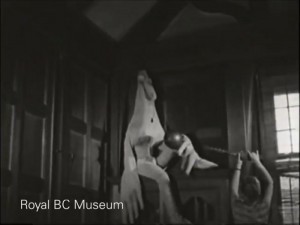
"Produced as a gift to Dorothy Burritt's husband, filmmaker Oscar Burritt (who was working in Toronto at the time), this is an offbeat study of life at their Vancouver apartment -- suite 2, 1960 Robson Street. The camera explores the apartment and the household memorabilia, and Dorothy is seen sitting for a portrait by painter Peter Bortkus. Later some friends drop by for a screening of Sacha Guitry's film Pearls of the Crown, followed by a party. Among the guests are Moira Armour, film editor Maureen Balfe, UBC student Stanley Fox, photographer Peter Varley, and an unnamed figure wearing a bird costume. Most of the people shown would have been involved with the National Film Society of Canada (Vancouver Branch). Suite Two won honourable mention (amateur category) at the first Canadian Film Awards in 1949." (BC Archives)
The film was restored in 1986 by the British Columbia Archives.
"Scenes before a hunt in Gisburn village of the riders and hounds waiting to set off, showing John and Harold Hindley mounted. Also stable scenes at the Ribblesdale Arms, Gisburn, including Rosemary and Valerie saddling their ponies. The hunt out and about on country lanes and riding across fields at Worston, near Clitheroe. John Hindley and daughter Val sitting by the fireside in 1947. A Pony Club Rally on Gisburn Park estate. Hunter Trials, possibly at Gisburn. Lawn Meet of Pendle Forest and Craven Hunt at Gisburn Park. Interior scenes of guests at the buffet, before the hunt moves off in frosty weather." (NWFA Online Archive)
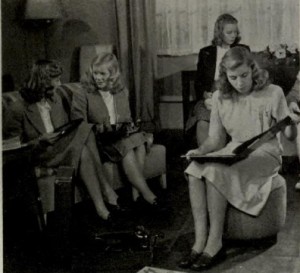
"Sitting Right, a lively, attractive argument for good sitting posture, directs its message to the 'teen aged young ladies of America. Shrewdly, its producers — Grant, Flory and Williams — have brought complete authenticity to this possibly unpopular thesis by presenting it throughout in the playing of actual (and average ) high school girls. These same girls, adds John Flory, the director, even contributed many of the situation suggestions which are woven into the swiftly moving message of the film. The production is marked by fine lighting and camera work, heightened in their effect by a modern and refreshing treatment of the narrative track." Movie Makers, Dec. 1946, 490.
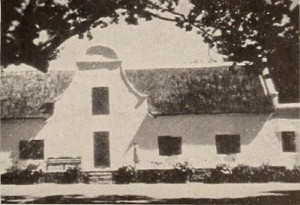
"The solid splendor of Dutch colonial existence in South Africa is attractively recreated in White Gables, by G. Brian McIntosh. Moving out from Capetown, the film carries one swiftly over the barrier crags of Table Mountain into the fertile valley beyond. Here, surrounded by its flowers and fields of grape, stands Groot Constantia, the great and graceful manor house built by Governor Simon van der Stel in 1685. Mr. Mcintosh presents it with sympathy, imagination and skill. Scene flows into scene, sequence into sequence, with a suave progression which could have been achieved only by the most cunning advanced plan. A gracious lady in 17th Century dress moves through the terraced grounds on the gentle errands of that leisured age. White Gables is a bright and glowing evocation of mood and manner which now are history." Movie Makers, Dec. 1946, 489.
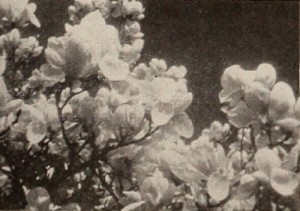
"It is spring in Brooklyn, and Leo J. Heffernan has found a multitude of trees there. He opens the film with a sombre shot of New York's waterfront and skyline, to indicate the tense activity of a large city. A title suggests that those who live in the midst of this turmoil can find solace not far away. The film proceeds to the bounteous display of flowering trees in a large public park. Glowing shots of heavily laden branches against blue sky are interspersed with scenes of Sunday strollers wandering through shaded walks and falling petals. Mr. Heffernan has used to good effect his fine technical skill, and his color transitions between scenes are smoothly accomplished. Trees That Grow in Brooklyn is accompanied by a rhymed narrative written especially for the film by Mr. Heffernan." Movie Makers, Dec. 1946, 489.
Total Pages: 299
 Amateur Cinema