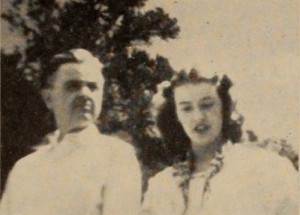
"Basing his story line on an incident which is said actually to have occurred in Sweden, Harry W. Atwood has proved once again in Through the Valley his imaginative understanding of what makes a true motion picture. For here is camera work of the first order, expressed in meaningful angles and building through a stirring chase sequence to a point of very real dramatic tension. If anything, the film's climax has been staged with a shade too much of melodrama, while a concluding quotation from the Scriptures left these reviewers regretfully more puzzled than uplifted." Movie Makers, Dec. 1949, 471.
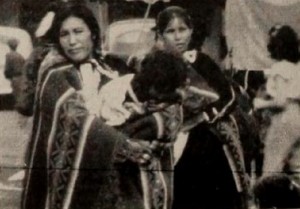
"Edward F. Cross covered an extensive territory of national parks and vacation spots in the Southwest and Western sectors of the United States and has brought back an attractively filmed record of his tour. Unique rock formations have been pictured from well chosen vantage points to make the most of light and shadow. This Land of Ours is climaxed by particularly colorful units in a rodeo's grand parade and a dexterous camera handling of Indian dances. A full narrative indicates careful research to supplement the scenes on the screen." Movie Makers, Dec. 1947, 539.
"No matter how one feels about the outside cover of a magazine, George E. Valentine's The Inside Story of the Outside Cover will be a surprise. If you think that the production of four color engraving plates is a simple matter, you will do some quick revising of your thinking. If you have a certain admiration for the technical skill that goes into such work, that admiration is likely to be heightened by Mr. Valentine's step by step story of the creation of a four color magazine cover. Aside from the story it tells, Mr. Valentine's film is a real technical achievement because of the working conditions under which most of the shots were of necessity filmed. His peak sequence — a proof-press run analyzed in slow motion — was achieved by mounting the camera directly on the moving press. When you can do that, you're good." Movie Makers, Dec. 1947, 539.
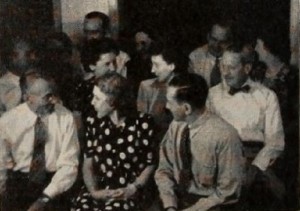
"This clever 16mm. picture is amazing in several ways, but two characteristics stand out. It is only 250 feet long and it was completely filmed, with the exception of the double exposed titles, in one evening. George Merz, the producer of this novel study, warned his guests that, when they came to see the Louis-Conn fight televised, they would have to earn their way by acting in his production. Ringside Seats at Home shows the guests arriving, reacting to the fight and paying off bets. It also contains surprisingly clear footage of the fight itself, including the knockout in the eighth round. A unique and attractive picture, the movie shows what can be done if you work a little, pray a little and gamble a lot." Movie Makers, Dec. 1947, 539.
"Irwin Sharpe and Cye Landy have gone back to film beginnings in composing their engaging little etude, Picnic. The fundamental of their selection is the old reliable device of the chase sequence. Beginning quietly with a simple family picnic, the producers soon overlay on this bucolic subject a mysterious kidnapping and its resultant chase. The cutting, camera positions and tempo of this climactic sequence show a true understanding of cinematic expression." Movie Makers, Dec. 1947, 538-539.
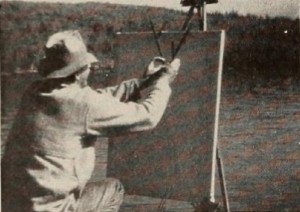
"In Lake Superior Landscape, the artist, Dewey Albinson, demonstrates his technique of landscape painting from the bare canvas stage to the climactic moment when the glowingly finished product is first exhibited. Shot by Elmer Albinson, the film is marked by vivid closeups and many changing angles, which help immeasurably to achieve a comprehensive sense of growth as the painting progresses. Producer Albinson understands the relationship that exists between the object, the artist and the painting; he has used his camera with accuracy and sensitivity to pass this understanding on to those who see his film." Movie Makers, Dec. 1947, 538.
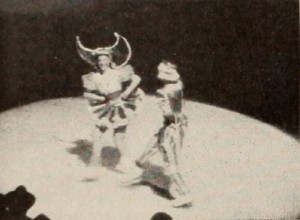
"Filming indoor spectacles is difficult, but it is made doubly so when the staging, actors and lighting facilities are in a constant state of flux. Yet Oscar H. Horovitz, in his Ice Follies 1947, has solved these problems with technical perfection. Points of filming vantage are carefully chosen, from which sequences of the major acts and personalities are imaginatively recorded. An intelligent use of varying focal length lenses contributes the near shots and closeups so necessary to a well rounded study of this kind. Mr. Horovitz more than maintains his position as one of the master craftsmen in his chosen field." Movie Makers, Dec. 1947, 538.
"From Capetown, South Africa, comes Help Yourselves, Boys!, by Lewis Lewis, a charming record of two handsome youngsters and their father engaged in planting, growing and harvesting zinnias. Using many effective angles and double exposed titles, Mr. Lewis relates a plausible tale of his boys raiding the grape arbor, being caught, and finally having their exuberance turned toward flower growing. Since the newly hatched garden is situated close to the ocean, the scenic backgrounds are startling as well as pleasant. Rich, black earth and flaming orange zinnias provide an attractive setting for an engaging family movie." Movie Makers, Dec. 1947, 538.
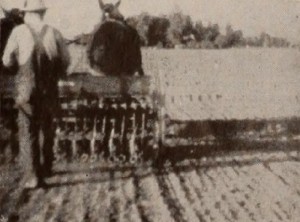
"To impart life and interest to a film about growing alfalfa requires more than ordinary patience and perseverance. Mildred J. Caldwell has supplied these in her picture, Green Gold. Filmed throughout the year, it shows the plowing, seeding, mowing, bundling and threshing, to create a story with depth and perspective. There were times when the movie maker had to climb on stacks of baled alfalfa or ride on a lumbering machine while it performed some vital operation in the culture of alfalfa. Hemet Valley, in California, was the setting, providing pleasant scenic backgrounds for the different operations." Movie Makers, Dec. 1947, 537-538.
Total Pages: 299
 Amateur Cinema