
"Aqua Viva, as its name suggests, is a study of water in motion. To state it thus baldly, however, cannot reveal the true cinematic beauty of Allan Hammer's swirling patterns of light and shadow, executed with consistent success under the most difficult exposure conditions. Yet more important than Mr. Hammer's technical competence is his imaginative perception of small moments of great loveliness. Such scenes, however, because of their very delicacy, tend always to lose their effectiveness in large doses. Aqua Viva as a production leans toward excess length." Movie Makers, Dec. 1950, 466.
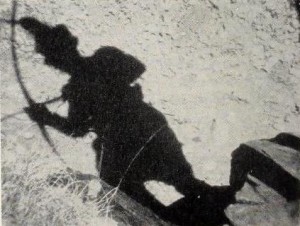
"In The Barrier, Glen H. Turner, Maxim Award winner in 1949 with One Summer Day, shows that the excellence of that production was no happy accident. Although the two films are as different as night and day, both are instinct with the same qualities of creative imagination and true understanding of the movie medium. This year's production, as we understand it, is bi-lingual in its message. On the screen Mr. Turner tells a robust adventure tale, in which a wandering western horseman, attacked by unfriendly Indians, has to fight his way out of their clutches and (even more menacing) over the heart-stopping challenge of a great stone barrier to his freedom. Around this screen action, and carried by the narrative, the producer also draws a frame of universal reference to all of life's challenging struggles. Pictorially, the acting of the horseman is powerful and convincing, while Turner's camera treatment of his adventures creates a spine-chilling sense of danger and drama. Especially effective is the producer's handling of the Indians, whose menacing presence is suggested only — by moving shadows, braceleted brown arms or moccasined stealthy feet." Movie Makers, Dec. 1950, 466.
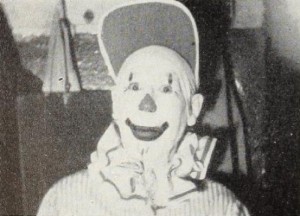
"A carefully detailed study of the biggest show on earth, Ringling Bros. and Barnum & Bailey Circus bears lively evidence to Oscar H. Horovitz's intense interest and attentive recording over a ten year period. The glamour and the tinsel, the thrills and the panoply, the sawdust and the sweat, all have been caught by his camera and painstakingly mounted. Backstage glimpses show something of what it takes to produce the massive extravaganza. The clowns in their dressing rooms reveal a little of the secret of their art. But in the eager faces of young spectators and the breathless attention of their elders can be read the circus's enduring mystery and perennial allure. The filmer's technical capabilities are manifestly demonstrated. Despite the obvious exposure handicaps, individual shots of admirable artistry turn up often enough to enliven any audience. With all these factors in its favor, however this massively impressive movie may leave some viewers wishing for a little less detail, a little more simplicity, and a still more stringent use of the editing scissors." Movie Makers, Dec. 1950, 465-466.
"This picture, in its original 1600 foot length, was selected by Movie Makers as one of the Ten Best in its 1950 competition. Oscar Horovitz has completely re-edited it, compressing it to 800 feet for what, we are sure, is a greatly improved picture. Certainly it is one of the best film documents of a circus ever seen by American Cinematographer's reviewers in many years, and we are sure that Cecil B. DeMille, who currently is producing a picture on circus life, would agree on the merits of its photography. Horovitz's camera—a Bell & Howell 70-DE camera—has caught the atmosphere of Circus Day with colorful scenes, both inside and outside the tents, beginning with the Sideshows and continuing inside the big top where he recorded all the big spectacles from a variety of angles. It is evident that making the picture required Horovitz to visit the circus on several different occasions, for it shows careful study and preplanning and a wise choice of positions for setting up his camera. The interiors, made under the big top with its attendant inferior lighting for photography, are commendable and offer a fine example of what can be done with Kodachrome film in the hands of a skilled cine photographer." American Cinematographer, May 1951, 190.
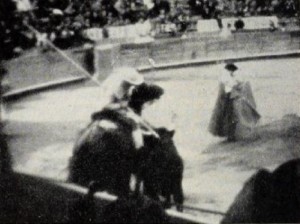
"Although Mexico has become a recurring theme among American movie makers, its varicolored panoramas seem fresh and vital when viewed through the discerning eyes of so capable a film reporter as Esther S. Cooke. She has a fine talent for blending human interest with purely scenic passages, so that Nextdoor Neighbor presents an informative and entertaining pageant of the sights and scenes below the border. Not the least of this producer's potentials are her diligent research, able organization and skillful editing. The more familiar scenes of Mexican life are supplemented here by an admirably detailed coverage of the national sport, bullfighting. Looking at this spectacle as if through Latin eyes, Mrs. Cooke has been able to transmute onto film its stirring pageantry and ritualized passion. A happy choice of Mexican recordings provide a beautifully blended musical score, which reaches its apex in the, bullfight sequence with the haunting and classic La Virgen de la Macarena." Movie Makers, Dec. 1950, 465.
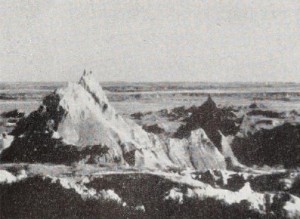
"Films about national parks and monuments fall into the traps of banality with greater ease than almost any other variety of footage. It was. therefore, with great delight that the judges reviewed Timothy and Delores Lawler's Isle of the Dead. For, using the famed Boecklin painting and the equally known Rachmaninoff music as theme and atmosphere, the Lawlers have produced a cinematic tone poem from the materials offered by Yellowstone and the Badlands. Their efforts completely dominate both music and painting, which become effective substrata of the esthetic whole. The film's great virtue and its slight defects spring from the same source — the single mood that the Lawlers have worked for and have achieved." Movie Makers, Dec. 1950, 464-465.
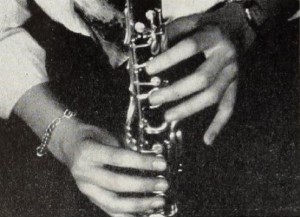
"Almost since the beginning of amateur movies, the dawn-to-dusk continuity has been a perennial favorite in personal movie making. In Hands Around the Clock, William Messner presents a suave and refreshing variation on this well-worn theme. For in his version, as the title suggests, only a pair of hands (apparently belonging to a talented teen-aged youth) portray the morning-to-midnight activities being pictured. Outstanding in Mr. Messner's production is the implicit evidence of exact and imaginative planning. Scene flows into scene, and sequence into sequence, with an effortless ease which finds every transition in exactly the right place. Mr. Messner's musical score is pleasantly suitable, excellently recorded and accurately synchronized. The producer of Maxine's Big Moment, a 1948 Ten Best, has taken a big step forward in creative filming." Movie Makers, Dec. 1950, 464.
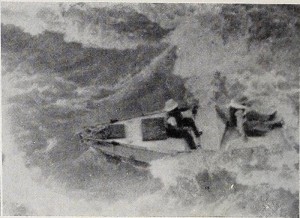
"Al Morton has conquered another river. This time it is the unruly turbulence of the Green River in Utah. Not content to be simply a passenger, Mr. Morton built his own boat (and named it Movie Maker!) for shooting the rapids, one of three craft making up the river party. Green River Expedition is a record of lazy, sunny days on quiet stretches, of motor trouble and of scenery along the banks, of back breaking portages where the rapids are too dangerous to maneuver, and finally of the breath taking excitement of riding the tumultuous waters. To partake of this dangerous sport would seem accomplishment enough, but Mr. Morton puts it all on film as well, in about as sparkling, steady photography as one will ever see. The narrative accompaniment, while informative concerning the technique of river boating and the historical background of the surrounding country, seemed overfull. It is enough, in parts, to devote one's whole attention to the thrilling action on the screen." Movie Makers, Dec. 1950, 464.
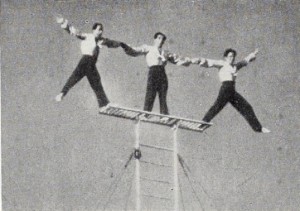
"Tackling the circus in broad daylight is a brave undertaking for the most advanced amateur. The lack of dramatic lighting and exciting colors found at night exhibitions or in darkened auditoriums puts the burden of making an interesting film squarely on the filmer. George Merz, in his Circus Time, has overcome these obstacles ably and with imagination. Highly competent camera work and excellent editing mark every foot of Circus Time. When the action threatens to lag, Mr. Merz knowingly inserts audience reaction shots of high human interest. A colorful musical score adds an extra fillip of excitement to moments that might otherwise become static." Movie Makers, Dec. 1950, 464.
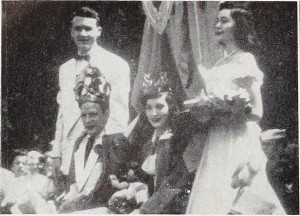
"With the help of almost unbelievable luck from the weather man, Helen C. Welsh has achieved a high level of what is essentially newsreel filming. Her subject matter is in itself appealing — displays of tulips in a public park, children wearing amazing holiday headgear, dancers performing Old World figures, all climaxed by the pageantry of the coronation of a new king and queen of the festival. But Miss Welsh handles it expertly. Her viewpoints are varied and her camera work accomplished, while a wisely sparse and well recorded narrative ties the whole presentation into an attractive package. Albany's Tulip Festival is colorful, entertaining and fulsome as a record of a city's spring holiday." Movie Makers, Dec. 1950, 464.
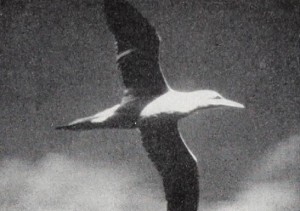
"In one sense, the outstanding strength of The Gannets, Maxim Award winner for 1950, is its seemingly worst weakness. That strength is the unquestioned — but apparently accidental — entertainment which the film provides. Running a brief 400 feet of 16mm. color, the picture examines the famous gannet colony on Gaspe's Bonaventure Island, treating the giant birds with lighthearted good humor and casual unpretension. The entire accomplishment seems too easy. You could do it, you feel, over a single sunny weekend. But don't let this fool you. To begin with, there is the technique. In The Gannets, Warren Levett has employed with a knowing skill every technical artifice learned in long years of bird filming. Telephoto lenses present his gleaming subjects in crisp and astounding closeups. The follow shots of birds in flight are suave and invariably centered, while slow motion reveals arrestingly their superb aero-dynamics. Side and back lighting enhance repeatedly the natural beauty of the birds, aided on occasion by a shrewd use of the polaroid filter. Secondly, there is the subject matter treatment. Pictorially, Mr. Levett knows his way around a sequence with unerring instinct. He knows, too, the strength which lies in a pair of shears; his editing of a subject so often overladen by the amateur is incisive and refreshing. And, perfectly interwoven with the pictorial presentation, is the third strength of The Gannets — the delight of the picture's narrative. You learn things about gannets as you listen — but they're not long-winded nor in Latin — and you're scarcely conscious of the learning. What you are conscious of is that the gannet is a strange, gabby, beautiful and, sometimes, supremely ludicrous creature. You are, in a word, entertained as you are informed — and you love every light-hearted minute of it. It is only later, if at all, that you realize the true measure of this superb movie." Movie Makers, Dec. 1950, 446-447.
Total Pages: 299
 Amateur Cinema