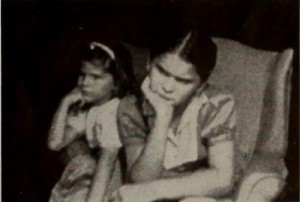
"We had thought satire, especially in films, was a lamented art of the past. Thus it is a pleasure to report that it is back again with a vengeance in March of TV. Following both the visual and narrative patterns originated by the now-familiar March of Time series, Charles E. Coleman has created an uproarious satire on television and the inroads it has made into the American home. Both subtle and devastating by turns, the film leaves no aspect of this electronic marvel unscathed. On the technical side, all departments have been capably handled, with the crisp direction and portentous narration being, perhaps, the most notable. The acting is assured and natural, remaining always within the farcical framework of the satire. Whether you like, dislike or simply ignore the subject which this shortie so sparklingly derides, March of TV is unreservedly guaranteed to keep you in stitches." Movie Makers, Dec. 1953, 332.
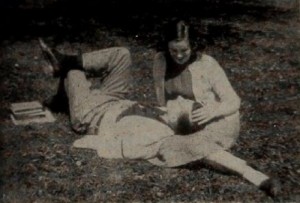
"Concerto, by Warren Doremus, is a sensitive and touching story of young love, following a couple from the joy of their graduation and marriage to the anguish and pain of the man's recall to war service in Korea. The telling of this simple tale has been done with such warmth that the observer cannot help being caught up in the current of emotions which fill the film. The performances of Sallie Dunn and George Harrison as the young couple convey the right mood for each scene with complete sincerity and heart, while Mr. Doremus's direction is forceful and yet restrained. Accompanied by and an interpretation of the Warsaw Concerto of Richard Addinsell, Concerto, the film, may truly be styled a cine tone poem." Movie Makers, Dec. 1953, 332.
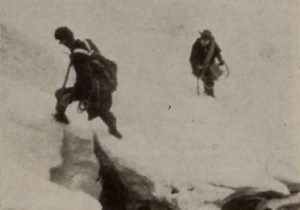
"With the recent scaling of Mt. Everest, it is appropriate that a mountain-climbing film should be entered — and should win — in this year's Ten Best contest. Jerry More's Canadian High Adventure is such a picture. Obviously, Mr. More is a competent climber himself, as well as being a good movie maker, for the film presents an amazing variety of camera angles which make one question where the cameraman must have been to take them. For example, some scenes show the climbers crossing a crevasse from underneath, leaving you with the single assumption that the cameraman climbed down into the crevasse to shoot them. Excellent photography, competent editing and a friendly, well-written narrative all combine to make Canadian High Adventure an outstanding mountain-climbing study." Movie Makers, Dec. 1953, 320, 332.
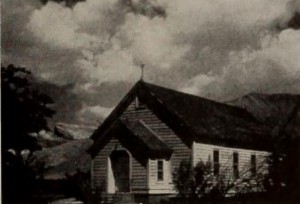
"In Caineville, Glen H. Turner has now turned his camera on a Western ghost town, and with moments of sheer movie magic, he has brought it to life again. The slow turning by the wind of the leaves of an abandoned school book, and the slow pan to initials carved on a schoolhouse desk, evoke as if he were alive the youngster who carved them. In another scene, done with consummate smoothness, Mr. Turner shows an abandoned street on which a schoolboy, with books over his shoulder, slowly materializes into solid form — and then dissolves again into thin air. Surrounding Caineville always are the brooding mountains and the ever-encroaching river which implacably seeks to destroy the last vestiges of the crumbling village. Caineville is a triumph of imaginative creation over static material." Movie Makers, Dec. 1953, 320.
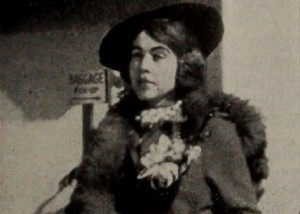
"A high-pressure advertising agency, rivalry within the firm, a switch of entries in a beauty contest and the effects thereof — these are the story ingredients out of which the Los Angeles 8mm. Club has fashioned an outstanding club film. Competent in all phases of movie production, from the smart opening titles to the corny romantics at the end, A Switch in Time is a hilarious cine satire of the foibles of big-time advertising. Seldom does a film of this type demonstrate so capably — in story, photography, direction, acting, editing and sound — the combined abilities of a group of enthusiastic movie makers." Movie Makers, Dec. 1953, 319-320.
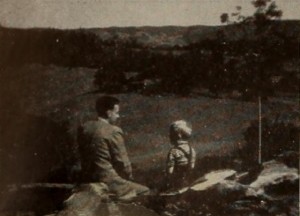
"Five years before the action of The Old House opens, a young man and his bride of but a year had been involved in a train wreck. The bride, Claire, was killed: but the man — scarred in mind, bruised in body and (he thought) dependent on a walking stick — lived on. He comes now, as the film begins, for one last look at the Old House, "the Old House where I was born and grew up, where Claire and I had been so happy for one short year, with hopes and plans for a future that never came." But, instead of viewing (with self-inflicted sadness) his old homestead, he meets accidentally with a brightfaced boy of five, son of his widowed tenant. How this youngster, this "artless wisdom dressed in blue jeans," frees the man from his stick (a mere surface symbol of his bondage) and from his obsession with the past is the theme of The Old House. But it is fruitless always to attempt a factual outline of any visual study in human relations. And, heartwarmingly, believably and triumphantly, The Old House is simply and exactly that. The producer, Keith Hall, has plotted the course of his tenuous drama with a sure touch and unfailing taste. His scenic progressions are so artful as to seem artless, while his camera work and narrative exposition never fail him in the delicate unfolding of his denouement. Yet it is to the three players of this picture — and to their narrator — that the ultimate tributes must be paid. Young Ross Hall as the Boy, Noela Hall as his widowed Mother, and Mr. Hall himself as the Man are exactly and exquisitely right in their restrained underplaying of three diflicult roles. Reg Cameron, the narrator, speaks lines which are always literate, and often lyric, with warmth and understanding. From its simple opening to its quietly soaring climax, The Old House is a tender and moving triumph." Movie Makers, Dec. 1953, 318-319.
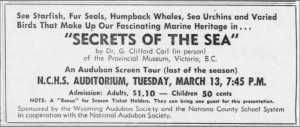
"Marine and seashore life on the Pacific coast. Includes: tidal plants, crustaceans, fish; oolichan fishery and its importance; seabirds of Triangle Island and Queen Charlotte Islands; seals and seabirds on the Pribilof Islands, etc. Also footage of Victoria Inner Harbour area, houses and gardens." (BC Archives)
Compiled from Clifford Carl's BC Provincial Museum films for use on an Audobon Screen Tour. Appears to have been revised in 1959.
"The Pelican colony at Stum Lake in the Chilcotin Region." (BC Archives)
"Bird colonies of Langara and Cox Islands in the Queen Charlotte Islands." (BC Archives)
"In this year's goodly collection of films based largely on extension tube cinematography, Nature in the Garden by W. G. Nicholls tops not only the excellent pictures of many other contestants, but also his own Ladybird, a ten best award winner in 1953. Nature in the Garden is an instructional film pure and simple, chock full of facts to please the most apathetic, as well as the most enthusiastic, bug-viewer. Excellent technical work by a master student of both nature and cinematography has resulted in outstanding and often exciting closeups of bees, spiders, moths and other insects. Skillful editing and an unobtrusive yet informative narrative make Mr. Nicholls' production an exceptional short subject. To this teacher, Nature in the Garden is definitely superior to most of the professional nature films now being circulated in American educational circles" PSA Journal, Jan. 1955, 49.
Total Pages: 299
 Amateur Cinema