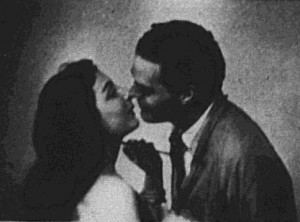
"Strangely enough, although its producers may or may not have intended it, Entre dos Rosas (Between Two Roses) is essentially an old-fashioned morality play set forth in fairly modern filmic turns. For here is a handsome young artist as the protagonist of the action. Here, in the girl of a white rose, is the embodiment of virtue; while there, in the girl of the red rose, is the embodiment of evil. And, overlooking this eternal tug of war, is the figure of Fate or Destiny. Only at the end does Entre dos Rosas turn away from the classic formula, since, with a realistic and more modern psychology than that which stirred the medieval dramatist, it refuses to resolve the ultimate struggle. To the drawing of this age-old triangle, Carlos Barrios Baron has brought stimulating though deliberate direction, while Alfredo Rubio has interpreted his ideas in monochrome imagery which is both visually creative and dramatically compelling. Although Entre dos Rosas of leaves its classic central problem unsolved. It is a striking experimental film well worthy of study by less daring movie makers" PSA Journal, Jan. 1954, 50.
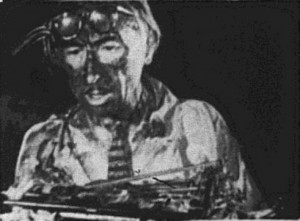
"What happens when a modern gentleman of advancing years advertises for a mail-order bride and tries to answer the applicant of his choice? Der Brief, (The Letter), an excruciatingly funny farce by Dr. Oscar Wurmboeck, gives us one answer to this problem, as our shy but determined hero is confronted at every turn by confusion and frustration. Everything happens - the ink spills, the fountain pen leaks, the mechanical pencil won't hold leads, the wooden ones won't sharpen, and the typewriter refuses to type - to deter our man from his course. Competent camera work, incisive direction and crisp editing serve to point up the brilliant and appealing portrayal of the unfortunate lover by Rudy Rattinger, so that Der Brief builds quickly and smoothly from laughter to hysterics. Here is pure farce in the old tradition. It is nice to welcome it back to the filmic fold after too long an absence" PSA Journal, Jan. 1955, 50.
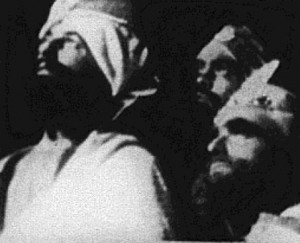
"Everybody has religion of some kind, of some creed. But to try to portray it in motion pictures takes courage in any language your faith. In The Nativity, Sal Pizzo has picture the story of the birth of Christ with unerring good taste, complete reverence and warm beauty. In it he follows old Biblical paintings as a pattern, but he animates these tableaux in a natural manner. One might wish, in fact, that he had followed them even further and used lighting to suggest halos around Mother and Babe. The long-shot model of the town of Bethlehem is believable. The bearded faces of the innkeepers are believable and, a great achievement, the costumes of the opulent kings are believable. The acting is handled with admirable restraint, the story being carried by the words of familiar Christian carols of background music. Especially well-staged are the scenes of the shepherds around their fires and of the Magi as they present their gifts to the Child in the humble manger. Mr. Pizzo and his associates have planned and executed a picture on a subject that few if any would dare to attempt. They are to be congratulated on their tender and moving triumph" PSA Journal, Jan. 1955, 50.
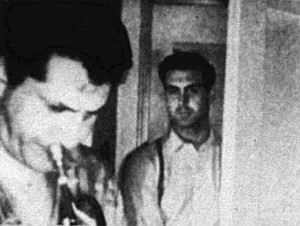
"The Horn, which hepeats should not confuse with Dorothy Baker's epic Young Man With a Horn, is nevertheless a yarn about a jazz trumpeter—and, like Miss Baker's Rick Martin, one whose life ends in death after he loses his stuff. It is a swift, savage, tender and tragic tale which Dominic Mumolo (himself a professional musician) tells here. And to its telling he has brought with amazing proficiency every resource—imagery, acting, music, speech and pace—of high motion picture drama. Herb Willis plays the part of the manic and despairing trumpeter as if to the manner born. His miming makes this difficult and decisive role wholly believable, while his voice (used not as narration, but in a musing, stream-of-consciousness flashback) is by turns tender, pathetic, searing and passionate. Musical phrases, prepared especially for the picture by Frank Worth, add immeasurably to the film's power. The Horn is a stirring and trenchant study in human emotions. If you dislike having your heartbeat aroused, you'd better avoid it. But if not...then The Horn is a movie made for you" PSA Journal, Jan. 1955, 49.
"Mathis Kverne returns to the winner's circle with another delightful and imaginative animated cartoon, Strokets Kavalerer—which has been translated for us "Main Street Romeos." This time we meet two boy paint brushes who try, with varying degrees of success, to win the hand of an attractive girl brush. One, a wordly boulevardier, plies her with costly presents, while the other, a real booby, offers her naive, if presumptuously intimate, gifts. When the lady has at last been won—by the booby, of course—we follow the happy couple through their marriage and the birth of their first born, a yellow brushlet of undetermined sex. Although this film may not captivate the viewers as completely as did Mr. Kverne's Muntre Streker (Ten Best 1952) that picture's promise is more than fulfilled. The animation here is smoother in all respects, the development of the story line more definite and the personalities of the individual characters more precisely realized. The result is a film of lighthearted charm which will enchant one and all. And puzzle them too, for the animated methods used by Kverne are still his own secret!" PSA Journal, Jan. 1954, 49.
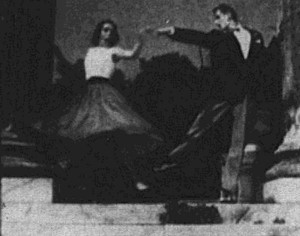
"Once Upon a Rose is romantic fantasy of a high and handsome order. In it a young gallant on a walking tour comes upon a lovely pleasance leading, at its far end, to a columned Grecian portico and the statue of a goddess. Starting to dance upon the wide stone steps, he soon hears footballs echoing behind him. The goddess has come to life and, in a series of gay modern dances, she and the boy make tender and romantic love. Then, like the princess in the fairy tale, she is again transfigured into stone—and the young man is left with only a rose to mark her memory. Now...except for brief opening and closing sequences, all of this action takes place in the single setting of the Grecian porch. To be sure, the choreography by Jimmy Inman (who also plays the young gallant) is lively and kinetic. And Mary Jo Bishop is graceful as the girl. But the film's real rhythmic flow is due in its major part to the imagination and skill of the producer, William H. Eddy. It is from his fluid camera that there blossoms this rose-scented romance which never was" PSA Journal, Jan. 1955, 49.
"Het is Lente in Holland!, by Esther Cooke, may well be one of the most beautiful and perceptive travel studies of this (or any) contest year. For here is no banal tourist mish-mash of the usual wooden shoes, windmills and cheese markets; we find in their stead a literate and respectful account of a small country with its old and cherished travel conditions. Technically sparkling and esthetically pleasing, It is Spring in Holland is so deceptively simple that each viewer is likely to assume that he could easily do likewise. But the skill which Mrs. Cooke has lavished on each succeeding scene should not be taken lightly. Her exposures are exact, creating color which seems magically luminescent; her viewpoints are knowingly selected to create fresh and revealing compositions, and her editing has blended the whole into a travel study of exceptional poise and beauty" PSA Journal, Jan. 1955, 48-49.
"Choosing one of the most common sites of seasonal move making, Benjamin Crocker has by the sheer virtuosity of his production methods come up with an attractive and entertaining travel short. Here are, to be sure, Marineland, Miami, Silver Springs, Cypress Gardens and all the rest, tied neatly together with an animated map and a lively commentary. But with his clean camera work, fresh viewpoints and incisive editing, Mr. Crocker covers them in a tight ten minutes of unflagging good fun. To these same subject other amateurs have devoted twenty, forty or even-sixty minutes, and, all too often, have encountered the inevitable law of diminishing returns, Florida Vacation Fun dances where others have dawdled" PSA Journal, Jan. 1955, 48.
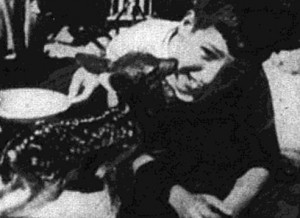
"Eye to Eye, by Tullio Pellegrini, is an instructive and hilarious romp through the insect world, as seen via extension tubes and as scenarized with a sharply satiric sense of humor. Mr. Pellegrini has managed to poke just the right amount of fun at both insects and insect hunters (particularly movie makers) to tickle the most crusty rib in the audience. Among the more madcap moments are a parody of Dragnet, in which a spider lures his hapless victims to their deaths, and a sequence of "Bug-o-Phony" sound, in which (audio-wise) caterpillars make like locomotives and ladybugs like taxicabs" PSA Journal, Jan 1955, 48.
"When an experienced cameraman such as Oscar H. Horovitz turns his technically competent camera on attractive outdoor subject matter, attractive outdoor pictures are quite likely to result. When, in addition, such a producer lines to discipline his editing, inform his narrative, and make graceful his musical score, a motion picture of true charm and beauty will be his reward. Such is the happy combination which makes up Colonial Williamsburg. A thrifty thirteen-minute study of this handsome 18th Century capital." PSA Journal, 1954, 50.
Total Pages: 299
 Amateur Cinema