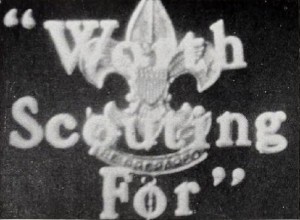
"With the vitality of youth, the wonder of the woods and adolescent hunger for adventure, you have the ingredients for an excellent movie. Al Morton accepted the challenge offered by them, and turned out an interesting and competent film. Worth Scouting For has the indefinable quality that comes from fine filming, innate good taste and an understanding of boys' ways in the woods. Taking two independent youngsters and a large Boy Scout troop, Mr. Morton skillfully weaves a good story, based on the scorn of the two boys for the "sissy stuff" of Scouting. Both the troop and the boys go camping in the same area. The untrained campers make the mistakes avoided by the Scouts. They eat cold food because of their inability to build a fire; they become ill from smoking cigarettes which they have stolen; one almost drowns and is rescued by a Scout. They learn their lesson and decide that to "know how" is intelligent, not "sissy." A fine ability to film and direct youngsters with success makes Worth Scouting For an excellent picture which will be a delight to the actors in years to come. That, in itself, is a high accomplishment." Movie Makers, Dec. 1945, 495.
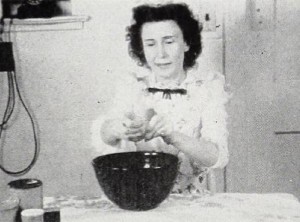
"With the help of four wild ducks and two cooks, Dan Billman, jr., has produced a gay film of contrasting culinary abilities. With understandable economy, he has allotted only one duck to the novice cook, while three are given to a jewel of the kitchen. The preparation of the birds in competent hands is a delight to watch, for the closeups of each step are examples of superb interior lighting. The abandon with which the beginner mixes the dressing and what happens to her stuffed duck in cooking are presented in ludicrous contrast. The Inside Story has as its climax an attractive sequence of serving the perfectly roasted birds at a family dinner. A light touch is added by gay titles and their accompanying sketches, while special mention must be made of the fine scene shot from outside the house at night, to reveal the warm interior of a pine paneled room through the black tracery of the casement window frames." Movie Makers, Dec. 1945, 494-495.
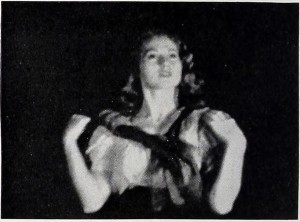
"In The Alpine Vixen, a dramatic story based on folklore legend, Anchor 0. Jensen has raised 8mm. color filming to a level that movie makers in any width would do well to emulate. Particularly in the double exposed sequence of the Titian haired girl in a cave of crystals does he prove his skill with the camera. Mr. Jensen also achieves unusually pleasant outdoor lighting, both in close shots and more distant scenes. The film is accompanied by a narrative, to clarify the pictured story, interspersed with a folk tune played on an accordion, all of which is recorded on a sixteen inch disc. One might have hoped for more somber music to match the menacing mood of the early part of the film, but the accordion tune is in keeping with the climactic scenes of the festive villagers. Infelicities of modern accouterments which would have marred the spirit of the legendary tale have been judiciously avoided." Movie Makers, Dec. 1945, 494.
"Return from Fire, as defined by its producer, Dr. W. Lynwood Heaver, is the "biography of a mental breakdown." In its opening we meet a boy and girl idyllically in love. But the clouds of war fall across their summer sunshine, the young man is called up and, in a short time, is announced as missing in combat. It is then that the fires of apprehension, misery and terror sear into the girl's mind. How modern psychiatry serves, at last, to recall her from this self inflicted limbo is the climactic denouement of Dr. Heaver's drama. The conception of Return from Fire is imaginative and exciting. The acting and its correlative direction are excellent throughout. A provocative musical score contributes markedly to the maintenance of dramatic tension. Dr. Heaver's camera work, rising occasionally to heights of cinematic imagination, is sound, satisfying and suggestive of still greater things to come. Put down his name as one to watch!" Movie Makers, Dec. 1945, 494.
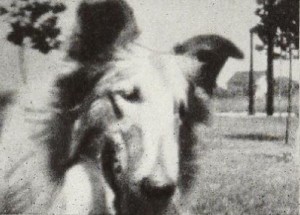
"Children and pets are generally lovable and always interesting; but filming them is not a simple task, as many amateurs have found out. Raymond J. Berger, in Lassie Stays Home, accomplishes it with a sure touch and an ease that will be the envy of his fellow filmers. The excellently planned story tells of a lost child who is found by Lassie, the loyal canine family member, after the baby's somewhat older sister hunts her frantically. No adult appears in any of the footage; and remarkably enough, one does not sense the directing mother, just out of camera range. The whole movie goes forward as if the children and Lassie were entirely alone, with the camera miles away. Here is 8mm at its best and here is a film that every amateur would be proud to have made." Movie Makers, Dec. 1945, 494.
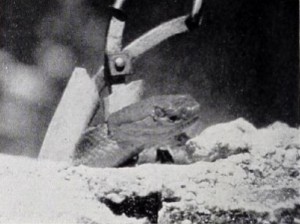
"Few individuals make so bold as to approach a snake either in a cage or its natural habitat. Leo J. Heffernan, however, not only approached a large number, but he has made a brilliant record of them in their natural surroundings and normal pursuits. No mere collection of harmless grass, garter and black snakes, this film of the field shows rattlesnakes, copperheads and coral snakes in their deadly dangerousness. Land Snakes Alive! is a comprehensive record of a series of field trips made by a group of amateur herpetologists, specialists in the study of reptilian life. An effective sequence deals with milking a rattlesnake of its venom; here, unusual and intelligent use is made of a split screen which shows simultaneously a medium shot of the subject and a closeup of the detailed action. Although the film is popular in style, it is highly informative. Even persons who shudder at reptiles will find amusement in the scenes of the common hog nose, or puff adder, playing dead when it believes itself in danger. Mr. Heffernan lets snakes put their best coils forward." Movie Makers, Dec. 1945, 494.

"Ralph E. Gray has once again turned his inquiring and sympathetic camera upon the people and places of Mexico. The result is Arts and Crafts in Mexico, an authentic and altogether admirable record of that country's hereditary handicrafts. Here, in almost lavish detail, is an intent family of woodworkers, fascinating in their casual skills with hands and feet. Here are senoritas who both weave and wear the lovely silken rebozo, which shares honors only with the serape as the mantle of Mexico. One sees with equal clarity and charm the fashioning of pottery, the firing of copper vessels and the fine crafting of Mexico's soft and gleaming silver. Even the great Diego Rivera, pictured at work in a sequence which is a genuine "'beat," is engagingly included within the family of Mexico's artisans. Mr. Gray has compiled a cinematic document of great beauty, genuine human interest and authentic social value." Movie Makers, Dec. 1945, 494.
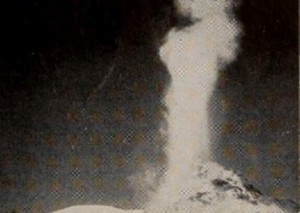
"With While the Earth Remaineth, Hiram Percy Maxim Memorial Award winner for 1945, Frank E. Gunnell crowns a long and distinguished career in the history of personal motion pictures. Beginning ten years ago with Adirondack Adventure, a Ten Best winner on 400 feet of black and white film, this career now embraces no less than ten award winners in nearly every category of amateur movies. Mr. Gunnell's chef d'oeuvre is a stirring and splendid climax to these efforts. The film is based upon the twenty second verse of the eighth chapter of Genesis, wherein the Lord pledges that He shall never again smite the earth, as He had done in the recent Deluge: For while the earth remaineth, seedtime and harvest, and cold and heal, and summer and ivinter, and day and night. shall not cease. Beginning with this great and noble theme, Mr. Gunnell doubles back in his production to show the creation of this Earth which the Lord has blessed. Here, used interpretively rather than for itself alone, Mr. Gunnell's superb craftsmanship with the camera rises to new heights of power and dignity. His sequences suggesting the formation of the cosmos and the first coming of light to the new planet are among the most stirring and purely creative passages in the history of amateur movies. His use of already existing scenes — a geyser or boiling springs of mud — to suggest the primordial genesis are imaginative editing at its highest plane. Flowers, fruits and the fowls of the air take on new beauty in Mr. Gunnell's moving testament to God's handiwork. As befits such a splendid theme, While the Earth Remaineth is scored with music of great stature. Presented with the picture are passages from Beethoven's Pastoral Symphony; the Symphony in D Minor, by Cesar Franck; Robert Schumann's Third Symphony; Harold in Italy, by Berlioz; the Deems Taylor suite, Through the Looking Glass; Omphale's Spinning Wheel, by Saint-Saens. and the Symphony in D Major, by Haydn." Movie Makers, Dec. 1945, 477, 494.
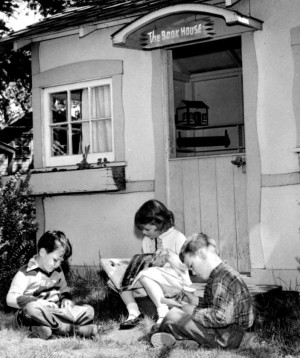
"During the 1940s, Mrs. Gertrude McGill ran the Children's Garden Library in the garden of her home at 1170 Tattersall Drive in Victoria. Open to children aged 4 to 12, this program aimed to improve reading habits and instill citizenship. It is seen as the beginning of cooperative preschools on Vancouver Island.
"Amateur film. Part 1 shows a day's activities at the Children's Garden Library, including games, calisthenics, playground equipment, dancing, and reading and storytelling at the "Book House". Part 2 shows the children participating in May 24 celebrations at Beacon Hill Park, which includes a May Queen pageant, maypole dancing, and activities honouring the "Queen of Health", the "Queen of Music", the "Queen of Drama", the "Queen of Race Friendship" and the "Queen of Art". A mothers' study group, and the toymakers' group, are also shown." (BC Archives)
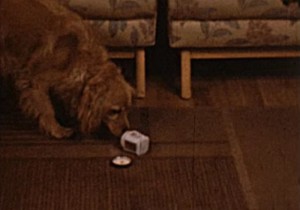
A married couple is hosting another couple for dinner. Before the dinner, the husband gives his wife a container of "vanishing cream," which they both use believing it to be a skincare product. When the dinner guests arrive, people and pets that contact the cream vanish from sight.
Total Pages: 299
 Amateur Cinema