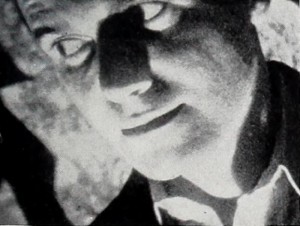
"Lon Wadman has done in This'll Kill You! what few movie makers who have tried it have achieved. He has filmed a farce that does not wander into other interpretive channels. His mockery of detective stories is accomplished with real humor, and the acting of the players is in like vein. The lighting is in proper melodramatic mood, but it leans toward underexposure. The film is presented with two phonograph records which were aptly chosen to supplement the theme. Mr. Wadman has kept his film brief, which is as it should be with this type of story." Movie Makers, Dec. 1945, 496-497.
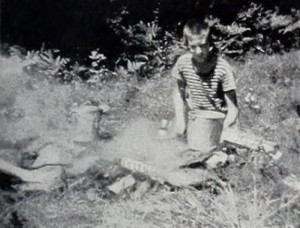
"Excellent films have been made that show by more or less indirection what adults believe boys should do in camp. But what would boys like to do? Henry E. Hird, in The Big Adventure, seems almost to have thought with a boy's mind — a very real accomplishment for a busy executive — in producing this dramatic tale of boys in the woods. Two youngsters of about twelve years, armed with bows and arrows, are taken by their father on an island camping trip. Resigned, as most boys are under the instruction of their elders, they watch Father show them camp life in detail — and how he enjoys it! Suddenly he leaves for a war conference in Washington, and the two adventurers are alone for the night. A tramp appears, captures them, is outwitted by them and is seized by a helpful farmer. To bed and fears of invading bears go our heroes — when Dad returns, the conference deferred. It is a safe bet that young boys will approve Mr. Hird's dramatic movie as more realistic than some of the "approved solutions" offered to youthful campers." Movie Makers, Dec. 1945, 496.
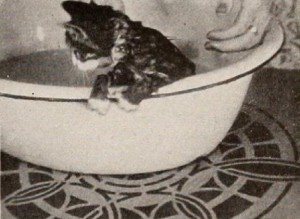
"Every movie maker who owns a kitten probably has tried to film it; and, if so, he knows what a difficult task it is. Walter Bergmann has recorded, on film, incidents in the life of a stray kitten that is adopted by a soft hearted family. Reaction shots of a wise and dignified old cat express the disdain with which it views the foolish antics of the kitten, especially when the latter satisfies its curiosity about high places. Human beings in the film are introduced logically and unobtrusively, but Squeaky is essentially concerned with the star actor. Mr. Bergmann may be pardoned for occasional uneven exposure, for he has produced a film that will delight everybody, and especially those who love cats." Movie Makers, Dec. 1945, 496.
"In a film of a familiar subject — a vacation trip to Florida — Ernest Kremer has done an excellent task of compiling a movie of varied sequences into a unified whole. His camera handling is competent, there are interesting viewpoints and he uses nice transitions to a new sequence, to avoid leaving preceding views too long on the screen. The continuous narrative that is presented with Southern Exposures sometimes draws attention from the pictured scenes, but the commentary in jingle style that accompanies the underwater scenes of fish adds a delightful touch. Mr. Kremer is to be commended especially for the compact and smooth editing of his film." Movie Makers, Dec. 1945, 496.
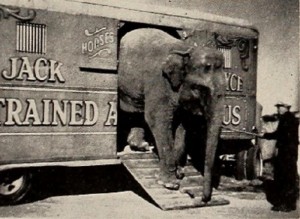
"What happens behind the scenes is always of interest to curious people — and most of us are curious. Remembering the delighted boys who sometimes get odd jobs in the backyard of the circus, Guy Nelli elected to let us see what they have seen, in Outside the Big Top. Not once are we shown the performance for which the whole effort is made, since Mr. Nelli very properly stays outside with his camera. Beginning with interesting and well filmed scenes of the circus in its early morning arrival, Mr. Nelli shows us how the Big Top is set up and carries us along until the show has ended. Odds are that he is a persuasive talker as well as a fine movie maker, because he got some of the best portrait and "candid" scenes of the performers that one will meet in many a day." Movie Makers, Dec. 1945, 496.
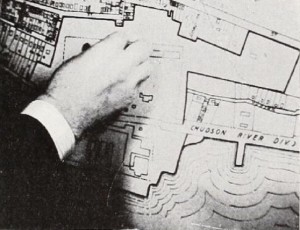
"Ossining in Wartime is a sincere cinematic record of civilian war activities which every community in the land would be pleased and proud to have. It was not an easy production to complete. Conceived only in the later years of our war effort, the majority of the picture's sequences had to be especially recreated for the ubiquitous camera of its producer, Robert F. Gowen. Newspaper headlines, posters, placards and an occasional subtitle maintain the film's episodic continuity from the earliest efforts of airplane spotters and air wardens to the final joyous ceremonies marking victory over Germany and Japan." Movie Makers, Dec. 1945, 496.
"Take a man who wants to play golf and his wife who wishes to see the sights on a family vacation and you have the simple plot of Nantucket Turnabout. Richard Elms treats the idea with a freshness, however, that lifts it from the usual vacation film class. Through the mechanism of the wife's desire to visit historical places, some lovely views of Nantucket are logically inserted in the film, while the husband wearily tags after her as his prepayment for a chance to play golf. The eventual golf game ends with the wife, fresh after her sight seeing, winning easily, while the exhausted husband repeatedly drives to the rough, far into the final sunset." Movie Makers, Dec. 1945, 496.
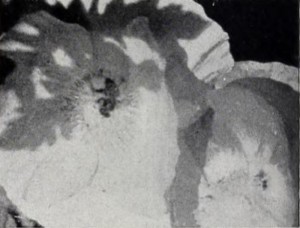
"As an openly avowed disciple of Herman Bartel, one of the old masters of nature filming, Martin E. Drayson has been an ably and imaginative pupil. Seldom have individual scenes of such delicate beauty as his poured across the screen of personal movies. Interlude in Sunlight, like Mr. Bartel's work in Awakening or Pathetique, is essentially an effort to interpret, in cinematic imagery, compositions of music. As such, it is divided into three sections or movements, comprised pictorially of bees, flowing water and flowers. The musical scores which these interpret are Paganini's Moto Perpetuo, Massenet's Meditation from Thais, and Johann Strauss's Wiener Blut waltzes. Preceding these pieces (during the lead title assembly) and between the several sections, Mr. Drayson has elected the use of complete silence." Movie Makers, Dec. 1945, 496.
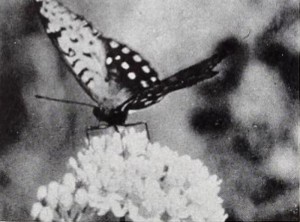
"The late and unlamented war kept amateur movie makers — along with the rest of peripatetic America — pretty close to their backyards. Robert S. Walker is one who has made this restriction pay dividends. The result is Butterflies, a charming study of these winged wanderers of blossomland. Those filmers who have ventured into the field of extreme closeup work will understand and applaud the patient skill with which Mr. Walker got wellnigh perfect results in recording each new specimen. Rhymed quatrains serve, with the scenes, to create a film of light and airy entertainment." Movie Makers, Dec. 1945, 496.
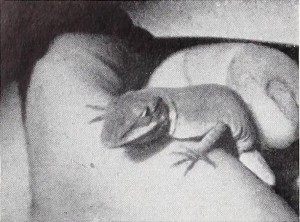
"To film an insect well, when it is crawling, creeping or flying, is a real feat. Francis M. Spoonogle does this with great success. In his film, Backyard Zoo, he has taken completely undirectable creatures and has managed to capture them on film with such intimacy as to give one the feeling that he might be living for a while in the insect world. Unsuspected beauty is revealed in the coloring of caterpillars with normally unseen fur collars. So sharply has he focused on insect life in this beautiful 8mm. film that the "feathers," making up the coating of a butterfly's wings, are almost discernible." Movie Makers, Dec. 1945, 495-496.
Total Pages: 299
 Amateur Cinema