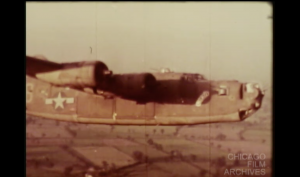
"A short combat film documenting WWII allied forces "liberation over Europe." The film begins in Wesel, Germany March 24, 1945, followed by aerial shots of war-torn countries. The film ends with a non fatal crash landing followed by allied forces drinking coffee." Chicago Film Archives

"Amateur film footage shot by Dave M. Tatsuno while he was interned at the Topaz War Relocation Center, the Japanese-American internment camp located in Delta, Utah. The footage dates from 1942-1945, the years that Tatsuno was interned in the camp." Archives West.
"Life-cycle phases and characteristics of frogs, toads and salamanders found in BC." (BC Archives)
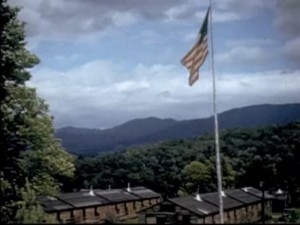
"Filmed in color during the war years of 1941-1944, this silent film shows the Vermont State Guard holding muster at the Tunbridge Fairgrounds and at Camp Wills, which later became Camp Johnson in Colchester, Vermont. The film also shows a bond rally on the steps of the Statehouse in Montpelier, and maneuvers at the airfield in Berlin, Vermont, and at a camp in Moscow, Vermont. The State Guard began as Company H, 1st Regiment, Infantry in 1941 and was re-organized in 1943 as Company H, 2d Battalion. This film is an important documentation of the State Guard's early history and Vermont's home front activities during World War II. Although silent, intertitles are inserted with an explanation of the scenes to follow, as well as scrolling text of explanation at the beginning and end of the film." Vermont Historical Society.

"Albert D. Furnans has taken a group of charming people in a natural pursuit, truck gardening, and has developed a genuinely amusing "running gag"; the result is a delightful family film. Through an excellent sense of timing, he has sustained the "gag" with proper finesse until its final disclosure. The refreshing use of angles and the meaningful employment of lighting, together with good editing, bring balance and clarity. The entire picture shows the result of good planning and directing, and the filming keeps well abreast of these." Movie Makers, Dec. 1945, 496.

"If you have never thought much about the communal effort that produces your breakfast honey, you will find a whole new world of careful organization set forth in William W. Vincent, jr.'s movie. If you have read about this world, you will realize the very great accomplishment of the filmer of Honey Harvest, as you see his picturization of the regimented and incredibly organized bee communities. By means of amazing closeups, Mr. Vincent identifies the various workers, shows them at their hard tasks and lets us see the queen bee, the drones, the nectar scouts, the farmers, the nurses and all the complex bee classes. Nectar is sipped and collected; it is used or stored until, finally, man takes the residual product for his own use. A breakfast sequence of great compositional charm begins and ends this highly unusual record." Movie Makers, Dec. 1945, 494.
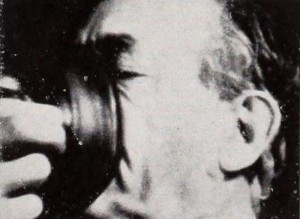
"Ernest Kremer has produced, in The Silent Alarm, a film dealing with the first aid duties of the volunteer fire department of East Hempstead, N. Y. — hence, the "silent" alarm. The picture opens slowly, showing first aid training ifor newly inducted members of the department, but it builds to a remarkable climax in a sequence of the firemen using an inhalator on a badly suffering asthma victim. This closing sequence was filmed during an asthma attack from which the department, working heroically throughout the night, actually saved a man's life." Movie Makers, Dec. 1944, 496.
"In order to acquaint university students with courses of study other than those which they pursue, Mervyn V. Miller has filmed The School of Physical Sciences. In so doing, he has given each department significant and generous footage to display its particular factors. The result gives other students a general understanding of an activity which otherwise might remain obscure to them. Mr. Miller's project is believed to be the first of its kind. He presented it as a thesis for a doctorate. The film is intelligently planned, edited and executed in such a way as to introduce the student to the unusual features, as well as the commonplace facts, of each of the physical sciences of the school. Through the shrewd handling of the script, the picture is developed as an excellent medium of orientation." Movie Makers, Dec. 1944, 496.
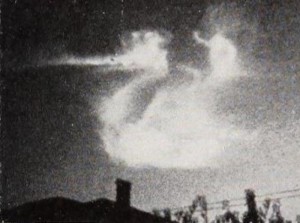
"With the use of a time lapse device, S. G. Lutz has made, in The Heavens Declare the Glory of God, a highly competent record of clouds in motion. Although the subject, treated in a different manner, might easily become too static actually to constitute a true movie. Mr. Lutz has achieved a sure continuity and a sense of artistry that is unusual. In many instances, the film presents sequences of such an unusual kind as to be highly exciting and almost awe inspiring. Speeding the motion of the clouds creates, from the commonplace, a sense of eeriness and weird beauty. In many of the storm sequences, the motion is so greatly dramatized as to impart a nearly terrifying sense of impending disaster." Movie Makers, Dec. 1944, 496.
Total Pages: 299
 Amateur Cinema