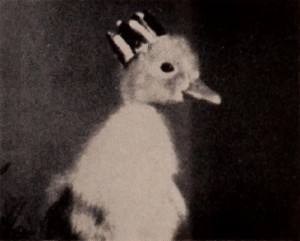
"Denny Plumlee credits Hy Knaack as associate cameraman on this unusual film, which demonstrates excellent miniature settings, lighting, and camera treatment. Together, the two have given cine filmers something new to top in amateur movies. A sound-on-film production in 16mm Kodachrome, the narration is a masterful job and contributes considerably to building and sustaining interest in the picture." American Cinematographer, May. 1952, 222.
"Bert Seckendorf is at his best documenting interesting places and events of this land of ours, and in editing and titling such films to impart sustaining interest on the screen. In 'Romance of Gloucester' he has focused his camera on both the interesting places and much of the contemporary life of Gloucester. His discerning lens brings satisfying multi-scene sequences of activities of Gloucester natives, instead of the one-shot treatment so often accorded such material by the uninitiated cine filmer. Result is, one experiences something in viewing this picture on the screen. Seckendorf's photography is clear-cut, discerning, and shows good taste in composition." American Cinematographer, May 1952, 222.
"Sam Fass, having captured some remarkable footage of the Ice Follies in 16mm Kodachrome, set about to weave these shots into an interesting continuity with a logical story line. The director of the ice show summons to his office two likely prospects for one of his ice numbers. When the young women arrive, he projects 16mm movies of his show in order to demonstrate the numbers in which he wishes the girls to take part. When the film ends, the girls agree to join the show and sign contracts -a simple story thread on which the shots of the Ice Follies were deftly strung. The camera work on the Follies numbers is just about tops. Exposure is all anyone could ask for and each number is carefully chronicled and later edited in a slick manner that gives the illusion it all was carefully planned production." American Cinematographer, May. 1952, 222
"George A. Valentine long has been one of the nation's leading 8mm movie makers, because of his knack for consistently turning out capsule movies with a punch, which have won numerous awards. In 'Make Mine Magic' Valentine has scored again with an appealing story of a lad who comes into possession of a magic wand, and thereafter brings to reality numerous wishes of his and those of his brother and sister. Valentine has a slick way of injecting humor and also a surprise last-minute gag into his movies. His 8mm color photography is consistently good and his editing and titling, as always, is skillfully done." American Cinematographer, May 1952, 222
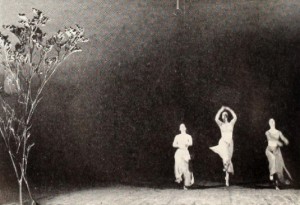
'In Fancy Free' is a fantasy, imaginatively planned, photographed, and edited, which pictures the day-dreams of a young woman as she sits by the window looking out on her garden. Nearby objects, such as a Buddah, a porcelain figure of a dancer, a flower, and the passing of friends by her house set her to reflecting on her greatest wish -to be a dancer. She becomes absorbed in these dreams as a participant and the dances she imagines are laid against colorful and symbolic backgrounds. As the picture unfolds, narration by a young woman with a remarkable appealing voice tells the story of the young girl's desires, and then in the closing sequence, we learn in a brief heart-tugging climax that the girl, a cripple, can never take part in the activities of her dreams. The production is replete with effect lighting and special photographic effects -a forte which Turner ably established in his earlier productions. The dance numbers demanded skill, both in direction and execution; and the musical score, especially prepared by members of the student orchestra of the college where Turner is an instructor, is a vital and moving contribution to the picture." American Cinematographer, May 1952, 222.
"Save for a few opening and closing scenes, In Fancy Free is creative film fantasy of the highest order. For in it Glen H. Turner, beginning only with an idea, has evoked from his own mind and heart and spirit a superb and moving visual drama. As with all truly great art, the theme of In Fancy Free is essentially simple. At the film's opening a grave and tranquil girl is seen seated by a sunny window overlooking a rose garden. Laying aside her book amid these halcyon surroundings, she daydreams to herself of that which in all her life means most — the joys of dancing. There follow then four sequences of modern ballet, their themes suggested by objects or activities around her — an Oriental figurine, a string of paper dolls, a tennis game and the sunny, nodding roses. As these ballets end, we learn — in a brief, throat-tightening climax — that never, in her lifetime, can the girl take part in them. Although thematically quite different, In Fancy Free is a direct descendant of One Summer Day, with which (on 8mm. film) Mr. Turner won the Maxim Memorial Award in 1949. For in both fantasies the producer has, with sound dramatic instinct, related his world of pulsing wonder directly with the world of poignant reality. Thus it is that Mr. Turner's brilliant creative imageries take on a meaning above and beyond their mere technical virtuosity. The story development, dance themes, abstract settings and, needless to say, the camera work of In Fancy Free are all original creations by the producer. Mr. Turner enjoyed, however, a wealth of heart-warming collaboration in bringing this picture to its full flowering. An assistant professor of art at Brigham Young University, he was able to enlist the enthusiasm of countless other creative spirits. Thus it was that an original and brilliant musical score was written directly into this film dream. Thus, too, that this music was performed for recording by the university orchestra and that the dance themes were developed, almost step by step with the picture's progress, by the college ballet group. There will be those among the carping who are sure to complain that with this cooperation and those resources any amateur could produce a winner. To these few our unequivocal answer is "Non-sense!" Great art is created by the mind and heart of the artist — not by the hands of those who help him. That Mr. Turner could integrate these efforts into his own filmic concept is only another measure of this man as a truly creative cine artist." Movie Makers, Dec. 1951, 392-393, 410.
"The story concerns an incident involving a psychopathic criminal at large. It is told by a radio narrator during his nightly program and through flashbacks of the action itself. All action takes place at night, which placed an added burden on the abilities of Cowart. Nevertheless, his lighting of the night shots, both indoors and out are as good as one sees in theatre films today. The closeups of the radio narrator could be cut a little tighter, thus speeding up the pace, but that is about the only serious criticism one can find with this unusual amateur production." American Cinematographer, May. 1952, 222.
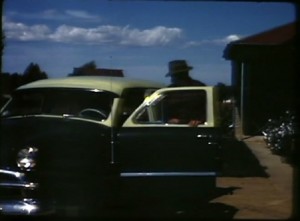
"All In A Day - Consistently good photography marks this humorous document of the trials and tribulations that beset a man who goes fishing despite the objections of his wife. Overruling his wife's plea that he take her to visit her mother, the man sets out on his trip early the next morning. His first disappointment comes when the pal who was to accompany him bows out. Setting out alone, trouble comes in bunches. He gets a ticket for speeding, then a flat tire, and when he arrives at the lake selected for fishing, the boat is flooded with water. After bailing it out, the man rows out on the lake, forgetting his lunch, tackle, etc., and he must return to shore - further building up his state of high dudgeon. Before night falls, he's fallen in the lake, not to mention the fact he caught nary a fish, so he returns home a sadder but wiser man. But even then, his troubles are not over. His wife, who promised he'd 'be sorry' for going on the trip, locks him out of the house. In the closing scene he finds solace in his little son, who remains his only friend. One outstanding feature of this film is the maker's ability to cut scenes as he shoots. Result is each scene dovetails snugly with the next, and this greatly simplified, we are sure, the task of editing the film." American Cinematographer, May. 1952, 211.
"Film about three little boys, played by Doug, Bill and Lorne Woodley, the sons of Charles Devenish Woodley, visiting the Canadian National Exhibition in Toronto on a sunny day." Library and Archives Canada.
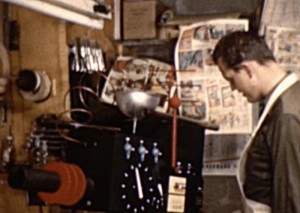
After celebrating his fourth wedding anniversary, a man becomes obsessed with building a homemade weapon of mass destruction. The man's efforts reach a breakthrough after the couple celebrates their fifth anniversary.
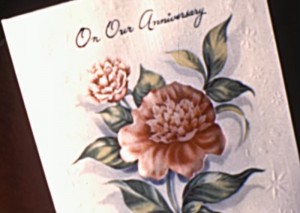
A man is late for his anniversary dinner after getting drunk at an "amateur magician's club." He attempts to make up for it by surprising his wife with gifts, but the gifts turn out to be magic tricks which further infuriate her. The man's magic tricks are accomplished via trick photography.
Total Pages: 299
 Amateur Cinema