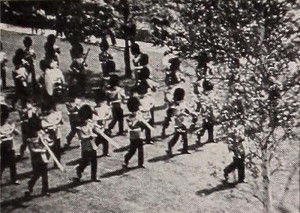
"In Streets of Peace, Lewis B. Sebring, jr., presents a manifold accomplishment in film. Here is a record of the New York World's Fair 1939, but a record which, because of its selectivity, gives the impression of completeness in setting forth a single theme, although the material is both voluminous and varied. Here, also, is an interpretation of the epic idea behind the foreign participation in this great American exposition, the vision of peace, which has since been so rudely interrupted. Mr. Sebring takes his camera through the streets of peace, literally, and we see one after another of the foreign buildings and exhibits at the Fair; we also look at the different national celebrations in the Court of Peace. The visit of the King and Queen of England is recorded in considerable detail. After a scene of children of many lands uniting in a gathering in the Children's World, we find the pointed query as to what these youngsters will make of the "world of tomorrow," and the picture closes with distinguished shots of the United States Building, with its flag and the word "Peace," which appears on its façade. Mr. Sebring's titling is admirable, both in wording and in execution. His Kodachrome exposures have less good moments, but his camera handling is otherwise pleasing. Here is a workmanlike and finished recording of a great international event." Movie Makers, Dec. 1939, 635-636.
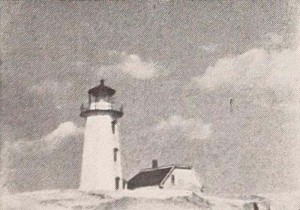
"Francis M. Hirst's Peggy's Cove is 8mm. scenic cinematography of a very fine kind. This familiar movie subject for personal filmers is given added interest and beauty by Mr. Hirst's handling of it. He has not departed from the high standard set by Edward Bollinger in the first of the many Peggy's Coves to be offered for Ten Best. While Mr. Bollinger had the advantage of a larger frame size, Mr. Hirst had the added factor of color, and he makes the most of it, hurdling the problem of distant shots in 8mm. Kodachrome in gallant fashion. Here we have the sincere recording, by an artist with an instant eye for beauty, of a locale that will, for years to come, invite the attention of filmers who wish to match their art against a distinguished subject." Movie Makers, Dec. 1939, 635.
"In Ski Legs, the family filming team of Cinecoles has produced an able and amusing farce comedy on the perils of skiing for the novice. Spurred on by the waning love of his onetime sweetheart — newly devoted to the current ski champion — the hero risks life and limb on the snowy trails, to win out in the end through a series of adroitly conceived mishaps. The film is a pat illustration of the oft spoken truism that the best humor for amateur films is the humor of situation, not the "funny" acting of the actors. To Charles Coles goes the credit for crisp and competent photography, with Robert Coles responsible for the direction of a well developed plot and its genuinely amusing "gags." " Movie Makers, Dec. 1939, 635.
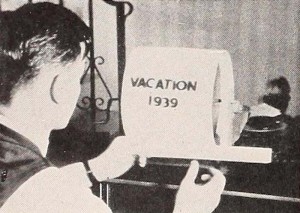
"When movie makers turn to movie making itself as the subject of a picture, sometimes they are a little self conscious and heavy handed — more particularly if the approach is humorous. This fault, the Dallas (Texas) Cine Club has successfully avoided in Out to Win, an opus that displays the adventures of a new convert to filming. The hero of the tale observes that everybody has a movie camera and that he is out of things. So his trombone and the equipment of other hobbies go to the "hock shop" to finance the purchase of a new cine camera. His wife isn't particularly sympathetic to movie making, and here the real humor enters, for Mrs. Movie Maker is not antagonistic; she is just oblivious to the real importance of movies. She walks in on her husband when he is developing titles, she tramps through film clips when he is editing; but, when the movie maker receives an incredible sum for a newsreel scoop (well handled airplane wreck sequence) and, in consequence, gets a check that enables the pair to buy a new car, Mrs. Movie Maker's attitude changes. In the last scene, she is proudly using a camera. The actors are excellent: they do not overplay their roles, and so the film is really funny." Movie Makers, Dec. 1939, 634-635.
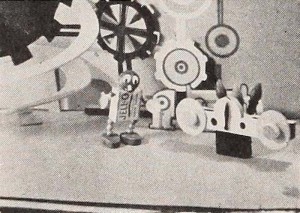
"Jello Again is an entertaining film, produced entirely by animation, that stands by itself even when the special work necessary to produce it is discounted. This Kodachrome subject, filmed by Carl Anderson, is made entirely in stop motion with puppet actors, an exceedingly difficult job. The excellence of the handling of the puppets and accessory properties, together with the imaginative quality of the settings, makes the subject an outstanding one. Here and there throughout the film, there are certain indications of unevenness in exposure on the "over" side, but, because of the real achievement embodied in the film as a whole, this very slight flaw may well be overlooked. The models used in the action were most cleverly constructed and colored, and the variety of camera angles employed was especially appropriate to the subject from the point of view of presenting the material advantageously." Movie Makers, Dec. 1939, 634.
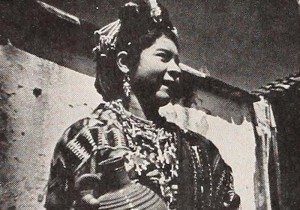
"Ralph E. Gray's 1939 entry, Guatemala, the Glorious, is another of those studies of Central American lands for which this fine filmer is noted. No less an ethnologist than a movie maker, Mr. Gray has an insatiable curiosity which always runs to the unusual and striking folkways of the countries he records in Kodachrome. He has found these folkways in Guatemala, as he has found them before in Mexico, and he knows the trick of making them interesting, by a most intelligent interplay of distant, medium and close views. He has footage of the mysterious ceremony at Chichicastenango which has not been obtained before, as he filmed the interior of the church for the first time. Mr. Gray's editing and titling bear evidences of haste, without which his entry would have won higher rating, but, in spite of these, it maintains his high standard of fascinating subject matter expertly presented." Movie Makers, Dec. 1939, 634.
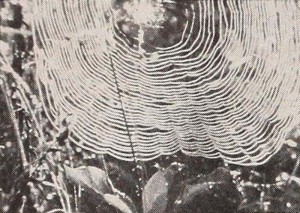
"Combining the sensitivity of an artist and a camera skill that theoretically only professional experts could acquire, Robert P. Kehoe has produced, in Chromatic Rhapsody, a film that would command the amazed admiration of any movie club in the country. This beautiful picture can only be described as a scenic — a scenic held together rather tenuously by editing to create a symphonic arrangement of color and to associate scenes with the seasons. It is in the sheer beauty of color cinematography that Chromatic Rhapsody excels. This reviewer has never seen, in any medium, more gorgeous color photographs of autumnal foliage and winter landscapes. One is so impressed with the flawless color that he is inclined to suspect that nature puts on a special show for Mr. Kehoe. The truth is probably that Mr. Kehoe has a special understanding of nature and an intuitional sensitivity to light and color. For the rest, as Mr. Kehoe would say, he simply follows exposure instructions. The film is marred somewhat by lack of complete camera steadiness, the only flaw in an otherwise superb cinematic accomplishment. A charming musical score, arranged by double turntable, accompanies the movie's presentation." Movie Makers, Dec. 1939, 634.
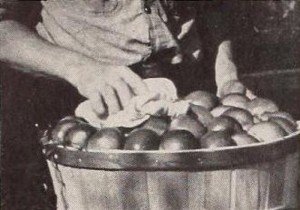
"In An Apple a Day, F. Radford Crawley has epitomized, in color, the story of a Canadian apple orchard. He shows, in perfectly exposed Kodachrome scenes, how the trees are grafted and pruned, how the orchard is mulched with straw and how the trees are sprayed. He shows the apple pickers at work in attractively chosen angle shots and, without interrupting the flow of action, he introduces the different varieties of apples grown in Canada. Horse drawn carts carry the apples to the packers, and there follows a tightly edited sequence of the ring pack method, culminating in a brilliant closeup of the top of an open basket of apples. In an epilogue, the basket is opened in a home, and children bob for apples at a Halloween party. Ingeniously managed upward angles show the children's faces bobbing for apples floating in the water above the camera. (The method of producing these shots was described in The month of plenty, by Mr. Crawley in the October, 1938, Movie Makers. The execution of the plan is perfect in the film.) Brilliant close shots of beautifully colored fruit stud this film like jewels, and especially satisfying are the subtitles, made by double exposing white lettering on a scene of an arched branch of an apple tree, filmed against a dark, late afternoon sky." Movie Makers, Dec. 1939, 634.
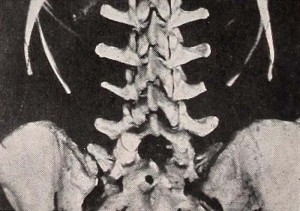
"Imagine, if you can, a subject which would be harder to present in motion pictures than the effects of a spinal anaesthetic. This is the problem that Leslie P. Thatcher solved so ably in his Technique and Principles of Spinal Anaesthesia with Nupercaine. Because most of the action takes place within the body, it was necessary to do some real thinking before a suitable motion picture presentation could be worked out. For example, the action of the fluid as it floats in the spinal canal was shown dramatically and effectively by floating some of the drug in a solution in a slowly tilting glass phial. A considerable use of X-rays served to show clearly just how the hypodermic needle should be handled, while well photographed diagrams and models aid the film's clarity. Operative scenes represent the best technique, and the action clearly demonstrates the qualities of Nupercaine as an anaesthetic. The picture is a study in straightforward exposition and, as such, it should serve its sponsors admirably. It is to be noted that Mr. Thatcher showed admirable restraint in his brief shots of operations. While sufficient for the medical man, they are not too long or gruesome for a lay audience." Movie Makers, Dec. 1939, 633-634.
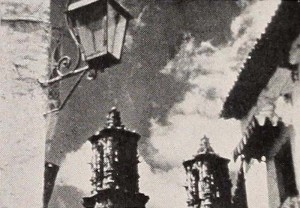
"Mexican Silhouette, conceived as a gamble, has grown up to glory. After but a few years of average movie making experience, Clement K. Chase — as with so many — felt an irresistible urge to attempt, in one film, a concentration of all his accumulated skill and experience. He turned to a subject he knew with intimacy and affection, and Mexican Silhouette was the result. It is a splendid educational and general interest study, divided flexibly into three main sections — Mexico, D. F., Mexican Agriculture and Mexican Cities. To these subjects, Mr. Chase has brought a mature photographic skill, marked by tripod steadiness, stimulating compositions and a dramatic feeling for the use of filters. Well titled in the original silent version, the film is now being distributed commercially in both sound and silent editions." Movie Makers, Dec. 1939, 633.
Total Pages: 299
 Amateur Cinema