"documentary on the hunting of swordfish shot in the waters of Scilla."
"documentario sulla caccia al pesce-spada girato nelle acque di Scilla"
—"I Littoriali del cinema: Un’altra interessante serie di documentari,” La Stampa, September 3, 1939
"documentario/documentary"
"inteso a porre in luce lo sforzo fisico e la passione dei vogatori nel loro formarsi e al giorno della loro prima affermazione"
"intended to highlight the physical effort and passion of the rowers in their training and on the day of their first statement"".—""I Littoriali del cinema: Un’altra interessante serie di documentari,” La Stampa, September 3, 1939
doc. scientifico"/scientific documentary
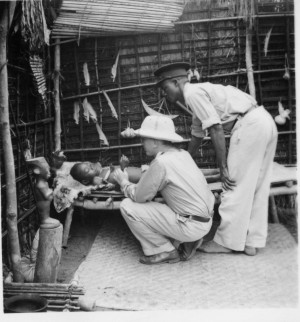
"The Story of Bamba is a drama filmed in Africa by Ray L. Garner for the Harmon Foundation in New York. This reviewer calls the production a film drama advisedly, for, although it is made as a report of the medical work of a missionary group in Africa, the picture is, in itself, an entertaining photoplay. The boy, Bamba, is the nephew of the tribal witch doctor who cures sickness with his fetishes. Bamba is to become the medicine man's successor, but he falls ill with the fever and is deserted by the tribe when they hurriedly flee their village to rid themselves of a plague. Rescued and cured by the native representative of the missionary medical center, Bamba is sent to school so that he too, can cure in the white man's way. An adult, he returns to his own tribe, where he meets and finally overcomes the resistance of his uncle. Thus, the plot unfolds clearly and entertainingly, yet the story does not interfere with a complete exposition of the medical work of missionaries. Skillful handling of native actors is apparent in every scene, for there is scarcely an unconvincing piece of business in the whole film. Camera treatment is matter of fact but adequate." Movie Makers, Dec. 1939, 637.
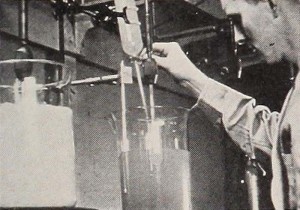
"Keeping in Touch, planned to indicate how printer and ink maker alike must keep in touch with fundamental research which is revolutionizing the graphic arts, was produced by Willard Pictures for International Printing Ink, a division of Interchemical Corporation, in New York City. A complex technical subject, involving such problems as spectrophotography and the effective filming of many gleaming machines, the production has been handled smoothly and clearly. In a pictorial argument where accurate color renditions of many differing materials were of paramount importance to the client, Willard Pictures has given its customary first class account of technical ability. The development of the film is well paced, and the use of music and narrative intelligent." Movie Makers, Dec. 1939, 636-637.
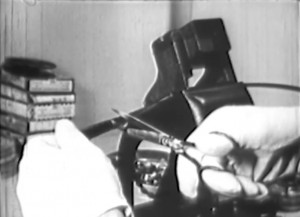
"Film Editing, an exposition of this topic, is a single subject in the series, You Can Make Good Movies, produced by the Harmon Foundation of New York and photographed by Kenneth F. Space. This film presents the successful use of a medium to explain its own working and is divided into two parts — first, the mechanical operations involved in editing and splicing and, second, the methods used to present simple cinematic ideas through cutting. The clear and well ordered presentation of this subject is noteworthy. The first part of the film is characterized by a number of excellent, unusually large closeups showing the operations of scraping the film, applying cement, splicing, etc. In one or two of these closeups, however, the significant action was partially obscured, as in the case of closeups showing the application of cement to a splice, where the cork at the end of the brush got in the way. In general, however, the presentation was very clear and well photographed. Other methods than those shown could have been employed to produce the same results, but, in an instructional film of this nature, it is taken for granted that only one method can be presented without confusion." Movie Makers, Dec. 1939, 636.
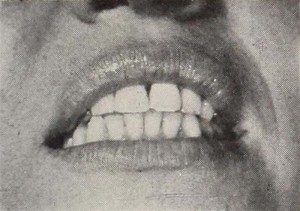
"In A Complete Immediate Denture Technique for the General Practitioner, Dr. James E. Bliss offers a striking example of how skillfully motion picture technique may be adapted to a subject as highly specialized as dentistry. An intelligent and systematic scheme of varying camera positions serves to present detailed material in as effective a manner as possible. Unhampered by the conventional idea, that the camera should rarely be shifted from one viewpoint to another when making such a film, Dr. Bliss has approached the subject with a plan of shooting sequences just as if he were making a dramatic film. The whole scheme of shots is simply considerably closer than it would be in the case of an ordinary subject. The result gives a feeling of unity and assures one that he is not looking at a series of movie slides. The ultra closeups in color are among the finest that have ever been filmed and, because of excellent lighting and precise focus, they make an outstanding teaching film." Movie Makers, Dec. 1939, 636.
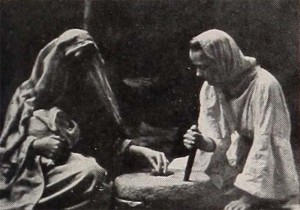
"In the best tradition of filming technique, a movie should be an independent story telling medium. It should not require explanation or demonstration to make its meaning clear. Yet, there is no reason why this cardinal principle should not be violated, if the variation from accepted technique serves an artistic purpose. The Book of Ruth, by G. Manley DeBevoise, involves a new departure from tradition, for the film itself is an illustration in motion of the Biblical story, rather than a complete dramatization of the story. The tale is told by a narrator in synchronism with the appearance of the scenes on the screen, and, without the narration, the movie would be incomprehensible. Yet the two form a perfect unit which resents a fuller interpretation of the story of Ruth than would be possible by any other means. Costuming and selection of properties for this film are excellent and accurate. A church group worked for months in research to avoid anachronisms. The result is a splendid religious teaching film. The narration is given in person, and music is carefully scored by double turntable." Movie Makers, Dec. 1939, 636.
Total Pages: 299
 Amateur Cinema