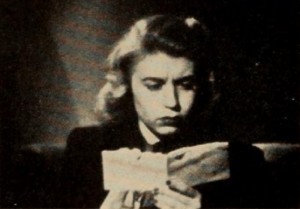
"Although there is no actual violence portrayed in this psychological thriller, Storm Due — in which a young wife discovers her husband to be a murderer — is instinct with mounting tension and terror. Francis J. Barrett's film is a potent combination of several related elements. Wedded almost as one are dramatic, hard-hitting camera angles and the visual stimulus of brilliant, low-key lighting. Acting of theatrical calibre by the young wife is accented by an off-stage voice which underlines her fears — a technique that suggests a loan from the best in modern radio. A taut continuity only hints at the story line as it hurries through this exciting evocation of violence. This very economy of dramatic exposition, in fact, will make Storm Due an unpopular and often misunderstood production. For these reviewers, however, it remains creative cinema of a very high order." Movie Makers, Dec. 1949, 454-455.
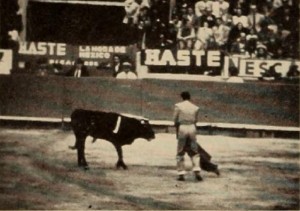
"It takes Cal Duncan 1300 feet of 16mm. color film to tell a pair of politely uninterested guests how he caught a sailfish off Acapulco — but the effort, as exemplified in Mexican Malarkey, is decidedly worth it. Mr. Duncan's running gag, climaxed by a truly comic finish right out of the funny papers, is the flashback technique developed to a high and satisfying order. His Mexican footage itself is no less effective. The robust and hearty producer has an artist's eye for fresh viewpoints, a dramatist's instinct for revealing action. His sequence on Mexico's traditional Sunday bullfight, always a difficult assignment, is outstanding. Mexican Malarkey is a refreshing variation on an increasing wellworn theme." Movie Makers, Dec. 1949, 454.
"Unity of theme is the striking characteristic of Jose M. Pavon's Menemsha — and its Achilles heel as well. The producer, in a series of beautifully composed scenes that seem to ebb and flow with the surging rhythm of the sea, has extracted the essence of a small fishing town on the coast of Martha's Vineyard. For almost its entire length, the film emphasizes the salt and the sea and the strange, lovely things of the ocean littoral with a feeling that Mr. Pavon accents brilliantly in double exposures of the shimmering sea water sweeping over even the deserted wharves. Unfortunately, Menemsha's unity breaks down a little as Mr. Pavon's camera roams too far afield and brings in elements that suggest fresh water and inland life rather than his original theme. A little cutting would tighten up a film that, technically and artistically, is a delicate and creative delight." Movie Makers, Dec. 1949, 454.
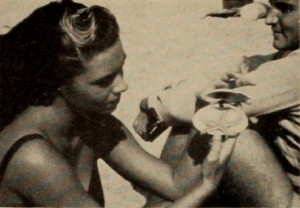
"By a facile blending of warm hearted humor and a keen perception of human interest values, George Mesaros has created a film study of a famous beach in New York's metropolitan area that is replete with interest, information and entertainment. His technical skill and knowledge of what makes a motion picture move prevent this from being the dull collection of random shots all too frequently characteristic of this genre subject. Employing himself as a frenzied and frustrated shutterbug and a filming friend as plain Joe Doakes at the beach with his wife, a lunch and box camera, Mr. Mesaros proceeds to examine with interest and obvious affection the thousand and one attractions of the Long Island resort. An excellent musical score and a brief commentary help to integrate the compact 700 feet of the film's lively length." Movie Makers, Dec. 1949, 454.
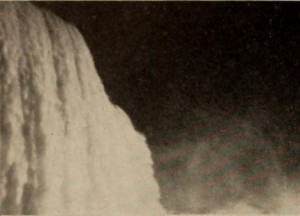
"Warren Doremus might have made in his Escape just one more film about Niagara Falls. But he did not. Instead, with unerring instinct, he has blended music (Wagner's Liebestod) with emotional imagery to produce a very nearly perfect small work of art. His secret seems to be great brevity and even greater selectivity. In a film as short as this, flaws show up more strongly than in longer works. Escape has its flaws, particularly in a series of opening scenes presumably supposed to set the mood before the film proper begins. To these reviewers these shots do not seem quite suited to the main theme, and lack of musical accompaniment makes them a bit pointless. But Escape survives as a fresh and moving treatment of a very old subject." Movie Makers, Dec. 1949, 453-454.
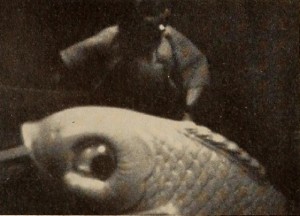
"Neither the lead title nor the unpretentious opening scenes — as a small boy is seen building a crude toy boat — prepares the spectator for the pure enchantment of One Summer Day. For, almost unrealized even as it happens, the film melts with incredible smoothness from live action into animation and make-believe. The toy boat becomes a pirate galleon of old, a flower a maiden in distress and a twig her gallant suitor, as there unfolds a tale of romantic derring-do. Under cover of darkness, the pirates plot to kidnap the lady, whose protector, a humble fisherman, is away at his nets. He returns, only to be bested in the ensuing sword play, yet, undaunted, he still gives chase. With the help of a friendly whale, he overtakes the pirates, frees his lady and, as the galleon goes down in flames, the lovers return to shore, to live happily ever after. Then, as quietly as it all began, we are back at the edge of the sunlit pond. The boy lifts his boat from the water and turns homeward. And yet, through the true magic of the movies, we have entered for a brief moment childhood's enchanted world. Highly imaginative camera handling, technical skill and a keen sense of cinematic values make this an outstanding example of personal filming. The musical accompaniment and sound effects (including the cling-clang-cling of clashing swords) complement the picture perfectly. Glen Turner has added a new dimension to amateur filming with this simple story so superbly told in its brief 350 feet of 8mm. film." Movie Makers, Dec. 1949, 452-453.

"Émile Gallet, ACL, a man of rare talents and infinite patience, treated us to a showing the other day of his 16mm. color cartoon, The Legend of St. Nicholas, which, with a six year interruption by the war, has been in the making since 1938. Based on an old French folk song of the 12th century, the cartoon relates the fairy tale adventures of three little children, a wicked butcher and kindly St. Nicholas." Movie Makers, Sept. 1949, 327.
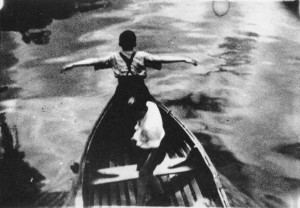
"An impressionistic portrait of city life during a day off in the summertime, with poetic narration set opposite some very observant and intimate views of Vancouver and its inhabitants. These include numerous street scenes; departure of the passenger ferry 'Hollyburn'; shots of and from Interurban railway and streetcars; sequences on Chinatown, Kitsilano Beach, Stanley Park, Victory Square, and the downtown waterfront; and a glimpse inside a typical beer parlour. The film received honourable mention in the amateur category at the 1950 Canadian Film Awards." (BC Archives)
Opening credit reads: "The Vancouver Branch of the National Film Society presents..."
Additional credits (on 1986 restored version): "Restored 1986 by Dennis J. Duffy for National Film Week '86 in co-operation with Canadian Filmmakers Distribution West and the Provincial Archives of British Columbia. Restoration funded by BC Heritage Trust."
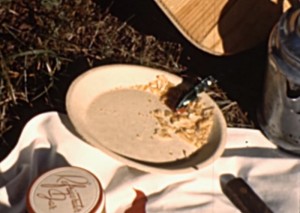
A group of families takes separate vacations – the husbands go fishing, while the wives and children choose to hold a picnic. Both vacationing groups encounter obstacles that disrupt their plans.
"This is a film about a hobo who steals a pie from a windowsill." Library and Archives Canada.
Total Pages: 299
 Amateur Cinema