"'Navajoland' entered by Richard V. Thiriot, of Salt Lake City, is a travelogue on that part of the great Southwest where dwell the dwindling and not-to-well-off Navajos. Thiriot has caught the beauty of this colorful country with his camera and Kodachrome film, and concludes the picture with intimate shots of some of the Indians who inhabit Navajoland. Had Thiriot been able to schedule his filming during the stormy weather season and thus been able to capture the colorful skies abounding in Navajoland at that time of the year, his photography would have greater pictorial interest, highly neccesary where subject material is predominantly static. Thiriot used a Filmo 70-DA and Kodachrome film." American Cinematographer, Apr. 1950, 145.
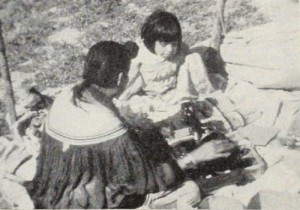
"Florida's colorful Seminole Indians, who never have taken kindly to the white man's rule, generally are no more responsive to visiting filmers. Thus it is a rare and rewarding pleasure when an understanding amateur cameraman gains both their confidence and their cooperation. Such is the stimulating accomplishment of Elmer W. Albinson in his picture called simply Seminole Indians. Among the film's outstanding achievements are its detailed studies of the Indians' arts and crafts, its exceptional work in ultra closeups, and its pictorial probing of the Indian character and customs. An extraordinarily good musical score enhances the appeal of this informative ethnic documentary. The picture needs, however, a somewhat stronger ending, the present one impressing these reviewers as artistically indecisive." Movie Makers, Dec. 1950, 466.
"'Cup of Fear' produced and entered by the Stamford (Connecticut) Cinema Club and photographed by John Harms, is a well directed, acted and photographed 'whodunit' in which one of several office employees who have been passed up in a company promotion, murders the hapless executive promoted to the vice-presidency. A cup of wine, antidote for poison supposedly fed the murderer at a dinner, proves his undoing. All shots are interiors and save for one or two, are excellently lighted and photographed. Many professional touches, such as dolly shots, dramatic camera angles, and story-telling closeups highlight the picture. Harms used a 16 mm. Bolex camera and Kodak Super-X panchromatic film." American Cinematographer, Apr. 1950, 146.
"'Overdose,' filmed by Francis J. Barrett, of Seattle, Washington, is an expertly photographed dramatic photoplaylet, done in 8mm. black and white. The story concerns two young men sharing a room together. One, a writer is upset by annoying tactics of other who, sensing this, plans to put his friend out of his misery. He brings him a cup of coffee to which he has added sleeping tablets. A fight ensues and the other strikes his benefactor down with an ashtray. It is then he discovers the sleeping pills are not fatal. The plot is simple, but the acting is expert, and complemented by the dramatic low-key lighting and highly effective camera handling, presents a very professional bit of cinematic artistry. Barrett used a Bell & Howell 8mm. 'Sportster' camera and Ansco Hypan film." American Cinematographer, Apr. 1950, 134.
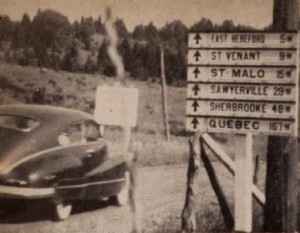
"'Vacation Highlights,' as the title implies, is a record of a vacation trip, but instead of the usual array of catch-as-can shots which make up so many vacation record films, Terry Manos has given this excellently photographed narrative substance by employing inserts of a letter to his wife and daughter, describing his trip, and a number of tie-in shots of the two to knit the whole into a pleasant continuity. The picture is remarkable, not so much from its narrative standpoint as for its consistency in exposure. There is not a measurable difference in exposure in any scene throughout the picture. The picture depicts the start of the trip by automobile, which takes the travelers across the U.S. border into Canada and thence through the province of Quebec. On the return trip they visit such interesting sights as a wood pulp mill and the famed Ausabel Chasm, in upper New York. The camera treatment of the pulpwood sequence and of the Chasm scenes definitely mark this filmer as a photographer of promise. Manos used a 16mm. Bolex camera and Kodachrome daylight type film." American Cinematographer, Apr. 1950, 134.
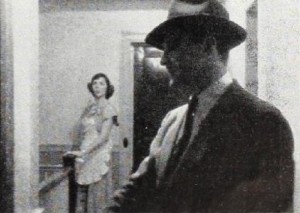
"'The Voice of the Key' is a magnificently staged photoplay, beginning with the very professional series of opening titles and featuring remarkable interior photography, considering the limited equipment at the disposal of the filmer. Charles Carbonaro, using photo-floods entirely, has achieved some truly professional illumination in his interior settings, and his camera technique displays an artist's genuine feel for forceful and dramatic story telling with a camera. The story concerns a murder of an unfaithful wife's lover by her husband, and the steps the husband takes to conceal his part in the crime, only to be tripped up by his door key as the incriminating evidence. Carbonaro used a Cine Special Camera and Eastman Super X panchromatic film. The script, which he wrote himself, was adapted from a story published in 'This Week', Sunday supplement magazine of national distribution." American Cinematographer, Apr. 1950, 133.
"Great ambition and a wide knowledge of both amateur and Hollywood camera techniques mark Charles J. Carbonaro's The Voice of the Key. The film is a whodunit, involving many of the human reactions — from love and hate to cynicism, impatience and sudden passion — all of which have to be registered by the actors at Mr. Carbonaro's command. It's a large order, and the film does not quite fill it dramatically. But the good things about The Voice of the Key are very good indeed." Movie Makers, Dec. 1950, 468.
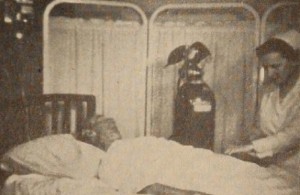
"Efforts of the American Cancer Society both to disseminate accurate information on the disease and to dispel erroneous conceptions form the theme of this unit production by the Amateur Movie Society of Bergen County, in Hackensack, N. J. Based jointly on a case history of neglect and a situation illustrating some baseless fears of cancer, the film shows the many forms of service rendered by the A.C.S. through its local chapters. Handsomely mounted and capably photographed, the picture is a tribute to the technical skill of its director, William Messner, and the cameramen who assisted him. The commentary and music on the sound track ably support the visual message. A tendency towards confusion in the scripting prevents the picture from fulfilling completely the thesis implied in its title." Movie Makers, Dec. 1949, 472.
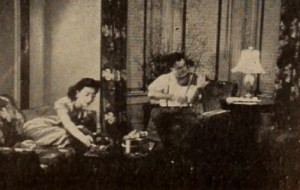
"Using black and white film, Carl D. Frazier has produced a tightly knit and well paced farce of a married couple and a burglar. Excellent lighting of wholly interior settings shows study of the monochrome medium and, properly exploited, how it can result in sparkling results. The acting is adequate for the simple plot, but it is the camera work and editing that make the film above average." Movie Makers, Dec. 1949, 472.
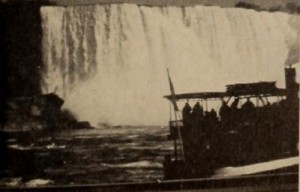
"In Tumbling Waters Leo J. Heffernan has turned his experienced and competent camera on that perennial favorite of travel filmers, Niagara Falls. The result is a sparkling piece of lighthearted showmanship, climaxed by a truly gripping and probably unique sequence filmed amid the swirling mists of the Cave of the Winds. The overall effect of Tumbling Waters, however, was marred for these reviewers by recurring levities of treatment deemed out of key with the essential majesty of the subject." Movie Makers, Dec. 1949, 471-472.
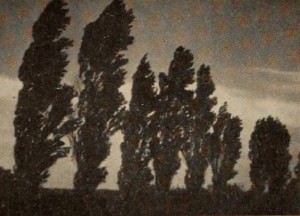
"In Trilogy, Timothy M. Lawler, jr., submits an interesting and, for the most part, successful effort to match romantic verse with appropriately emotional scenes. For his verse, Mr. Lawler has used Kilmer's Trees, Malay's The Wide World and Shelley's Love's Philosophy. The moods of the movie footage are excellent. The verse suffers a little, however, because it is released on the screen (or in narrative readings) a couplet at a time, at varying intervals, thus breaking into the overall rhythm. On the whole, however, Trilogy is a good approach to an attractive and difficult ideal." Movie Makers, Dec. 1949, 471.
Total Pages: 299
 Amateur Cinema