"In Thyroidectomy, Henry M. Lester, ACL, has combined all the essentials of the perfect medical film. The delicate color gradations of tissues that mean much to the surgeon are clearly evident, due to excellent exposure, lighting and suitable film stock. Thorough presentation of the operating technique is given by means of suitable telephoto lenses and properly placing the camera in relation to the surgical field. An unusual feature of this particular operation is the large number of instruments which necessarily must remain in the field most of the time, creating a difficult problem for the photographer in that the many shining surfaces tend to produce undesirable reflections. However, Mr. Lester has solved this problem to perfection. The film is a result of the combination of highly specialized skill, equipment designed for the purpose and an exact knowledge of the requirements for the perfect surgical film." Movie Makers, Dec. 1934, 534.
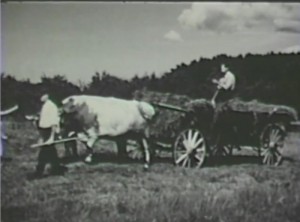
"In Peasants, Konstantin Kostich, ACL, has produced a sympathetic and withal entertaining picture of the people of village and farm land in Czechoslovakia and Roumania. Expert photography, an understanding choice of camera angle and workmanlike sequences mark this interesting film study and serve as a vehicle for its outstanding quality — a sincere and attractive presentation of the people as they are, not as they might be made to appear for the sake of motion picture cleverness. Mr. Kostich needs rely only on his own skill and can afford to neglect making a point of what, in dress or custom, might appear to be a strange peculiarity to another people. Unlike many professional travel photographers, he can avoid these obvious aids to sustain interest and can present his peasants on the friendly basis of real understanding. This does not mean that he does not tell a real story; it simply means that he tells it fairly and sincerely and, hence, beautifully." Movie Makers, Dec. 1934, 534.
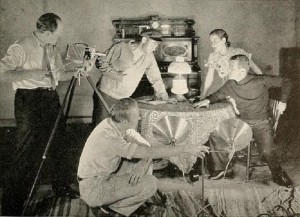
"Not One Word, by Kenneth F. Space, ACL, is an all around triumph of amateur photoplay production. It is a simple melodrama of the keeper of a lighthouse, his wife and the rejected suitor who returns. A wreck at sea (beautifully staged in miniature) is the complicating dramatic factor, and, with these ingredients, a dignified motion picture story of remarkable unity has been produced. In it, Mr. Space and his able staff have blended dramatic lighting, authentic settings and superb photography to achieve a distinguished whole. Under restrained but smoothly paced direction, the three leading players have enacted their roles with definite histrionic skill. If one were to try to select a single quality in the film which is outstandingly brilliant, the vote of this observer would be cast for the cutting. It is accurate and incisive, adding that last bit of dramatic "punch" which is perhaps the quality least often achieved by the amateur producer. Not One Word speaks for itself, but in the wordless and potent idiom of cinematic imagination." Movie Makers, Dec. 1934, 534.
"Made by F. D. Koehler, jr., ACL, The Mississauga Canoe Trip is a fine example of what the movie maker can accomplish on a hunting trip in capturing a picture that has both good photography and an interesting story presentation. The fact that a tripod was added to the duffel did not daunt this cinematic hunter, and the result is refreshingly rock steady pictures that leave nothing to be desired. Perfect exposure, for the most part, and some excellent lighting show that the maker had an eye for the essentials of good picture making. A knowledge of what makes a good screen picture is demonstrated in the many effective closeups throughout the film. An excellent job of amateur titling is another feature that places this film in a high category for vacation films." Movie Makers, Dec. 1934, 534.
"The Last Review, by George A. Ward, ACL, is an almost faultless example of a military motion picture, into which is woven a story that has the rare quality of evoking deep emotion from the audience. Actually, the film is a record of the camp life of the 105th Field Artillery of the New York National Guard, in its summer instruction quarters at Pine Camp, N. Y. Dramatically, it is the story of a Field Artillery private soldier and his friend, the oldest horse in the regiment. Condemned to be shot because of age and the approaching motorization of the command, the horse is reprieved and is given a review by the entire regiment in honor of "the artilleryman's best friend." The tale was not fictional, but actual. The hero was a member of the regiment, he loved the veteran horse and the review was actually held, not for purposes of filming but as a tribute. The film ends with the review, while actually the reprieve was only temporary and the equine actor has since been destroyed because of age. In this film, Mr. Ward exhibited cinematography of high quality and much incidental beauty. He contrived, as well, to give a military record that errs in no detail and that has no false note. To crown it all, he filmed a scenario, in itself moving and acted with complete sincerity." Movie Makers, Dec. 1934, 534.
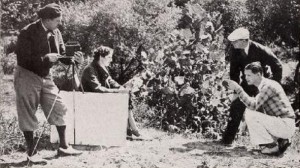
"Hooked, an 8mm. comedy by the Grand Rapids Movie Makers, was intended as a straight drama of the trout streams. It has ended, however, as a delightful farce of a movie club trying desperately to complete such a picture — and is probably the better because of this mid production metamorphosis. For, although the first and original section of the picture is wholly charming and well photographed, it is in the latter section that the film picks up spirit, sparkle and definite dramatic power. It is in this part that the producers have conceived and executed a number of cinematic coups, climaxing them with a stunning multiple exposure sequence probably never before equalled or even approached in this medium. Walter Mills, ACL, L. Thorny, ACL, M. P. Gamber and Wendell Patton, of the Grand Rapids club, continue and enhance, with this film, their rightful reputation as most able advocates of 8mm." Movie Makers, Dec. 1934. 534.
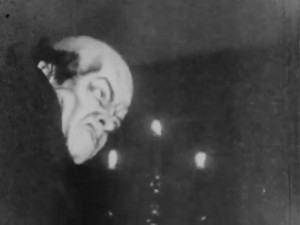
"A colonial scene in the U.S. An old lady sits astride a bell while a man in blackface, wig, and livery pulls the bell rope. From an upper door emerges an old man, dressed as a dandy, who tips his hat to the woman as he walks down stairs grinning. Others leave the same door and walk down the same stairs: a shabby man, a cop, and, several times, the same dandy. The man in blackface hangs himself; the dandy continues to smile. A bell tolls, a grave beckons. In the dark, the dandy plays the piano. Is he Death?" IMDb.
Orson Welles' filmmaking debut, which was co-directed by William Vance. An amateur production, Welles later described the film as a parody of surrealist cinema and the films of Jean Cocteau and Luis Buñuel.
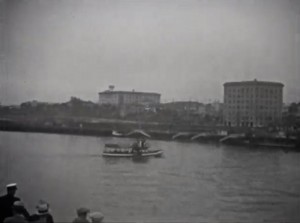
"Footage of various places in Southern California and Mexico." Archive.org
"Film depicting the 1755 Expulsion of the Acadians from Grand Pre, Nova Scotia. Silent footage interspersed with written text. Scenes show the Grand Pre Church and various shots of farm life. An actress portrays Evangeline." Nova Scotia Archives.
"Item is a film taken by Dr. Willinsky of a trip to Italy. In the form of a travelogue, footage of landmarks, ruins and the local population is interspersed with captions that were added in by Dr. Willinsky to provide information about the country's history and culture. Although the title highlights the film's documentation of Rome and Naples, other Italian cities are featured as well; including, Pompeii, Florence and Venice. Dr. Willinsky's wife, Sadie, is occassionally spotted in the footage with travel companions who are probably relatives or family friends." Ontario Jewish Archives.
Total Pages: 299
 Amateur Cinema