"Springtime in California, by F. B. Judson, ACL, is an example of what every Kodachrome filmer would be proud to have made, because it studies Nature in her most extensively colorful manifestations, with complete freedom of camera viewpoint, offering closeups, medium shots and long views, all of them richly hued. This film indicates a delicate appreciation of color on the part of its maker, who. having a highly chromatic subject to his hand, did not let it run away with him. but kept it well under control, with the result that he delights with his management of pastel shades, where another might have omitted these and substituted garish footage so easily available in the highly colored California landscape. Mr. Judson is awarded Honorable Mention because he has done a typical thing — a Kodachrome landscape study — with restraint and liveliness, combining two qualities not always found together." Movie Makers, Dec. 1935, 553.
"A combination of time lapse cinemicrography and shooting huge factory interiors presented William Schanzenbach, ACL, with the gamut of technical difficulties in the photography of the four reel picture, The Commercial Production of Yeast. The interior shots of huge tanks and other machinery were not only adequately exposed but also were shot from attractive angles without extreme consciousness of camera angles. The laboratory sequences, in which time lapse technique was combined with work at the microscope to show the growth of yeast over a period of time, were well handled. Careful planning and clear titles add to the virtues of this exceptional industrial film." Movie Makers, Dec. 1935, 551.
"The relatively short photoplay, Choosing a Scenario, has been awarded Honorable Mention because it is a smooth and superficially brilliant example of comedy film story making. Originally produced as one of the entries in a group filming contest conducted by the Cinema Club of San Francisco, the picture took first award in that contest for its director, William Palmer. ACL, its cameraman, K. G. Stephens. ACL, and its lone actor, J. Oliver Tucker, ACL. Although comparatively slight in significance, it offers fine photography, intelligent cutting, effective angles and deft acting in telling a clever story with lively tempo." Movie Makers, Dec. 1935, 551.
"Among the pictures awarded Honorable Mention is Bermuda, the Floating Gardens, a color travelog of that island, another of the competent publicity pictures made by Konstantin T. Kostich. ACL, which make the audience yearn to buy a steamship ticket and set sail. Mr. Kostich has mastered the art of this appeal, and Bermuda, the Floating Gardens is one of the best examples of his genius. Here are shown glimpses of the comfort of the ship, the colorful beauties of the island and some of the recreational facilities that are offered. There is splendid color photography throughout and numerous examples of cinematic decor which enliven the work but which do not detract from the film's primary purpose. Notable are such things as the shadow of the horse and carriage moving along the warm colored stone wall and a cleverly planned composition of a winding road banked with brilliant flowers. It would be dangerous to look at this picture around February." Movie Makers, Dec. 1935, 550-551.
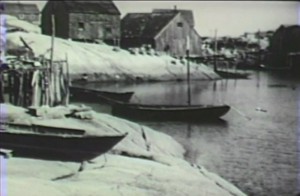
"In Ultima Thule and Peggy's Cove, produced by Edward A. Bollinger, ACL, and Mrs. Bollinger, one finds what must be the ultimate in beautiful scenic photography, magically infused throughout with a sensitive feeling for the relationship of ordinary people to their natural backgrounds. Beyond the veritable perfection of many of the scenes in these pictures it seems impossible for camera and film to go, even when guided by skill and imagination as superb as Mr. and Mrs. Bollinger's. Compositions, cutting and sequence structure are incisive and stirring, while the title wordings and execution leave little to be desired in suave good taste. The two subjects are first and last reels of a four reel study of Nova Scotia, in which, it is understood, Mr. Bollinger has done the camera work and his wife the editing and titling. It is a happy combination, from which have resulted documentary reels of magnificent skill and breathtaking beauty." Movie Makers, Dec. 1935, 550.
"In London Terrace, a picture made to advertise an apartment house, T. W. Willard, ACL, has shown quite clearly that interesting and attractive scenes and well planned action can combine to make a most effective sales argument. The interiors were even better handled than in Mr. Willard's Honorable Mention winner for 1934. The film has an air of complete confidence in presentation that was largely because of effective planning and direction, items very often slighted in the production of commercial pictures. The film succeeds in entertaining an audience and holding its attention consistently, in spite of a continuous sales message. Excellent, straightforward photography of many rather difficult sets was featured throughout the entire reel. The picture shows clearly how well 16mm. can be used for industrial work." Movie Makers, Dec. 1935, 550.
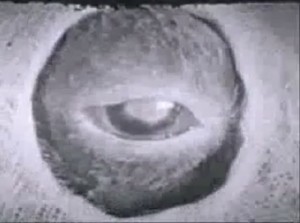
"Keratoplasty, by Henry M. Lester, ACL, is a beautifully perfect record of the operation of a corneal transplant for leucomateous eyes, filmed entirely in Kodachrome. The operation is performed by Dr. Ramon Castroviejo, a rabbit being the subject. Aside from the fact that this clearly executed film records an important and extraordinarily difficult operation in this field, it is notable for its brilliant photographic technique in handling the ultra closeup. In much of the footage, the eye itself practically fills the frame and, in this limited field of action, Mr. Lester has successfully shown every delicate bit of operative technique that is involved in this extremely sensitive surgical procedure. The area is so lighted that no shadows are cast to obscure detail, and the amazing rendition' of the delicate bit of transplanted tissue, the suturing and the various solutions employed, all in full color, is a genuine tribute to Mr. Lester's mastery of the Kodachrome process." Movie Makers, Dec. 1935, 550.
"In the Beginning, although far from being a perfect picture, is nevertheless one of the few truly great films thus far to come from a motion picture camera — either theatrical or amateur. Here, the magnificent beauty and awesome strangeness of the natural world have been seen in their fundamental and ultimate meanings. As an interpretation of the epic story of creation, In the Beginning follows directly in the noble tradition of Homer, Dante and Milton. One is left stilled and humble before the simple purity of imagination which conceived it. To this superb document of nature, F. C. Ells, ACL, the producer, has brought a technical skill and sensitive craftsmanship more than equal to the demands of his subject. Using as his titles direct quotations from the first chapter of Genesis, Mr. Ells has added a subtle undertone to the beautiful King James English by the use of primitive, geometrical symbols (indicative of fire, rain, infinity, etc.) for his title backgrounds. Somber and stunning scenes of the heaving waters, the new born earth and bursting streams in the first reel are followed, in the second, by flawlessly executed telephoto and macroscopic studies of the earth's myriad creatures. Integrating the entire production is a musical accompaniment of stately church music, recorded on disc by the Sistine Choir. Mr. Ells, who has looked upon the earth and found it good, has produced a sincere and beautiful film, great even as it falls short of perfection." Movie Makers, Dec. 1935, 550.
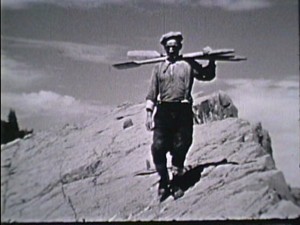
"In Fishers of Grande Anse, Leslie P. Thatcher, ACL, has compiled a vivid and crystal clear cinematic document of cod fishing in a little village in northern New Brunswick. This picture is a restrained work of art that depicts the austere beauty of toil. Repairing boats and nets, catching and cleaning the cod, salting and storing the fish for market and the fishermen leaving for home are the raw material from which this black and white production draws its rugged and satisfying beauty. Close shots and closeups (never affected or forced) comprise the simple devices whereby the irrelevant and possibly distracting material is excluded and whereby the magnificent compositions are achieved. The technical quality of the picture is superb, but probably Mr. Thatcher's greatest accomplishment is in his choice of camera viewpoint." Movie Makers, Dec. 1935, 550.
"Structurally sustained by only the slimmest of plot incidents, Dummy Walks Out is in essence an etude in cinematics, sparkling with brilliant photography and bravura with striking angles. An evening of bridge, consistently bad cards to one player and, in time, the dummy walks out — such is the simple scheme of this masterpiece in miniature. Throughout its brief footage, however, the producers, M. P. Gamber. ACL, and Walter Mills, ACL, have contrived a gleaming glossary of cinematic imagination which delights the eye and beggars analysis. Near shot, closeup and extreme closeup (in several scenes, a single playing card fills the entire screen) follow one another with graphic beauty. Dummy Walks Out is a brilliant answer to the timid souls who "alibi" that the Eights can't take it." Movie Makers, Dec. 1935, 534, 550.
Total Pages: 299
 Amateur Cinema