"Christmas Nuts, presented with a sound on film recording on a separate 16mm. film, produced by Paul Braun and Howard Goodman, is not only an interior color picture of exceptional beauty and impeccable technical quality but is also one of the best puppet films thus far created. With a camera technique paralleling that of the latest theatrical, animated talkie cartoons, the story of a wolf "hijacking" Santa Claus and the consequent near calamity for the two squirrels is unfolded in a completely cinematic fashion. The camera moves freely from medium shot to closeup, the mechanics of the sets are not obstrusive and the puppets move with agility and grace. The sets, which were designed and constructed with great care, are very handsome and exquisitely finished so that no imperfections are revealed in the enlarged picture of them on the screen. The sets, in combination with the colored lights used in part to illuminate them, embody the producers' theory of "created color." That is, no attempt is made to simulate nature, but rather to produce pleasing, vivid color combinations, as in the illustrations of a child's story book. A cleverly compiled dialog, song and music accompaniment has been synchronized with the picture, although recorded, at present, on a separate film." Movie Makers, Dec. 1935, 534.
"Children Grow Up, photographed by Charles J. Carbonaro, ACL, and produced by The Religious Motion Picture Foundation, is one of the best examples of effectively handling amateur actors in a story telling film yet made. This three reel film was avowedly produced to point a moral in parent and child relationships and, as such, may be classed as social propaganda, a function in which it succeeds admirably. Yet the story it tells seems genuine and is of general audience interest. The film is carefully cut so that the action is logical and smoothly paced. Mr. Carbonaro is particularly to be congratulated for his handling of the difficult technique of parallel action, which occurs as the development of the children of two separate families takes place. Both streams of interest merge into one in a well planned, dramatic climax. The story is told entirely with the aid of amateur actors. Interior shots are in the majority and, for these, no special sets were built, the furnishings of the ordinary home being used. The lighting and exposure under these conditions are excellent throughout." Movie Makers, Dec. 1935, 534.
"One of the most difficult of amateur subjects, a record of a child's vacation, is presented most ably in Adirondack Adventure, by Frank Gunnell, ACL. The photography was a joy to behold and showed quite clearly that a great deal of care and experience was back of it. Fine outdoor lighting, which made the most of every scene, predominated. The continuity of this competent picture was developed in such a fashion as to feature Mr. Gunnell's small son naturally and unobtrusively. Incidents which make up the picture are handled clearly and yet with a light touch. Only a movie maker would appreciate the fact that the sequences were far from casual but, instead, were staged carefully. The real charm of a summer vacation has been preserved in this fine picture." Movie Makers, Dec. 1935, 534.
"Among the Ten Best, A Christmas at Home, by Edmund Zacher, II. ACL. is a lovely mine of bright gems which glows with all the warmth and color so surely associated with this festive season. Although essentially of slow pace, the film never once loses appeal, as it presents with loving and tender enthusiasm the countless minutiae of beauty which blend into the charm of Christmas at home. Mr. Zacher's color photography, predominantly interior, is crisp and delicately beautiful, while his sensitive selection of material and cunning choice of angles are an unfailing delight. Multiple exposures of such charm and flawless craftsmanship as almost to defy detection adorn his opening and closing sequences, and the entire production is pleasantly scored with appropriate music and sound effects. More than once a previous winner in these annual selections, Mr. Zacher seems not yet to have reached the full measure of his fine skill with camera and film." Movie Makers, Dec. 1935, 534.
"Item is a film taken by Dr. Willinsky of a trip to Rome, Italy. In the form of a travelogue, footage of landmarks, ruins and the local population are interspersed with captions that were added in by Dr. Willinsky to provide information about the country's history and culture. Included are shots of the Pantheon, the Colosseum, a Roman market, the Appian Way and dinner at a Roman restaurant. Dr. Willinsky's wife, Sadie, is occassionally spotted in the footage with travel companions who are probably relatives or family friends." Ontario Jewish Archives.
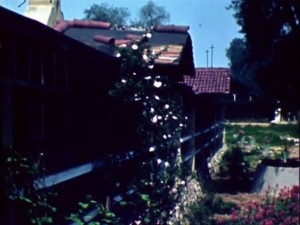
"Footage of various California missions [...] from the late 1930s." Archive.org
"Edited film used by an amateur travel-lecturer documents travel in western and southwestern United States beginning at a rodeo in Phillipsburg, Kansas (trick riding, lassoing jack rabbits, roping calfs, wrestling steers, horse races, bucking broncos and bucking steers as well as scenes of an airplane flyover and of an airplane crashing which possibly was a stunt) and continuing to Black Hills, South Dakota (forest scenery and ca. 1927 construction of Mount Rushmore--blasting off cliff face, scaffolding, men working and completed monument). Shown are roadside scenery, railroad tracks, men cleaning railroad tracks with hose and tank on small train car on the way to an unidentified mountain fishing camp possibly in Colorado (canoeing, fishing in stream, and a smokehouse) and a mountain farm where colts are branded. Cog railway is taken up to Pike's Peak. Travels continue to to the Southwest (unidentified southwestern town possibly Santa Fe with adobe buildings and men and children in Mexican dress singing and playing guitar, American Indian dance performance indoors possibly Zuni, parade of American Indians in unidentified city perhaps Gallup and Navajo band. Scenes of the southwest continue with Navajo in Canyon de Chelly (hogans and herding sheep), prehistoric archaeological sites (Mesa Verde, Chaco Canyon another unidentified cliff dwelling possibly Montezuma's castle) and Taos Pueblo. Film records American Indian dances at a gathering of Indian tribes possibly at Gallup, intertribal horse races and women's tug-of-war. Hopi are shown dancing at Hopi. Also shown are Indian women (possibly Apache or Navajo) and children together and children in cradleboard and the Navajo reservation (hogans, women spinning and weaving under a ramada, herds of sheep and goats and "dipping sheep"). Natural wonders of Grand Canyon, Monument Valley and Rainbow Bridge National Monument are featured.Travel continues to Yellowstone National Park, California (scenery, black bears, hot springs and geysers) and onto the California coast possibly Monterey (seals on rocks). Also shown are an unidentified town with oil pumps and derricks and people waterskiing" via the Human Film Studies Archives, Smithsonian Museum.
"a soggetto"/fiction
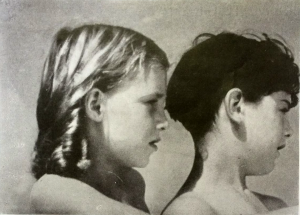
"Nuvola - Nuvola soggetto e regia di P. M. Pasinetti e Roberto Zerboni, fotografia di Francesco Cerchio, interpretato da due bambini, Giorgio Balboni e Liliana della Valle. Un cane e il solo altro personaggio della vicenda, e il film si vale di po-chi altri elementi per comporre il suo dramma: una barca, i cerchi, un fiore; e sopratutti iI sole e il mare: sia la vicenda che la sua trattazione si mantengono in un tono leggermente favoloso, che rimanda per certi aspetti a quel mondo che e proprio delle composizioni liriche di Roberto Zerboni, di cui anche noi abbiamo pubblicati vari esempi, e che sono seguite con moltissima attenzione dai bene informati. In senso cinematografico, la pellicola rispetta sempre una sobrietà di stile singolarmente accurata, e si vale quasi esclusivamente del sistema delle inquadrature fisse, studiando piuttosto la composizione e l'armonia del quadro, e mai cedendo alla retorica degli scorci o del montaggio inutilmente concitato, propria di varie produzioni sperimentali.”
"Cloud - Nuvola (Cloud), subject and direction by P. M. Pasinetti and Roberto Zerboni, photography by Francesco Cerchio, stars two children, Giorgio Balboni and Liliana della Valle. A dog is the only other character in the story, and the film makes use of a few other elements to compose its drama: a boat, circles, a flower, and above all the sun and the sea: both the event and its treatment are maintained in a slightly fabulous tone, which refers in some respects to that world that is proper to the lyrical compositions of Roberto Zerboni, of which we have published several examples, and which are followed with great attention by the well-informed. In the cinematographic sense, the film always respects a singularly accurate sobriety of style, and makes use almost exclusively of the system of fixed shots, studying rather the composition and harmony of the picture, but never yielding to the rhetoric of the foreshortening or of the uselessly excited editing, typical of various experimental productions.”
— Il ventuno 24 (Review of the G.U.F. of Venice) January 1935, p. 15
"doc. a fantasia"/avant-garde documentary
Total Pages: 299
 Amateur Cinema