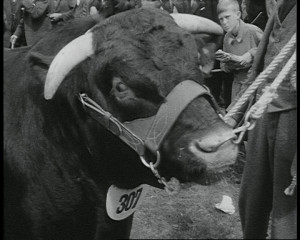
"Three short film sequences detailing competitions, parades and activities at local Agricultural Shows." (EAFA Database)
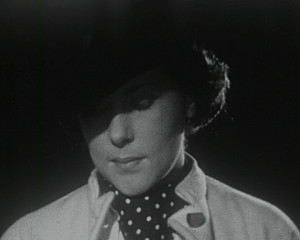
"Morality tale about the corrosive effect of money." (EAFA database)
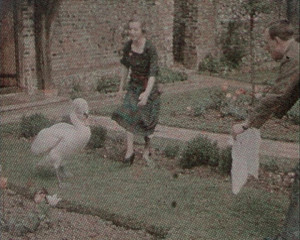
"A swan in the garden of Great Pednor Manor, the home of Captain Watson and his wife." (EAFA Database)
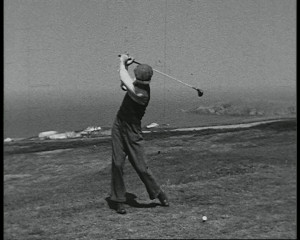
"Demonstration of four golf shots on Cardigan Golf Course with coast in the background, including the shot repeated but recorded in slow motion. Footage of tennis played at the 1931 Wimbledon Tennis Championships on 29 June 1931: including shots of the 3rd round mixed doubles match between Boussus/ Lycett v Von Cramm/ Aussem; the 3rd round women’s doubles match between Godfree/ Round v Holcroft-Watson/ Michell; the Men’s singles quarter-final between Shields v Austin; the Men’s singles quarter-final between Borotra v Satoh; and the Men’s Doubles 3rd round match between Collins/ Gregory v Cooper/ Greig." (EAFA Database)
"L. Clyde Anderson was given an award for Color photography, for 'October By-Ways.' We want to congratulate Mr. Anderson for his selection of colors. It is one of the very first amateur pictures we have seen where color was really properly balanced. There were no harsh notes to distract, but he chose scenes where the ensemble blended and where there was a fine eye-resting blance of color and also color composition. It was obvious that Anderson used haze filters on his outside scenes as the sky does not have that postcard-blue effect, but has been reduced to almost a gray haze which helps the fall colors in the trees and does not take the eye away from the main points of interest." American Cinematographer, Jan. 1937, 37.
"Myron F. Pettengill was awarded the trophy for Scenario pictures. This is a 16mm film of about 400 ft. It is a story of the Northwest Mounted. Pettingill is to be commended for his direction, his types, and the way in which he costumed his people. He injected little touches in his characters that left no doubt as to what they represented. He costumed them convincingly. It had many indoor scenes and of course a large amount of outdoor snow scenes. There was a fine handling of the camera." American Cinematographer, Jan. 1937, 25.
"Okamoto again demonstrates his fine sense of composition, repose and rhythm. Okamoto never hurries his pictures, neither does he hold them too long to bore you. He plans only to give you another fine picture, but he always puts life into his shots. Autumn Leaves is a fine Okamoto offering, but in the opinion of the judges it does not contain the same spark of creation as his last year's effort, 'Tender Friendship'." American Cinematographer, Jan. 1936, 24.
"In the countryside of Japan, the atmosphere of autumn is captured in shots of bare trees, reeds, reflections and sunlight on rippling water, floating leaves and dark clouds. A woman carrying a small child on her back is reflected in water as she stands near a pole, then rests against a harvest stack while crocheting from a ball of yarn. She walks along a path surrounded by farmed terraces. A child (described in the opening titles as motherless) plays with a paper ball while the grandfather tills the soil. The child blows into the ball to inflate it and the grandfather gets out his pipe and lights it with a match. Then he helps to inflate the ball. Against a sky of darkening clouds, they walk along the path, the man carrying the rake and the child a kettle. A woman with an infant on her back passes them, and the child stops and watches after her as she moves away. Then the child stops at a wayside shrine, and the grandfather offers comfort. Against low sun beneath dark clouds they are seen in silhouette as they continue on their way" (EAFA Database).
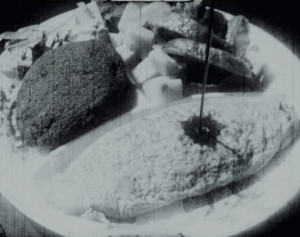
"Just a few years after the commercial release of Pathé Baby equipment [Mori Kurenai] was already a master of his craft, using a variety of trick shots, special effects, stop-motion animation, colouring processes, dialectical montage... Kitchen Drama is a vivid, fast-paced, and delicate portrayal of female domestic labour." - Anna Briggs, Michele Manzolini and Mirco Santi, "The Making of 9 1/2," Journal of Film Preservation, 108 (April 2023): 73.
"The most stylistically experimental film among Kaneko’s works but also one of the most self-reflexive Japanese films of the interwar period. In this film, Kaneko featured the process of 9.5mm filmmaking by means of visual experiments and abstraction. By constructing the film in a way to trace the process of shooting, self-developing, editing, and projecting a film, he manipulated montage and multiple exposures as well as the use of light and shadow, while he elaborated the use of close-up shots that captured film devices and the filmmaker (presumably Kaneko himself) at work... Many advanced amateurs considered the process of filmmaking as an essential part of defining the idea of amateurishness. Unlike commercial productions that involved many casts and crews, amateur productions had the privilege of creating a work individually by going through the entire process of filmmaking, which allows the filmmaker to make every decision on his or her own. Kaneko’s Film Study 9 1/2 visualized this process by reflecting his artistic sensibilities." - Noriko Morisue, "Filming the Everyday: History, Theory, and Aesthetics of Amateur Cinema in Interwar and Wartime Japan" (Yale University: PhD Dissertation, 2020): 111.
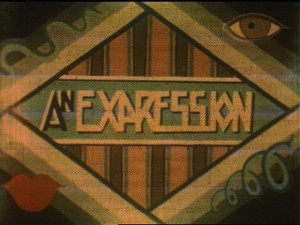
This film symbolizes a city man with a triangle and a country woman with a circle to express their encounter through movements. This work was created by using the Kinemacolor technique. To create a multi-color film, the creators shot a black-and-white film, alternating frame by frame between a red filter and a green filter, and developed it. They colored the film alternately in red and in green frame by frame, and projected the completed film at twice the normal speed (28fps to 32fps, according to Ogino).
Total Pages: 299
 Amateur Cinema