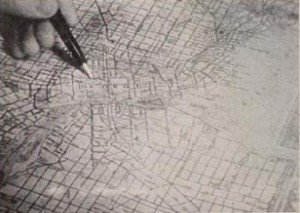
"The cooperative plan of education of Antioch College is presented in Campus Frontiers, made by George Chuck Klein. The picture shows how, every ten weeks, half the undergraduates of Antioch exchange classrooms for jobs in offices, factories and hospitals. The frontiers of Antioch's campus are in the world of business, engineering and production. Mr. Klein, traveling over many States, pictured the work experiences of typical Antiochians and shows how their jobs integrate with their classroom studies. The film is an extraordinary record of American industry and science — high lights of the nation's work on a vast scale. Considering the varied lighting difficulties and the problems of organizing setups, Mr. Klein has made an extraordinary picture, the biggest known of its kind. The film is imaginative and clever, with a well planned theme that ties the diverse material together. Numerous cinematic effects are included, and the whole is accompanied by dramatic commentary, recorded on disc." Movie Makers, Dec. 1942, 507.
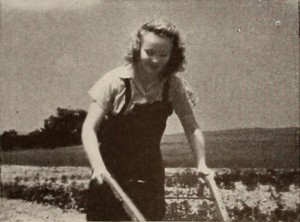
"Ross M. Gridley, filmer of By the Garden Steps, is an agricultural teacher who knows that many films used in education are, although they need not be, dull. He writes that he wanted "to prove that it is possible, as well as desirable, to increase interest by adding a touch of drama to instructional films, without losing any of the teaching value from a scientific standpoint." With this very sensible idea, Mr. Gridley tells the tale of three sisters who grow a 4-H Victory Garden. When they have worked away long enough for the audience to realize that a little more footage will be repetitive, the story shifts to a couple of youngsters who are shooting at targets. By means of a toy airplane which is given rough treatment as a Nazi invader and which the girls mistake for a new kind of garden insect, the boys meet the girls. Finally, prize day comes, and the boys add an unexpected tribute to the girls whose tomatoes are honored. In cinematography, in handling subject matter and in the capacity to fit teaching objectives into the methods of movie making, Mr. Gridley has done a sound piece of work. Girls who see the film will catch the idea and will wonder if they, too, should not have a Victory Garden." Movie Makers, Dec. 1942, 507.
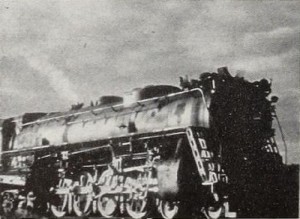
"Railroads Speed the Freights, filmed by T. W. Willard, is a compact industrial picture that presents its story with the maximum of effectiveness. The technique of operating our country's vast railway freight system is clearly summarized; the audience learns the methods employed in sorting, loading and routing freight cars and, in the process, sees some especially handsome movies of railroading. Particularly impressive are the dissolves from the shot of one moving freight train to another. Mr. Willard carefully studied the relationship of motion in the successive scenes and produced a sequence of dissolves, unmatched in cinematic effect. The series is climaxed by a scene of one train passing through the picture, which dissolves to a shot of another train racing almost head on toward the audience. The outstanding quality of this picture is its completeness and suavity, achieved with a minimum of footage and the smallest practical unit print charge." Movie Makers, Dec. 1942, 507.

"After looking at advertising films for many years, we have reached the point where we can take them or leave them alone — but this film took us. Although presented by the General Electric Company as a sales picture, this film is really an important educational document, and it holds one's attention every minute. Camera work and sound are, of course, excellent, and the sections of the film that are illustrated by animated diagrams, to show exactly what FM (Frequency Modulation) really is, are extremely well done. We have little or no radio knowledge, but the film was so clear and concise that we not only want an FM set when the war is over, but we know why. Special mention must go to the writer of the sound commentary, for the production of an excellent narrative. We can only hope that other companies that use movies commercially will follow the high standards of quality and good taste set by this film, for its advertising is both subtle and completely inoffensive. Listen—It's FM! deserves a top score in every respect, for continuity, cinematography and sound all combine to form a perfect film." Movie Makers, Dec. 1942, 506-507.
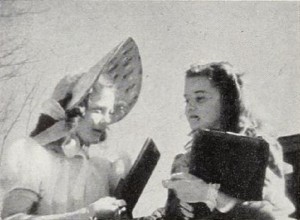
"The 246 year old Voorlezer House, believed to be the oldest elementary school building still standing in the United States, is located on Staten Island, N. Y. It has long been an interesting landmark, but it is now preserved for posterity in Kodachrome by the master hand of Frank E. Gunnell. On the occasion of the one hundredth anniversary of New York City's present school system, this site was selected for one part of the ceremonies, and eighteen girls and boys, in costumes designed from illustrations in Godey's Lady's Book, went through a typical day, recreated to appear as it might have been in 1842. Mr. Gunnell's technically superb nature films are well known, but in The Voorlezer's House there is much more than immaculate cinematography. There is lighting that fits the mood of days gone by, and there is a sensitive faculty in the direction of a group of children that is appealing. The film is simple in that the continuity is chronological, but the charm of the Gunnell touch was never more telling than in this picture. If ever a potentially dull film subject was made to glow and come alive, this is the time." Movie Makers, Dec. 1942, 506.
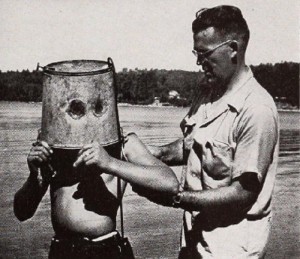
"Kendall T. Greenwood, who has proved his competence in a number of detailed industrial records, turns with Incident from Life to the ways of a growing lad and achieves a clear and carefully observed record of his own youngster that will, in years to come, testify to the fact that his father took the boy seriously. Mr. Greenwood's picture is a compliment to his son and, as we think it over, an unintentional compliment to an understanding father as well. Young Greenwood is a reader. In the course of his reading, he comes upon the subject of diving, but he does not let the matter rest there. Paralleling the "spool and old coal hod" of another inventor, he contrives, out of the detritus of a trash heap and a cautious borrowing from Dad's camping outfit, a diving bell that works so successfully that he goes down with it into a lake near the family home. Father maintains an almost incredible calm and communicates some of it to his wife, although Mrs. Greenwood's face is a study, when the boy's young helper fouls the airline and has to be assisted by Mr. Greenwood. But all ends well, as an absorbing and well made picture comes to a close. Director, actor and cameraman (although Mrs. Greenwood must have lent needed aid), Mr. Greenwood has made a family film that is dignified and interesting and, above all, is one that Junior need not shrink from, as it is shown in later years." Movie Makers, Dec. 1942, 506.
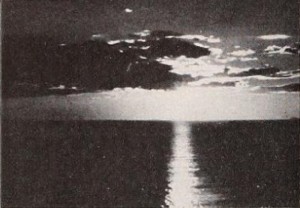
"In the Beginning is a title that appears for the second time in these lists, for this film is a new version of a picture by the same name that was produced in 1935 by Fred C. Ells. The first picture was filmed in black and white when Mr. Ells was working in Japan, and the second picture was made in color in this country. In the Beginning tells, with extraordinary beauty, the story of Creation in the Book of Genesis, and it is climaxed by the creation of man and his works. It is a symphonic film of water, earth and of nature, graced by the cinematic skill and artistry familiar to all who have seen Mr. Ells's work. He has the gift of exquisite motion picture composition and distinctive choice of precise subject matter to which, in this picture, is added a unique control of color. Some of the scenes of birds forming moving patterns on the sand are astonishing, both in composition and in color effect. Back lighting, slow motion and the telephoto lens are tools that Mr. Ells uses frequently, but never for their obvious effect. They are but part of the magic by which he takes his audience back to the days of Creation." Movie Makers, Dec. 1942, 506.
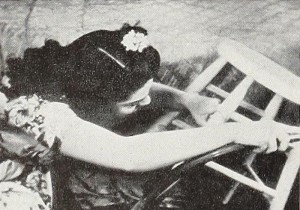
"Fire from the Skies should be a ringing challenge to amateur movie clubs and individual personal filmers across the country. For it is a competent, compelling and altogether mature contribution to the cause of civilian defense. It was produced by the Long Beach Cinema Club with no more facilities than are available to all of us. The added ingredient which put the production over was interest; they wanted to do it — and did ! The dynamic leadership of Mrs. Mildred J. Caldwell, ACL, former club president and coordinator of the present film, is felt throughout its footage. Telling a story of incendiary bomb protection, the picture tells it from the woman's angle, that of the housewife who, before all others, must fight to protect her home. The film employs shrewdly every artifice of the motion picture craft — color, sound, music, narrative and special effects. All are handled crisply and with confidence. The continuity is dramatic but informative, the camera work effective and the sound track exciting in its contribution to the visual message. Fire from the Skies need offer no apologies amid the too small company of America's civilian defense motion pictures." Movie Makers, Dec. 1942, 506.
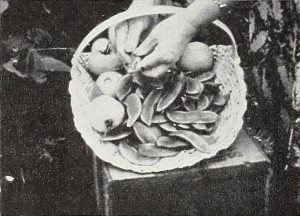
"With his victory garden as an incentive, George Mesaros has made Back to the Soil a record of his garden's progress that does credit to his movie making ability and to the quality of the vegetables produced. This genre little picture strikes a happy balance between the action scenes of planting, hoeing and harvesting and the magnificent shots of the opulent, colorful red tomatoes, green peppers, yellow corn and the beans, lettuce, cucumbers and other vegetables. Mr. Mesaros has a natural sense of pattern and design which he gives full play in the excellent arrangements in this film. Noteworthy, too, is the feeling of space and distance achieved in a small plot of ground. It is surprising to learn that the garden which seems so extensive in the picture is in reality only a small backyard plot." Movie Makers, Dec. 1942, 506.
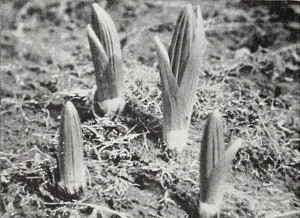
"Most movie makers look about for suitable music for a picture, only after it has been completed. Herman Bartel, who produced Awakening, scores his films just the other way around. He listens to a composition that he likes until he thinks of picture material that will express its mood. Since Mr. Barters appreciation and selection of music are above reproach and since his ability to take a camera and a roll of film and make them sing is well known, we can only add that this is his finest film to date. It is very difficult to explain a Bartel picture. You can say that the subjects are flowers, trees, animals and the other common manifestations of nature, but what you must see to believe is that they have never been filmed in quite his way before. Mr. Bartel does not use parts of records and change from one to another with abrupt shifts in themes. Instead, he uses each record in full. In this film, the blend of picture and music is so matched that, in some scenes, reeds and bushes sway to the rhythm of the music. Needless to say, the camera work in this picture is superb. Other color films may be exposed as well, but they will never be exposed better because here is more than perfect exposure and lighting. Mr. Bartel has taken what existed and has made it say what he wanted it to say through skillful control of the devices at hand." Movie Makers, Dec. 1942, 489, 506.
Total Pages: 299
 Amateur Cinema