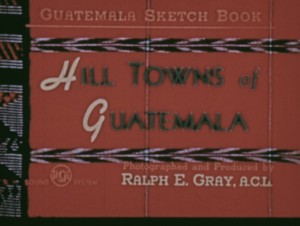
"A narrated travelogue addressed to viewers in the U.S. shows life in several small towns surrounding Lake Atitlan, Guatemala. Shows rope making from sisal hemp and traditional textile weaving. Concludes with a visits to the outdoor markets in Santiago Atitlan and Chichicastenango" Indiana University Libraries Moving Image Archive.
"documentario"/documentary
"documentario"/documentary
documentario"/documentary
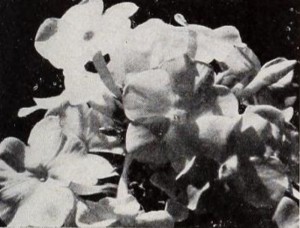
"Revelation indeed reveals the slow, but intense, life of flowers as they unfold. Hans J. Theiler, who built a special mechanism for the purpose, has made time lapse studies of blooms in their determined efforts to find sunlight. Other flowers lose as well as open. The time lapse sequences are preceded by closeup footage of various blooms impeccably filmed. In the chief section of the picture, Mr. Theiler has caught very dextrously the unusual and almost terrifying performances of plants as they carry on their exceedingly active careers. The time lapses are exceptionally smooth." Movie Makers, Dec. 1944, 496.
"It is a strange and savage world indeed which Dr. Richard Cassell explores in his Warriors of Another World, a striking recording of nature's continuing and inexorable conflict. His warriors, among others, are the ant lion (with its simple but treacherous sand trap), the scorpion, the mantis, the black widow and the field spider. Into the life of each of these — and their unwary and often unarmed victims — Dr. Cassell has probed with his long focus lenses, to bring back reports of murder, sudden death and cannibalism among the insects. His technical handling of the specialized tools of his trade is beyond reproach, while his continuity treatments range the full gamut of motion picture story telling. Both micro and macrocinematography are used in the film's course, to develop well rounded sequences that are, incredibly, complete with medium shots, near shots, closeups and even reaction scenes made during the tiny but titanic battles. We see (in full frame closeup) the multiple lensed eye of a housefly, only to learn from immediate and striking imagery what such an eye might record — a housewife approaching with a fly swatter. Warriors of Another World is a distinguished contribution to educational film making." Movie Makers, Dec. 1943, 474.
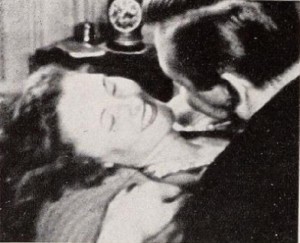
"Novel continuity, beautiful cinematography and a nosegay of feminine charms are the distinctive features of Ten Pretty Girls, produced by Anchor O. Jensen. This expert little drama, made on 8mm Kodachrome, is an excellent example of quality workmanship in that width. The opening scene shows a young man contemplating his address book. He folds a large piece of paper and cuts from it a string of ten dolls, which become the symbols of as many lovely young women. As each doll is torn from the group, a new sequence featuring one of the girls is introduced. A different flower, corsage or bouquet figures in the action as each of the girls is shown in some individual and flattering setting. At the conclusion, the young man has made his choice; he spurns the blondes and brunettes for the favors of a titian beauty." Movie Makers, Dec. 1943, 474.
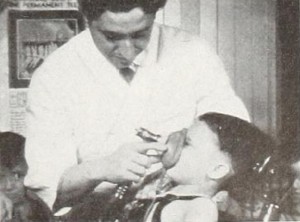
"Morton H. Read has made, in Teeth and Good Health, an effective study of the work accomplished by the Dental Clinic of the Public Schools of Springfield, Mass. This film should be of great interest to educators whose institutions offer a similar service to children of grade school age. The picture lucidly outlines the program followed by the teachers, nurses and doctors in the system set up by this school, to facilitate caring for the children's teeth. Charts and diagrams that warn the children of the danger of neglected teeth are shown, as well as excellent shots of the dentists at work. Thus, through familiarizing youngsters with the importance of dental care and its mechanics, the child is taught not to fear the dentist. A recalcitrant mother serves as a focal point for the detailed explanation of the advantages of the dental program in the school. The filming is marked by competent cinematography, logical sequence arrangement and simplification of detail." Movie Makers, Dec. 1942, 509-510.
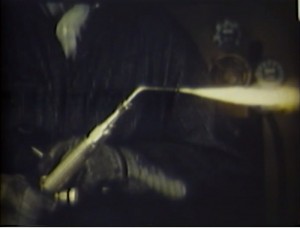
"Good teaching films are not easy to produce, and welding activities are not easy to film. In making this picture, Ray Garner and the Harmon Foundation have solved both problems in a highly satisfactory manner. The procedures are clearly and simply outlined in titles which are combined with unusually fine camera work, to produce a well integrated whole. Done almost entirely in closeups, the actual welding scenes show perfect exposure and, in many instances, very interesting angles. The film was made at Hampton Institute, in Virginia, and a student demonstrates the proper techniques in procedure. The title art work was especially good in this film, and the entire production showed the effects of a well organized plan and a careful procedure." Movie Makers, Dec. 1942, 509.
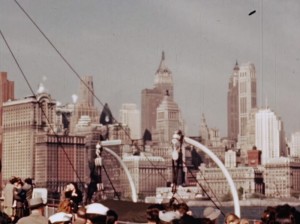
"Most of the residents of New York City know that the world's metropolis is something more than a play place for sensation hunters. But, if one were to judge from many films of New York City, the conclusion would be inevitable that the urban settlement at the mouth of the Hudson River is chiefly devoted to night clubs and parades and is populated largely by those who frequent them. In New York Calling, made for the New York Central System, of which he is supervisor of the Motion Picture Bureau, Frederick G. Beach has presented the New York Central's eastern terminal city as a reasonable and understandable place, where sane people live and to which a man may bring or send his family for a holiday without wondering if they will survive the experience. Made for showing to families, Mr. Beach's excellent Kodachrome footage covers the best of New York City with an apparently effortless leisure, in spite of its brevity. Including many different phases of a great city, the picture has a generous amount of well made closeups. Things that will interest children are strikingly presented. If this reviewer did not already live in New York City, Mr. Beach's movie, with excellent narrative and music, would be the best possible argument for him to change his residence. It certainly will prove to be persuasive in the days when railroads can again urge us to travel for pleasure." Movie Makers, Dec. 1942, 508-509.
Total Pages: 299
 Amateur Cinema