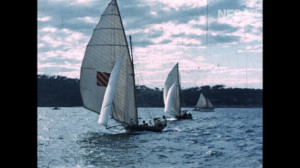
"Semi-professional documentary made in a romantic style as a tribute to Sydney Harbour and the different types of vessels that cruise on it." NFSA.
"JAMES A. SHERLOCK, S.A.C, Sydney, Australia, with his "To the Ships of Sydney," is the winner of the grand prize of $200 in the American Cinematographer's 1937 International amateur competition for 8mm and 16mm films. Under the terms of the gift of $100 in merchandise by Bell and Howell, to go to the maker of the film which in the opinion of the judges was the best in photographic technique of those films made entirely with Bell and Howell cameras, the man Down Under automatically comes in for a second award." American Cinematographer, Jan. 1938, 26.
"a soggetto sonoro"; filmed with the recently released Italian camera from Novati and the soundtrack was also made with the Milanese company Novati's devices made by the engineer Dollari.
"Oltre a questi ve ne sono altri che apparirebbero soggetto ma la trama è così tenue e poco chiara che noi non esitiamo a porli fra i documentari (La prora incatenata; Zoo; Cacciatori delle Alpi o 65 O.M.)"—Cinegiornale, 1936
"In addition to these there are others that would appear subject but the plot is so tenuous and unclear that we do not hesitate to place them among the documentaries (The Chained Bow; Zoo; Hunters of the Alps or 65 O.M.)"-Cinegiorniale, 1936
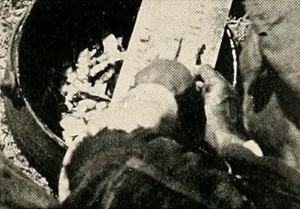
"Porpoise Oil presents a cleverly planned and charming story that shows how the Indians of the upper St. Lawrence region live today and how their ancestors obtained oil from the porpoise of the neighboring bays. Dr. Leighton was fortunate enough to find an old Indian who, in his younger days, had been a champion porpoise hunter and the picture tells in Kodachrome how the fish was shot and the oil tried. This constitutes an important document of Indian craft that, otherwise, in time would be lost to the world. A touch of humor throughout and a surprise ending serve to spice the film and to make it the excellent study that it is instead of a routine record film. The continuity is well developed and the photography is of good quality." Movie Makers, Dec. 1937, 630.
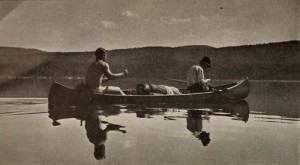
"The refreshing story of a voyage by river into the Canadian wilds, presented by F. R. Crawley in Glimpses of a Canoe Trip, is really deserving of a less modest introduction than that implied by the word, "glimpses." Here, within one reel, is as comprehensive a movie tale of a trip by canoe as one could desire. The entertaining continuity, based on the natural sequence of events, is not loaded with unimportant detail; instead, footage is conserved for the more interesting episodes involved in paddling and portages. These are given a well rounded treatment that has genuine entertainment value coupled with a freshness of approach born of the enthusiasm of the maker. This sort of thing communicates itself to the audience, especially when photography, editing and titling are as well handled as they are here." Movie Makers, Dec. 1937, 629.
"In China's Gifts to the West, we have what may be termed a tour de force of cinematic cutting. The most interesting part of the film is made up of a series of beautifully composed and photographed "stills," but the duration of each of these shots is so carefully timed that the entire sequence is fused into a relationship which conveys a distinct impression of cinematic motion — perhaps not "motion" in the ordinary sense of physical activity, but rather the deeper and more fundamental activity of the mind as it contemplates, one after the other, the various ideas which make up the unity of a conception. This has been accomplished by Mr. Space in his excellent choice of illustrations, which are projected into the mind in exactly the right order and appearance. Beside this purely cinematic achievement, the maker of the film is to be congratulated on his excellent taste in selecting and displaying objects of art to the best advantage. The photographic technique employed in producing closeups and ultra closeups of fabrics, china and other materials is undeniably pretty close to perfection." Movie Makers, Dec. 1936, 551-552.
"A Chinese and an American boy find China's products in the latter's home." The Educational Screen, Jan. 1946, 23.
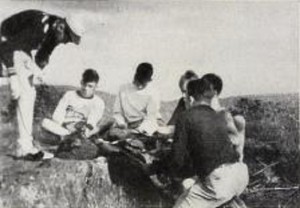
"The fact that the film, Camp Pinnacle, made by Robert F. Gowen, was provided with a clear spoken accompaniment served to enhance the workmanlike excellence of its cinematic presentation. Since it was a film made, avowedly, to sell to prospect parents the advantages of Camp Pinnacle, it would hardly have been fair to look for those more delicate nuances of atmosphere and sequence which may become a labor of love in the more personal film. Thus Camp Pinnacle was chosen for its excellence as a straightforward exposition, in glowing color, of every interesting aspect of the lives of the lads and their counselors at camp. In setting this forth, Mr. Gowen has chosen simple, natural sequences and has interpreted these with technical excellence and secure knowledge of the Kodachrome medium." Movie Makers, Dec. 1936, 551.
"These Bloomin' Plants, by Eugene L. Ritzmann, has been given Honorable Mention because of the striking technical tour de force which it represents. In it, Mr. Ritzmann has pictured, by means of a camera controlled by a mechanism of his own design and construction, the actual blossoming of some half dozen or more flowers. Through this device of time condensation, buds are seen bursting open before one's eyes, often in cascades of beauty which vividly suggest the magic of colored fireworks against a night sky. The technical management of this difficult and esoteric phase of photography was almost without flaw. In the opinion of the judges, however, Mr. Ritzmann failed to do full justice to his material, both in his editing and in his title treatment." Movie Makers, Dec. 1936, 551.
"Misdirected medical research, with gruesome and very exciting consequences, is the basis of the plot of The Scalpel, a photoplay produced by Richard H. Lyford, with the aid of a group of boys and girls of high school age. The plot is extravagant, the story is rather too filled with amazing action, and there is not a doubt that the melodrama as a whole puts too great a burden on the acting ability of a group of young people, even though they are surprisingly able. Nevertheless, here is an amateur made thriller of the Frankenstein and werwolf tradition that really sends chills chasing down your spine. The transition of the unfortunate doctor into a demented and abnormal creature involved makeup that is really astonishing outside of a theatrical studio. It can't be said that the handling of the episode is any less convincing in this amateur production than are the same undertakings in the best Hollywood films of this nature. In addition to being really successful in its object, this picture offers some excellent technical work and very competent management of a large cast." Movie Makers, Dec. 1936, 550-551.
Total Pages: 299
 Amateur Cinema