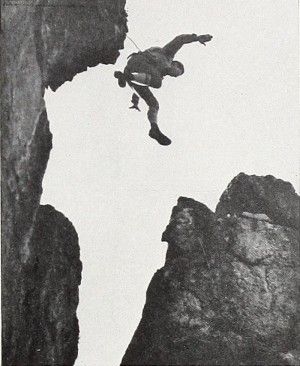
"The Mountaineers Club Teton Expedition, made by Ray Garner, tells the story of several young men who did some real mountain climbing among the peaks of famous Western mountains. A most interesting introduction, showing briefly the various types of climbing, prepared the audience for some of the amazing sequences later on. Remarkable attention to human interest details sustains the entertainment quality throughout and, when the actual climbing starts, the thrills are second to none. The agility of the cameraman contributed greatly to the effectiveness of the film." Movie Makers, Dec, 1936, 550.

"Pinch Hitter, a photoplay by Charles J. Cafbonaro, has been given Honorable Mention because of its continuously sustained technical brilliance in the face of many problems of cinematic story telling. A suave situation comedy, it presents the dilemma of a girl who is asked once too often by her roommate to substitute for her on a temporarily undesired date. In time, the pinch hitter goes to bat for herself, knocks out a home run and leaves her roommate caught flat footedly out. In presenting this comedy of manners, Mr. Carbonaro has been helped by good acting from his players but hindered by not quite a light enough touch in the film's pace and direction. The lighting and camera work, which are genuinely of top flight quality, go far but not quite far enough in disguising this one weakness." Movie Makers, Dec. 1936, 550.
"In Love Apples, Henry Hoke presented what is, so far as Movie Makers records show, the first approach to filming the hobby and preoccupation of an entire family. Unquestionably the Hoke family likes tomatoes and, something less commonly encountered, it is willing to work to produce them. Mr. Hoke's Kodachrome film lets us see the entire family group at work planting, weeding, watering and picking — especially picking, because Mr. Hoke makes quite a cinematic point of eager hands reaching for tomatoes in and out of season. The continuity is active and full of humorous touches, with a shade too great an emphasis on camera tricks for their own sake; the photography is adequate and often provides much screen beauty. Above all, this film has a unity which, added to its unusual motive, brings it into the Honorable Mention class." Movie Makers, Dec. 1936, 549-550.
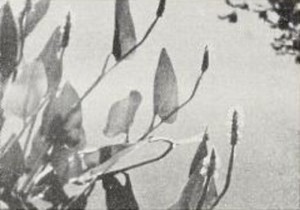
"In Consider The Lilies, Fred C. Ells, producer last year of the beautiful In The Beginning, continues his tender and loving examination of the natural world. When, at the close of this year's competition, his entry of 200 feet of 16mm. Kodachrome was viewed by the judges, it was found to be just that and nothing more. The lead title assembly, which was to be completed before the Ten Best deadline, had not arrived. But, in the half reel of chromatic flower studies which the judges were able to review, Mr. Ells has distilled a delicate beauty and lyric worship of flowers of the field which are breathtaking in their perfection. Seldom has the motion picture transmuted such pure loveliness from field to fireside." Movie Makers, Dec. 1936, 549.
"A most workmanlike travelog of the West is Bryce Canyon Wonderland, a Kodachrome accomplishment of Frank Gunnell. Even, careful exposures make the film a delight on the screen, while interesting touches portraying the personal angle provide the cinematic punctuation. Gorgeous color rendition obtained in this wonderland was the result of experience and good judgment. The use of a tripod for every shot, coupled with finished technique and a dramatic subject, accounts for this film's photographic excellence." Movie Makers, Dec. 1936, 549.
"An Interlude in Happy Isles, made by Dr. Delmer J. Frazier, is one of those comparatively rare vacation pictures that tell their story in detail, but only in that detail which will mean something to an audience that did not have the good fortune to take the same trip. We have no road signs nor guide maps (except for cinematic effect), we don't even know where "Happy Isles" may be. All we know is that the Frazier family has a delightful time there; that they plan their trips with care; that they love the woods and the wild life; and, finally, that their appreciation of it all thoroughly entitles them to an interlude of pleasure. This film is an excellent technical job — the interiors at the beginning of the picture are beautifully lighted, and follow shots of the squirrels in the woods are quite amazing. However, it is the continuity of this picture, with its well planned incidents, that gives it Honorable Mention." Movie Makers, Dec. 1936, 549.
"An outstanding example of what may be done with ordinary 16mm. equipment in the factory is to be found in The Story of Maytag, a black and white industrial film made by Fred Maytag, II. The problems of picturing the manufacture of washing machines in complete detail involved some tremendous lighting difficulties. Mr. Maytag handled these with ease, and throughout the film there is the conviction that the clear, clean photography scarcely could be improved. While the film was designed for use within the sales organization, the procedure of manufacture is so clearly pictured that it is not only comprehensible to the layman but interesting as well." Movie Makers, Dec. 1936, 548-549.
"In Mount Vernon Seminary, the T. W. Willard Motion Picture Company has made a remarkable Kodachrome publicity picture. No interior was too large for their color work, as is clearly shown by the fine shots of a "prom." Large rooms with groups of girls taken by artificial light were rendered in true colors with striking effect. The film demonstrates quite clearly how successfully color can be used in industrial and publicity filming and that no special limitations are involved. The most attractive titles were double exposed on well chosen bits of school scenery. The film has an air of friendliness and polish that is entirely in keeping with the spirit of the school it portrays. Just enough of the right things are shown to make a favorable impression on prospective patrons of the school." Movie Makers, Dec. 1936, 548.
"As We Forgive, produced by the Religious Motion Picture Foundation and filmed by Kenneth F. Space, with the technical assistance of Dan Lindsay, is a fine example of weaving the theme of the picture into the very warp and woof of its photographic material. The makers of this photoplay had a sincere and simple theme to present, and the excellence of their presentation lay in the fact that every detail of the handling, both in technique and continuity, was done sincerely and simply. It is this carefully worked out unity of treatment with theme that enables the film to serve as a model for producers of photoplays with a message. The filmers particularly are to be congratulated on their handling of child actors, one of the most difficult problems to be solved successfully in any field of the drama. From the technical point of view, we may remark the well exposed interiors, in which the lighting was carefully planned to give the effect of normal illumination; the fine photographic quality displayed in the closeups and camera angles and the smooth unity of the entire technical handling." Movie Makers, Dec. 1936, 542.
"In Two Weeks, W. W. Champion has contrived that rare and refreshing thing — a personal record picture implicit with general human interest. Telling the story of a fortnight's pack trip with friends through Yosemite, the film gets off to a flying start with a delightfully detailed sequence of camp preparations. With complete naturalness, we are made acquainted with each of the vacation party. When, in good time, they set off down the trail, we feel quite sure that these people will prove of more interest than the locales that they will visit. Mr. Champion does not disappoint us, as he continues with an adroitly spun pattern of personalities and places. Crisp, steady and effectively angled, the photography of the film, in both monochrome and color, is of able assistance to the imaginative treatment." Movie Makers, Dec. 1936, 542.
Total Pages: 299
 Amateur Cinema