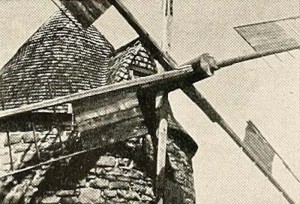
"The majesty of one of North America's greatest rivers is the theme of Walter Downs's Saga of the St. Lawrence. Stunning Kodachrome views of this mighty stream picture it from the decks of a river steamer. The ship is used as a mechanism for carrying the continuity theme forward and for providing smooth "trucking" shots of the passing shoreline. Brief stops offered the opportunity for sequences that show the character of the country and its people with the sympathy and understanding of one who knows the region well. These also punctuated the film in a pleasant and interesting fashion. The picture is accompanied by a musical background and some sound effects, all done by double turntable. This is a gracious and capable film of high photographic quality." Movie Makers, Dec. 1937, 630.
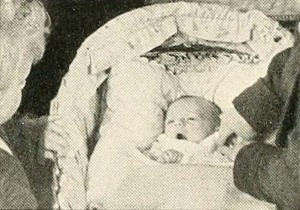
"With Number Three Arrives, John Martin carries on the continuity both of his charming family and of his delightful films of them, so ably introduced by his last year's award winner, A Day with the Young Martins. Here again are the sure feeling for cinematic story technique, the nicely effective angles and the smooth sequencing which belies any need for titles. Added to these deft and familiar abilities of Mr. Martin's work, the current production brings to light a delightful flair for farce comedy by the harassed father and a family terrier rivaling, on a small scale, the best of Hollywood's canine thespians. Once more, Mr. Martin has proved beyond argument that a well planned family film may be of interest to all who see it." Movie Makers, Dec. 1937, 630.
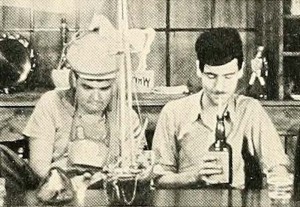
"The able talent of the Rockville Cinema Club again has produced an excellent photoplay. In Notoriety, the acting of this seasoned group of players sets a high standard for amateurs, and the work of the leading lady deserves special mention. Able direction and camera work help to carry along a story which has a few weak spots in its structure, for the film has a surprising amount of suspense, which is unusual in amateur dramatic ventures. There are several smooth comedy sequences that are extraordinarily well handled, and there are interior scenes of outstanding quality in lighting. The work of this group constitutes a good example to those who feel that good films are made only with elaborate equipment, for this picture tells its story in straightforward, workmanlike sequences filmed with the simplest of accessories." Movie Makers, Dec. 1937, 629-630.
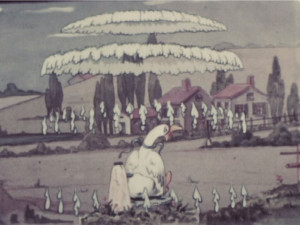
"To the producer of Ducky 'n Busty must be given the palm of accomplishment for making the first 16mm. cartoon story in Kodachrome that has come to the attention of the League. Plenty of publicity has been given to the immense amount of detailed work that goes into making a theatrical screen cartoon. In Hollywood, this is done by a large staff, but Emile Gallet, producer of this unusual film, performed every bit of the work himself. This included the construction of a special apparatus for shooting color film, frame by frame, the arrangement of proper lighting and designing an alignment device for bringing each separate drawing into correct relationship with its predecessor. In addition, Mr. Gallet, who is an artist, planned the scenario and executed each separate drawing in color. The monumental effort thus involved may be deduced from the fact that there are forty frames to each foot of film and that Ducky 'n Busty runs to a length of 400 feet. The subject matter of this amusing cartoon is of the type familiar in theatrical productions, wherein the antics of birds and animals repeat the foibles of humankind. In imaginative color design, fine technical work and sheer achievement in this field, into which so few amateur workers have ventured, Mr. Gallet rates highest praise." Movie Makers, Dec. 1937, 629.
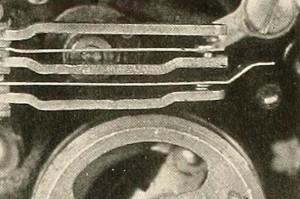
"To produce a clear explanation of just how the modern dial telephone works is a task that would tax any movie maker's ability, or even the united capabilities of any two filmers. Yet, when Kenneth Bloomer and Robert Orr. jr., pooled their movie making and telephone engineering knowledge to make Behind the Dial, they produced one of the most competent technical films that Movie Makers staff has ever seen. Clear, flawless photography, combined with a script that was worked out with infinite care, makes the story interesting and complete. Particularly effective are the sequences of the operation of the automatic machinery of the dial systems, in which shots of the encased mechanisms dissolve into scenes of the same mechanisms after the cases have been removed. The camera achieves the effect of an X-ray in revealing what actually happens within a maze of machinery to make the dial system possible. The film represents a tremendous amount of labor and planning, for much of the equipment shown had to be filmed at the telephone office late at night when the traffic was very light. This is a documentary film of both educational and entertainment value." Movie Makers, Dec. 1937, 628-629.
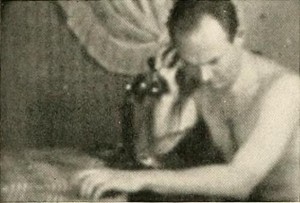
"Beach Holiday, an 8mm. story in Kodachrome, deserves high praise because of its smooth and interesting treatment of material that is directly within the reach of every movie maker. Made by Raymond O'Connell, this subject is a fine example of natural continuity, done in a simple, straightforward manner. The interior shots, which show the family getting up in the morning, their planning and preparation for a day at the beach and, at the end of the film, their return home, afford excellent examples of good exposure and technical work on 8mm. interior scenes. Many of the transitions are well planned, notably a clever shot which shows the final packing of the picnic hamper at home. Its cover is raised in the kitchen, so that the hamper fills the entire frame. The cover is then lowered, revealing a beach scene in the background. The outdoor work gives an excellent exposition of a day at the beach, complete with swimming, sports and boardwalk amusements." Movie Makers, Dec. 1937, 628.
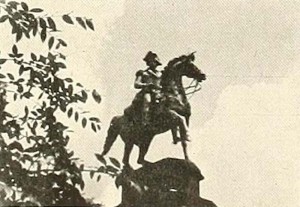
"To love a place so well that you can film it so well that the result becomes commercially sought is not the happy fortune of every movie amateur. Waldo E. Austin's Richmond Under Three Flags was paid for by the Morris Plan Bank of Virginia, in Richmond, and is distributed by the Virginia Conservation Commission. Here, a man of culture and a filmer of exceptional care and refinement has given us his own home, lovingly and interestingly presented, with a happy quota of cinematic ornaments. The pace of this accomplishment is leisurely, as was the Old South, yet its manner is modern, as is the new Richmond. In the title wordings, Mr. Austin is especially fortunate, avoiding banality on the one hand and '"fine writing" on the other, with just enough rhetoric to give the flavor of one of the country's most rhetorical centers. The interior scenes of public buildings have been accomplished with an apparent effortlessness that conceals a great deal of effort. Here is the publicity film in its most suave expression." Movie Makers, Dec. 1937, 627-628.
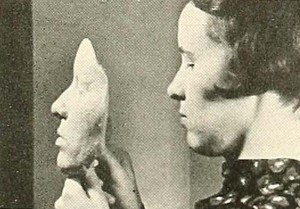
"In Moulage For Masks, filmed for Dr. G. A. Peterson, Dr. James E. Bliss presents with satisfying clarity a step by step study of the procedure of producing the facial masks used to guide the operator in making dental restorations. A logical and carefully prepared script, added to finished camera work and exact editing, has created a color picture that gives an amazing amount of information in brief footage. It is a classroom film of notable competence, both because of the logicality of the cinematic thinking that it represents and because of the successful manner in which it always focuses audience attention on significant action. Carefully written titles integrate perfectly with the sequences, and the whole forms as compact a study as could be produced on this subject. At the same time, an eye for color composition and human interest has made the reel attractive from the layman's point of view." Movie Makers, Dec. 1937, 627.
"Good classroom film describing a method for the construction of facial casts by the use of a rubber like 'Moulage' for the impression. The photographic quality of the film is so good and the subject matter so interesting that the film is far above average. The color of course adds to its attractiveness. Film follows the instructor through the procedure of making a mask." Educational Film Catalog, 1939, 227.
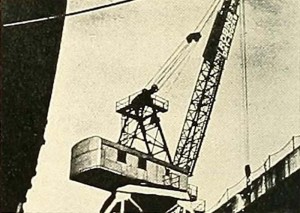
"In From the Sea, produced by Fenno Jacobs for Todd Shipyards Corporation, establishes a precedent this year, for it is the first 16mm sound film, directly recorded in this medium, to be offered for Ten Best consideration in the Special Class. But the fact that this film carries its own directly recorded sound is only one of its many unusual qualities. It tells an interesting and dramatic story of the manifold activities that make up a working day in a great shipyard, where the monster ships are hauled from their native element without ceremony and attacked by a swarm of workers who specialize in every known form of ship repair. By handling this material with great technical facility and by fine editing tempo, excellent choice of camera viewpoint and a flair for cinematic effectiveness, Mr. Jacobs has succeeded in creating an industrial picture which has a high general interest. Among the many noteworthy sections of this film is the sequence which shows the workers' lunch hour. It is outstanding for its fine cutting and for the dramatic pause which creates a respite from the Titanic activities of the working hours. Interesting also is the sound accompaniment which is an integral part of the film and which, in addition to a spoken commentary and spot recording of shipyard sounds, includes well chosen excerpts from Stravinsky's suite, The Fire-Bird, to establish a modern mood." Movie Makers, Dec. 1937, 627.
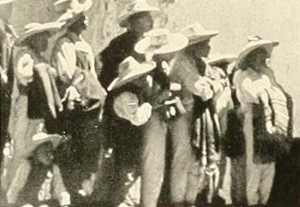
"One comes from a screening of Primitive Patzcuaro, by Ralph E. Gray, with an overwhelming impression of pure beauty. Here, in compositions which often echo the Old Masters in their warmth of color and satisfying balance, an amateur movie maker has turned his camera on the simple life about him and found it pleasing. One after another, the magnificent scenes and sequences bring from the spectator that involuntary expression of deep pleasure which is ambrosia even to the great of amateur movies. In Primitive Patzcuaro, Mr. Gray has portrayed, with leisure, the life of the Tarascan Indians, remote from civilization in a rarely visited section of Mexico. Although magnificent in its color studies, the film is abundant in human interest as well; in portions devoted to the bright native dances and religious ceremonies, it presents a series of tableaux that are breath taking in their effectiveness." Movie Makers, Dec. 1937, 626-627.
Total Pages: 299
 Amateur Cinema