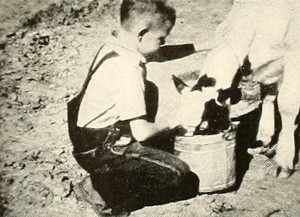
"On the Farm, made by Mr. and Mrs. Ray Garner for the Harmon Foundation, is an example of visual education at its best. By the use of two charming, healthy little American children as the chief characters, it enlists sympathy before it attempts to instruct. And it never strays from the fundamental concept which, to all evidence, was in the minds of its makers: namely that, to teach children by visual aids, one must appeal to their sense of fun. Charm, here, is not outlawed simply because it is not informative. Divided into two parts, Morning and Afternoon, and illustrated with unpretentious titles, such as This is how the animals help, which are chalked in white letters on a blackboard, On the Farm tells of a common workday, in terms of what two farm children can do to assist their parents. From the sequence in which the tousled farm lad puts his head out of the window to see what kind of a daybreak it is. to the time when the sun goes down behind the silo, almost every kind of farm activity is shown. Other children in city classrooms are going to see themselves in the scenes and will want to learn more about a way of life in which they can feel so much at home." Movie Makers, Dec. 1940, 600-601.
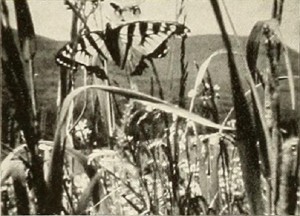
"Robert P. Kehoe, who won Honorable Mention last year with Chromatic Rhapsody, has "done it again" — only more so. In Wildflowers, with his own inimitable magic, he has gathered into light and color all the lazy loveliness of high summer. Here, as if he talked their secret language, bees drone and butterflies dance before his lens. Daisies and buttercups, the wild geranium and "butter and eggs" — a dozen flowers you do know and a score you have forgotten — nod in the warm sun with simple and unassuming beauty. Often, six blades of grass and a single bloom will comprise a moment of ineffable gaiety and song. The rough wood of a slanting black post gives accent to a field of daisies, or the delicate tracery of a "four o'clock" is a breath taking frame for a summer sunset. In Wildflowers, Mr. Kehoe has written once again a lyric testament to nature's incomparable loveliness." Movie Makers, Dec. 1940, 600.
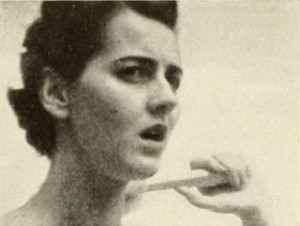
"Three Wishes is a fantasy, done by Earl L. Cochran with a delightful touch of originality. The story is told in footage that is relatively brief, yet clever editing and planning make it thoroughly complete. Here we have the familiar legend of the fortunate mortal who is given exactly three wishes by a supernatural power — and what happens when these three wishes are granted. The feat that Mr. Cochran accomplished was to tell such a story humorously and effectively, but without resort to complicated camera trickery. Except for one double exposed scene of the inevitable jinni which is evoked by rubbing a silver teapot (and this is a very good shot, too!) the film tells its story with straight cinematography. While the interior and exterior technique of scene recording, including a shot of an auction, was completely adequate, the outstanding feature of this film is its story telling quality, accomplished by careful cutting. An excellent performance was given by the single lead character of the photoplay, while the brief appearance of the jinni was very expertly handled." Movie Makers, Dec. 1940, 600.
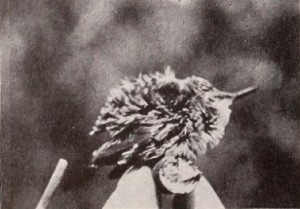
"Shakespeare tells us that Owen Glendower said that he could summon spirits from the vasty deep; Archimedes boasted that, with the right kind of lever and fulcrum, he could move the Earth. But, did either of them ever tackle hummingbirds? E. R. Hoff, in Hummingbirds, not only tackled them but, apparently, he so charmed them that they flew where and when he wanted. As a result, whoever sees his film will know more about the ways of the almost invisible aerial dynamo than he has ever believed that anybody could know, short of being a hummingbird himself. This film is not only a revelation of incredible patience and determination, but it is cinematographically an accomplishment of genuine intelligence. Mr. Hoff has called our attention to the control of composition, sequence and background quality, evidently because he feared that they might be taken for granted. It is precisely because of these factors that Hummingbirds placed in the Ten Best. It is beyond the limits of this rating of Movie Makers to attempt to find an adequate laurel for the superb achievement of the naturalist which Mr. Hoff is. At any rate, the next time we see a flash of color on a summer afternoon, we can say, "What now, little bird? We know what makes you go round." " Movie Makers, Dec. 1940, 600.
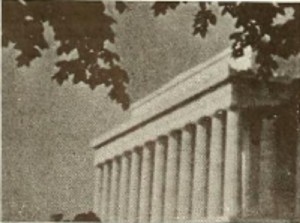
"In Holiday in Dixie, Morton H. Read, a Yankee from Massachusetts, has so well understood the essence of the Old South that he has called back from its storied urns a breath which inspires the whole film so intimately that Southern hats should come off to him. His remarkable sympathy with the remains of the Cavalier era has made it possible for him to present them with conviction and fire. Mr. Read first shows us Washington with its dignity and spaciousness, by carefully chosen shots. He pauses for an inspection of the caverns at Luray, and then he goes on to study the lovely cities of Lexington and Williamsburg. We reach the deep South at Charleston and the Ashley River; it is in this part of the film that its maker establishes his vivid emotional identity with a past epoch. A sequence of Negro rural life is brilliantly handled, and the film comes to an amazing climax with scenes of the trees and flowers in the gardens of ancient estates. With music and with a narrative that sets a new standard in this newer phase of personal movies, the mood of the film is not only sustained, but amplified, so that, after the projection, one wonders which of the three — film, music or words — one will longest remember." Movie Makers, Dec. 1940, 599-600.
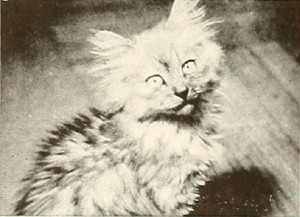
"In Fluffy, the Kitten, a kitten tells her own story about herself — the things that she likes to do, the way she spends her day, the things she eats and the way in which her mistress takes care of her, to make her a happy companion. In designing and filming this continuity, Grayce and Kenneth Space have created the most natural and expressive movie of a pet that we have yet seen. Interpreted with titles, written in the first person, as if the kitten were speaking, this film presents interior lighting and camera work without blemish. The cutting is masterly, and the whole unit is as smooth as Fluffy's silky fur. The intention of the filmer was to create a new, direct and simple type of teaching film that would convey its message efficiently and entertainingly to children. This purpose was completely achieved; you cannot look at Fluffy, the Kitten without learning important things about cats and you cannot look at it without being delighted. Most amazing of all qualities in this film is the uncanny success of the producers in controlling the kitten actor. Fluffy appears to play each scene like a trouper. Unlimited patience and extraordinary skill were involved in making this picture. Movie Makers, Dec. 1940, 577, 599.
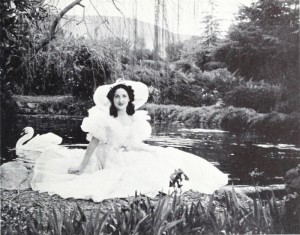
"Whatever that intangible thing called atmosphere may be, Harold E. Remier has created it — out of airy nothings, to judge by what he says — in his astounding photoplay, Diary. Here, in all its hues, in all its beauty, in all its tradition of courtesy and profound courage is the America of the late Nineteenth Century, told through the medium of a woman's devotion. A Southern mansion is the first setting, then the frontier. Fortunes rise and fall as the war flames. Costumes and settings of the 1890's are recreated with fidelity. Wagons collapse in the wilderness; stone houses are built; a silver mine is uncovered. And the cost, for this epic achievement, exclusive of the 8mm. film, was the staggering sum of ten dollars! Diary is particularly noteworthy for naturalness of its lighting. However he managed it, Mr. Remier. with two large flood bulbs, somehow succeeded in making each scene appear to be illuminated by the hand lamps and chandeliers visible within it. The moonlight elopement is glamorously effective; and even candlelight is simulated with success. So, in all, the picture is a distinguished achievement — a portrayal, not only of a past century, but of a part of our American heritage." Movie Makers, Dec. 1940, 577.
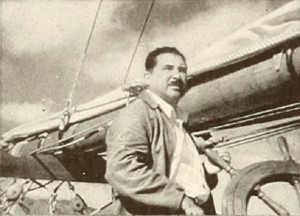
"When the schooner yacht Enchantress put out from San Pedro for a five weeks' marlin fishing cruise in the Gulf of Lower California, fortunately James H. McCarthy was on board with camera, Kodachrome and a filming plan. The result was Before the Wind, as happy a movie yarn of a pleasure cruise as we have ever seen. A spirit of jollity and a general good time pervade this chronicle, which is adequately strung on the thread of a series of entries in the ship's log of the Enchantress. This casual continuity is entirely sufficient, for each episode is beautifully sequenced, and the whole film reflects a consistent happy go lucky holiday spirit. Exquisite shots of the schooner in translucent California Gulf waters, numerous studies of ship life, handsomely lighted interior views in cabins and engine room are all technical accomplishments in this picture. The sequences of marlin fishing and of clam digging on the Mexican shore are gems of good film planning and good cutting. The movie is presented with an intelligently planned musical accompaniment that really fits the film, but it is the natural handling of sequences of people on a carefree sea vacation that makes this picture superb entertainment." Movie Makers, Dec. 1940, 577.
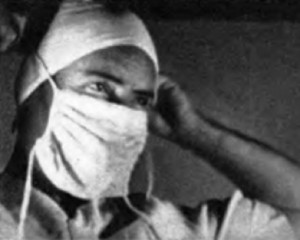
"The Will and the Way is a simple story of '"little people" — but it looms large in its appeal to the human heart. There are, in its tender adventures, the laughter of sympathy and the tears of pathos. From these, as from any great expression of beauty, there comes the genuine and ennobling uplift of the spirit which is so rare in a workaday world. Chester Glassley has been equal to his task. His photography, both indoors and out, is as nearly flawless as skill and patience will permit. His camera treatment is marked by a wise concentration on close views, a dramatic selection of angles and a fine sense of matching and contrasting color values. Good cutting, paired with a brilliantly executed montage sequence, rounds out the technical achievements. But his greatest production triumph lies in the casting and direction of the two lead players, who bring to the amateur screen its most genuine and sensitive acting to date. A young wife is to have a baby. Because of a harsh experience with a rum sodden doctor, she turns blindly toward the thought of going only to a specialist, a great obstetrician, famed both for his fine care and his $1000 fees. Her young husband's reaction as he learns of this feeling is the simple theme of the entire story: "I don't know where we'll get the money, but if that's the doctor you want, then that's the doctor you're going to get!" From then on. life for the young couple is a race against time, punctuated for the husband by a frantic search for cash, which leads him through the indignities of a pie eating contest, the insults of '"amateur night" and the bruises and battering of a vastly unequal prize fight. But the baby wins in the end. The harried father collects only three hundred dollars of the specialist's fee, a sum he begs the great doctor to accept as a down payment. This the physician does, only to return the entire amount later — with a receipted bill — as his tribute to the boy's courage. The Will and the Way is a short, unassuming film, made technically with the simplest tools provided by the craft. But, in its unfailing imagination, its moving tenderness and. above all. in its deep understanding of the human heart, this film is a proud peer among its colleagues of the Hiram Percy Maxim Award." Movie Makers, Dec. 1940, 576-577.
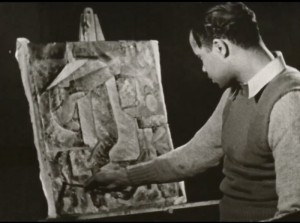
"Educational film surveying the instruction of the fine and performing arts at leading African American institutions, including Calhoun, Dillard, Fisk, Hampton, and Howard. The film argues that exposure to theater, music, dance, and the fine arts produces well-rounded students and enriches their lives." National Film Preservation Foundation.
Total Pages: 299
 Amateur Cinema