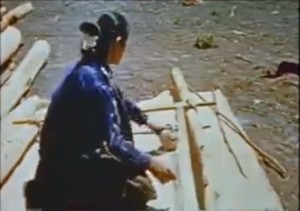
"E. Tad Nichols, III, born in the West, has been in the saddle almost since he first toddled. Much of his time has been spent among the Western Indians, and he has an intimate knowledge of their ways. So skillfully has he planned and edited each sequence of Navajo Rug Weaving that the audience has the rare satisfaction which comes from seeing just the right amount of each step of this ancient art that has held one method and course for many centuries. The direction and filming are of such excellence that the viewer almost seems to be present for the carding, spinning, dyeing and actual weaving of the rugs. Here is the human record film at its best." Movie Makers, Dec. 1945, 495.
"Unsung Heroes, produced by The Calvin Company, has just about everything that a good industrial film ought to have. It is entirely in color, and the exposures are excellent, particularly in many shots of technical operations in the plant, which are ordinarily considered difficult. The subject embraces the manufacture, testing and rigid inspection of the component parts of a modern electric refrigerator. It is presented in a smooth, comprehensive way, with well delivered commentary and good incidental music,specially arranged to point up the action. The opening sequence, which shows a lip synchronized effect on a traveling outdoor shot, is unusually well done. However, the relation between this sequence and the rest of the film should have been more closely established." Movie Makers, Dec. 1941, 568.
"Unsung Heroes tells of the extreme care used in manufacturing electric refrigerators and of the exacting tests for durability, accuracy and silence of operation. Although the film is based on the familiar "trip through the factory" pattern, it has great interest for consumer audiences." Movie Makers, Jan. 1942, 8.
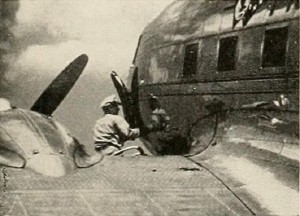
"Although Song of a City was probably as carefully planned as any film could be, it still got out of hand and grew on its producer. Try filming a great metropolis yourself sometime, and you will begin to understand what John Flory faced in this splendid study of the city of Cleveland. For this is no simple record, content with the physical surface of streets and skyscrapers, ships and steel. Song of a City is a heroic canvas, seeking to present in dynamic imagery the inner significance and meaning of its vast subject, relating the ships and steel, the workers and the wealthy, to the pulsating life of their community. Mr. Flory's sponsor in this new form of industrial publicity was the Cleveland Trust Company, and it is to this institution that the film turns recurrently in presenting its message of finance in the modern world." Movie Makers, Dec. 1941, 568.
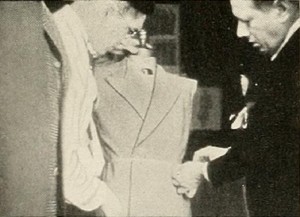
"Kendall T. Greenwood has told an interesting and uniformly attractive story of one of America's great integrated industries in Let Your Body Breathe. From the original Goodall Company plant in Sanford, Maine, to the elaborate retailing methods of the present day, the film presents a clear cut picture of Palm Beach cloth and its part in the modern pattern of warm weather living. Designed primarily for use within the trade, Let Your Body Breathe shows the retailer all the important points in the manufacture of this fabric, its tailoring by the parent company into suits and sportswear and the continued control over the product, even to such details as proper laundering or cleaning. Mr. Greenwood's camera work is crisp, his editing incisive, while the narrative contributes judiciously to an able industrial record." Movie Makers, Dec. 1941, 568.
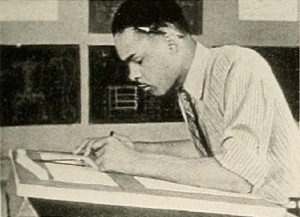
"Education for Life, an attractively filmed record of the daily work of the Hampton Institute, famous school for Negro youth, was produced by the Harmon Foundation and filmed by Mr. and Mrs. Ray Garner. The well planned sequences of this picture tell, in detail, of the high lights of the school's activities. The Garners were faced with the problem of recording, in color, a wide variety of skin tones and with the problem of lighting large areas. These problems were solved with more than the usual skill, and they have turned out an almost perfect filming job. They exercised an excellent choice of camera angles, and the whole film is a thoroughly polished production. The amount of detail in a picture of this type is considerable, but the subject matter is well balanced. The introductory material, a series of ''zoom" shots of maps, is especially well done." Movie Makers, Dec. 1941, 568.
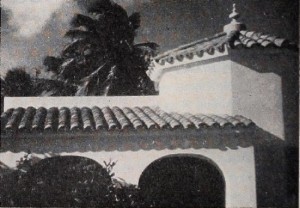
"There are clearly in Where the Americas Meet, by Esther and Morton H. Read, the same qualities which marked Holiday in Dixie, the award winning production made by Mr. Read last year. Here again is that intangible ability to evoke the feeling of past events, simply from pictures of their present landmarks. One can almost catch the glint of Spanish armor on ancient battlements, as Mr. Read's splendid cinematography and suave narrative study the fortresses of San Juan. Here again is that definite sense of research into the subject matter, before ever a foot of film has been exposed. Mr. Read piles detail upon detail with almost hypnotic elaboration, much in the manner of today's novelists in recreating the life of the Old South. If anything, the present film — like its predecessor — tells a tale too long, although speaking always with impeccable imagery and a wise use of words and music." Movie Makers, Dec. 1941, 567-568
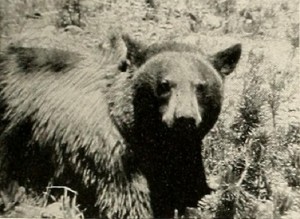
"In making Western Wild Life, Frank E. Gunnell has infused considerable imagination into a film of an essentially factual nature. Broken down into its component parts, this movie is purely didactic — each bird and animal sequence is receded by an identifying title. As a teacher, Mr. Gunnell knows that this type of film is ideally suited for educational use. Technically, it would be difficult to improve Western Wild Life; accurate exposure and focus added to good composition make an excellent film. The closeups of wild birds are some of the finest yet filmed. However, Mr. Gunnell has achieved more than technical excellence, for the film is attractive to naturalist and layman alike. An outstanding characteristic of the film is its highly selective editing. No sequence is too short or too long. Amazing shots of the very rare trumpeter swans provide a fitting climax for a nature film of first rank." Movie Makers, Dec. 1941, 567.
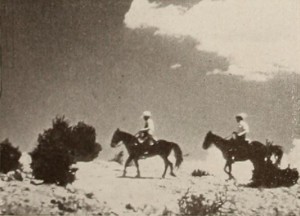
"Riders of the Pecos is a movie of a "dude ranch" with all the close shots of interesting and significant details that usually are missing in "dude ranch" films. During a summer vacation, few take the time and effort to make as human and colorful a document as has E. M. Barnard. He has caught the dust of the corral, the appetites of the open and even the barn dance. It is a horsy film, of course, with sequences of roping, "bronco busting" and plain and fancy riding. But best of all are the charming shots of a horseback trip and the campfire at the trail's end. There is a neatly turned "running gag" of a young equestrienne who is first seen repeatedly as more concerned with her brightly polished boots than with riding. But, after a few suppers off the mantel, she adds more dust and scars to her boots than got there naturally and becomes a real cowgirl." Movie Makers, Dec. 1941, 567.
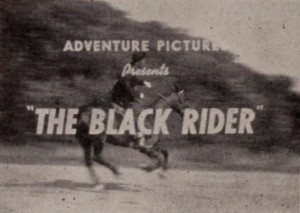
"For Louis McMahon, making movies must seem to be as natural as breathing — only far more fun. It stands out in his work, from the first dynamic opening of The Black Rider to the last dramatic gun fight, in which, inevitably, the villain is vanquished and the hero left triumphant. For this film goes back to first principles of the motion picture, both in its "horse opera" subject matter and in its unfailing sense of movement and compelling excitement. True to the old traditions, this young producer has turned seemingly impossible obstacles with cinematic trickery and imagination. For the present, his technical skill has not always been equal to his creative ambition, but the genuine urge is there in abundance." Movie Makers, Dec. 1941, 566-567.
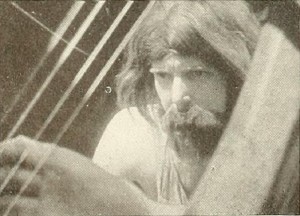
"C. Manley DeBevoise continues, in That All the Earth May Know, the development of his special field of the exposition of Bible stories in film. Here is the tale of the tortured Saul, the worried Samuel and the God sent David — musician and warrior. Since the film is made by a Sunday School class, it is prefaced by a statement from the class's teacher that a "success story" of long ago will be presented. The actor who portrays Samuel achieves real dignity and importance: others are sufficiently convincing with very hard assignments. Costumes and sets are contrived excellently, and a Long Island, N. Y., locale does not seem to be out of place in the film. Mr. DeBevoise solved one problem by purely cinematic methods. He showed the combat of the Jews and the Philistines, but the Sunday School class did not run to an army. With six or seven couples in actual hand to hand fighting, these become an apparent host by multiple exposure. Mr. DeBevoise improves each year in direction, cinematography and in the greater sincerity of his actors' work." Movie Makers, Dec. 1941, 566.
Total Pages: 299
 Amateur Cinema