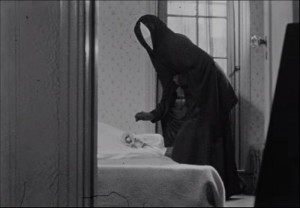
"Meshes of the Afternoon is experimental in nature and exciting in its cinematic development. In it, the producers — Maya Deren and her husband. Alexander Hamid — have been concerned with the inner experiences of an individual. Although one sees on the screen the familiar backgrounds and impedimenta of physical existence, the events which transpire among them, through a summer's afternoon, portray subjective feeling rather than objective incident. Miss Deren's creative use of her camera to suggest these emotions blazes new and stimulating trails in pure cinematography." Movie Makers, Dec. 1945, 497.
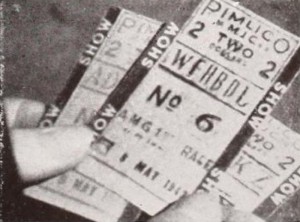
"In Turf Tales, Leonard Bauer, jr., has tackled an acceptedly difficult subject for the personal movie maker — and has done well by it. The subject, as might be guessed, is professional horse racing. The setting of Mr. Bauer's study is the relatively ancient track of Pimlico, outside Baltimore, with the climax of the picture provided by a record of its traditional classic, the Preakness. But the strength of Turf Tales derives more from its highly competent sequences of human interest behind the scenes — the early morning time trials, the stable boys and their chores, the track farrier as he shapes the delicate racing shoes and the strange, unexplained mascots of the high strung thoroughbreds. A commendably restrained narrative, set against a musical background, accompanies the film on a sixteen inch disc recorded by Mr. Bauer." Movie Makers, Dec. 1944, 496-497.
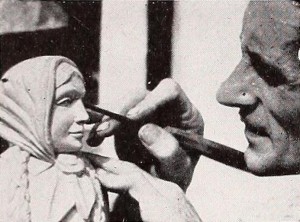
"Nine times a place winner in seven years of Ten Best competition, Frank E. Gunnell has probably done his best work to date in Baie St. Paul. The film is a bright and sunny visit to the little French Canadian parish of that name, nestling in parochial contentment along the St. Lawrence. Central in this existence stands the baroque and inevitable church, while about it one finds the familiar family names of the village butcher and baker, doctor and dressmaker, recurrent along the cobbled highways. Here too is an intent, sharp featured little woodcarver, a housewife coolly competent about her embroidery and an aloof mademoiselle who presides with dazzling beauty over an ancient spinning wheel. Packed with this essential human interest, Baie St. Paul was filmed with the sparkling competence that one has for years expected from a Gunnell production. Its editing fits shrewdly into the pastoral mood of the subject matter, while its titles, both in their wording and execution, are colorful and in good taste. Baie St. Paul should take a high and honored place in the Gunnell catalog of fine films." Movie Makers, Dec. 1944, 477.
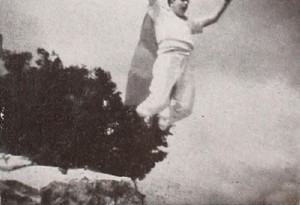
"Donald H. Kelly has cast a comic strip character in Superman Goes West, integrating travel sequences and comedy with great success. While the magnificent cinematographic record of a Western trip is the most engaging factor of the film, the entertainment value of the Superman motif cannot be minimized. The fictional hero is shown to be the consuming interest of a small boy passenger on the trip. The lad proceeds to read Superman comics under varying conditions, despite a changing background of allegedly awe inspiring scenery. One dream sequence with a Superman flavor is a triumph of trick cinematography." Movie Makers, Dec. 1943, 478.
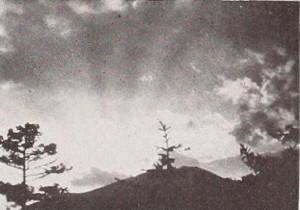
"September Peace, Robert P. Kehoe will tell you, is a film which not only made itself but named itself. It is, patently, a product of this world at war, the unconscious reaction of a sensitive spirit too long abraded by the rough edges of conflict. In it, Mr. Kehoe has found again the lyric loveliness of field and flower, the beneficent sturdiness of great trees, the warmth and beauty of the slanting sunlight. Unusually effective scoring plays its part in creating this moving attestation to the joys of peace." Movie Makers, Dec. 1943, 478.
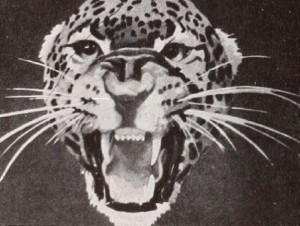
"Competence plus completeness distinguish Ringling Brothers and Barnum & Bailey Circus. Oscar H. Horovitz started his film with sequences of the circus's winter quarters in Florida and followed it as it entrained for Northern performances. Unloading the circus comes next, and, after informal views of the crews at work setting up tents and the performers preparing for work, there is a complete picture of the show in the big top. The quality of the lighting, although limited by the amount of illumination provided by the circus, is still astonishingly good. Even better is the sequencing of the scenes of the performances, for Mr. Horovitz succeeds in altering his camera positions almost as freely as if the circus were staged especially for him." Movie Makers, Dec. 1943, 478.
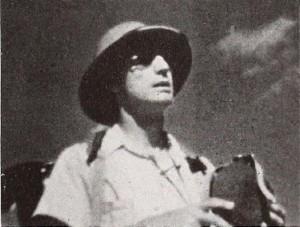
"Rainbow Fantasy, in the words of Charles C. Hammack, is "an attempt to produce — not a conventional travelog — but more a story of adventure, a hiking adventure to what is probably one of the least visited of our national monuments, Rainbow Bridge, in southeastern Utah." In achieving this goal, Mr. Hammack has been largely and creditably successful. For him and his young wife, Rainbow Bridge takes on the aura of a lost horizon, a Shangri La protected from the outside world by the blistering desert heat and the brutal desert rocks. He brings this overtone of feeling to his film, both through his imaginative camera treatment of the subject and the intentionally dramatic acting of the two travelers. Mr. Hammack's is a new name in Ten Best competition, but it is one which we believe will be heard again."Movie Makers, Dec. 1943, 478.
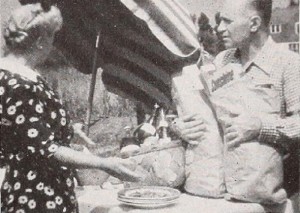
"George Mesaros, who has demonstrated his competence as a maker of good movies in other fields, turns to humor in this film comment on wartime conditions. The point of the story — for it is the foray and not the tale that is pointless — turns on providing for a picnic in the yard of the home. While the master of the house is shopping with ration points, the skeptical family gets, from the Victory garden, cooks and eats the alfresco feast, at the end of which Father — who really did find something in the shops — returns with loaded arms. First class Kodachrome pictures and a well knit continuity are used by Mr. Mesaros to bring to American audiences something of the spirit of easy and natural outdoor fun with food that for so long characterized the Europe of happy memory. Some of the scenes of cooking are so realistic that one almost reaches for what is shown on the screen." Movie Makers, Dec. 1943, 478.
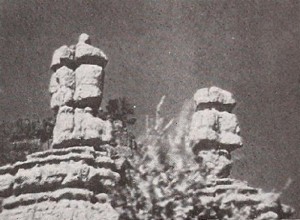
"Parks of Paradise was originally intended as a 2000 foot pictorial travelog that would cover every national park and monument in the United States, but travel conditions enforced a limitation, so Norris Smitley has confined the scope to include only the national parks of the Southwest, permitting a more detailed presentation of the material used. Many unusual scenes of popular subjects are shown in the picture, which is further distinguished by beautiful color and meticulous cinematography." Movie Makers, Dec. 1943, 478.
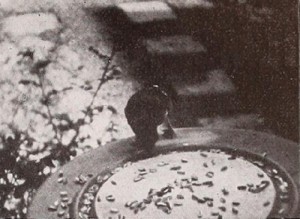
"Our Boisterous Bluejays is a remarkable study of bird life, filled with intimate shots that are among the best ornithologic cinematography on record. Mrs. Warner Seely, who produced this film, has become an expert at picturing birds in their natural habitat, and she shows the bluejay at every stage of development." Movie Makers, Dec. 1943, 478.
Total Pages: 299
 Amateur Cinema