"Filmmaking brothers Sidney and Harold Preston present a beautifully shot record of time and place, taking us to the great Lancashire seaside resort in the interwar years. Whether enjoying the bird's eye view from the top of the tower, trying out the Pleasure Beach rides, or just befriending the donkeys on the beach, the three generations of the Preston family are clearly having a grand day out." (BFI Player)
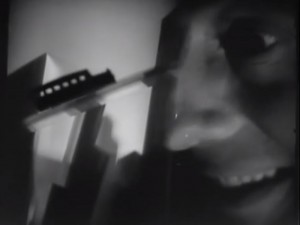
"Robert Florey and Slavko Vorkapich created one of the most creative (particularly in light of its reputed $97 budget) and bleakest of the early avant-garde films. Photographed by Gregg Toland, who would become best known for his work on "Citizen Kane," the film is the time-worn tale of a movie extra (Jules Raucort) marginalized by one casting director after another until he's seen only as a number symbolically appearing on his forehead. The ultra simplistic sets and props, made of toys and cardboard buildings projected like shadows, help to create intricate German Expressionistic cityscapes reminiscent at times of "Metropolis." " National Film Registry.
"An honorable mention in the 35 millimeter division went to Thomas Fisher, of 410 Semple Street, Pittsburgh, Pa., for his grim and Barrymorish study of Poe's 'The Tell-Tale Heart.' Mr. Fisher played two parts, displayed no little skill in make-up and worked out an interesting, if gory, film." Photoplay, Jun. 1928, 137.
"Clyde Hammond, of 65 Murdock Street, Youngstown, Ohio, won an honorable mention in the 16 millimeter division for his study of country life, 'The Dragon Fly.'Mr. Hammond worked out a strong atmospheric study of a selfish country boy, home from college, and his hard-working farmer father."Photoplay, Jun. 1928, 137
"The special award, also of $500, went to Kennin Hamilton, of 28 Maitland Street, Toronto, Ontario, Canada, for his visualization of Hood's 'The Dream of Eugene Aram' in 16 millimeters. Mr. Hamilton played the principal role of Eugene Aram, disclosing a graceful pantomimic skill. The photography was handled by K. A. Mackenzie. A Cine Kodak, using Kodak Safety Film, was used. Mr. Hamilton had no special lenses or equipment and yet he achieved some singularly beautiful shots. Nature supplied his lighting, even for his interiors. A stepplader served as a tripod." Photoplay, Jun. 1928, 136.
"This proved to be an unusual serio-comedy, telling of a restless young husband and how he was cured. It was very well acted by Alfred Fontana as the husband, Margaret Ervin as the vamp, Anne Howe, and Beatrice Traendly as the wife. The directon of Russell T. Ervin Jr. was remarkably good, revealing an unusual facility for telling a story concisely and quickly. Then too, he understood how to cover any histrionic imperfections of his cast. 'And How!' is a suprisingly neat amateur film" Photoplay, June. 1928, 66
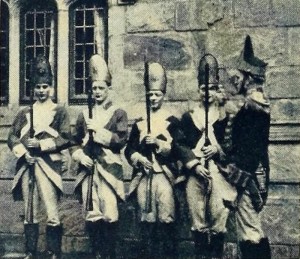
"Tom Jones, about 5000 ft., 16 mm, produced by the Purity Players of Yale University under the direction of S. Winston Childs, is the first amateur super-feature. The story is based on Fielding's Tom Jones and adheres with remarkable faithfulness to this famous novel, while many of the sets and costumes exhibit a care and an historical accuracy that has not since been equaled in amateur work. To those who have interest in 18th century literature, the picture will be particularly valuable." Movie Makers, Sept. 1930, 569.
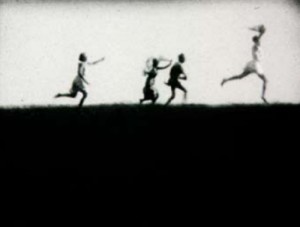
"Combines ancestral memory with reincarnation when the main character falls asleep, sees nymphs dancing in the same landscape hundreds of years in the past, and confronts his previous incarnation herding sheep and wearing fur." UC Berkeley Library.
"The Devon Amateur Film Production Society seems to be still forging ahead at a rapid rate. Its present production is a three reeler entitled “Pott’s Pride,” and it is anticipated that it will be cut and edited by the middle of April. All the “props,” scenery and reflectors have been made by members and though the developing and printing have been put out, the photographic section of the society has undertaken the tinting and toning of the print where necessary. It is hoped that every kinema in Devon will show the picture, the proceeds of which will be devoted to local charities. The film is being directed by Tom H. Hattershall and photographed by A. B. Sydenham, B.Sc." (Anon 1928, 62).
Later reworked as Meditation in the Hills (Richard H. Jobson, 1952), winner of Amateur Cine World 3-Star Award in 1953 Ten Best Competition, UK.
Total Pages: 299
 Amateur Cinema