"When The Red Gods Call, 1600 ft., 16mm., is noteworthy as an exceptional record of wild animal life in the great north woods and was made by W. H. Dodge. With infinite patience and camera skill, Mr. Dodge succeeded in recording the natural movements of moose, bear and other wild animal subjects and his photography under difficult conditions, as exemplified in this film, is exceptional. The results gained in many of the telephoto shots and in shots taken with fast lenses and superspeed film were made possible by a specialized cine outfit, developed by the maker of the film himself. Beautiful nature shots, as well as exceptional night and flare work, add to the original qualities of this film." Movie Makers, Dec. 1931, 685-686.
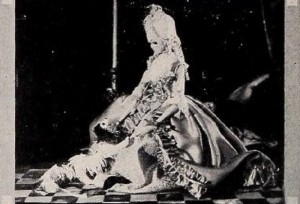
"In Traum Im Karneval, 1000 ft., 35mm., a distinctly new technique in cine puppet drama has been beautifully and conclusively demonstrated. Working with puppets free of distracting threads and controlled entirely from below the line of camera sight, Dr. Goldschmidt has brought to his film the fluidity and cinematic smoothness essential to a genuine photoplay. Gone are the proscenium arch and the unavoidably static feeling of photographed "theatre." Here the camera has moved freely from near shot to closeup or semicloseup as the action demands. Inserted scenes from real life, used with symbolism significant to the mood of the story, have served only to heighten the cinematic illusion, while the unusually graceful miming of the puppets amazes one with a feeling of uncanny and fantastic life. Traum Im Karneval is delicately conceived, sensitively directed and superbly photographed. Of brilliance equal to Dr. Goldschmidt's technique was the unfailing mastery of his collaborator, Richard Teschner, eminent European puppeteer." Movie Makers, Dec. 1931, 685.
"By Sea To Florida, 400 ft., 16mm., made by Porter Varney of Bradenton, Fla., is a film record of a sea trip which derives its importance from the fact that the photography and choice of viewpoint are consistently exceptional. Parts of the ship, such as the rigging and cordage, the portholes, the lifeboat davits, etc., were used with rare artistry as aids to composition and effect. An expert use of filters produced exceptionally pleasing and truthful black and white rendition of the sea and the movement and sway of the ship. Continuity was effectually obtained by a shifting of the camera viewpoint, emphasizing the harbor, the high seas and the arrival in Florida. A startling climax to the film was given by a series of shots of an approaching hurricane captured by Mr. Varney 's intrepid camera." Movie Makers, Dec. 1931, 685.
"Sport Reel, 300 ft., 16mm., represents a remarkable degree of understanding care given to this type of picture by Charles F. Chapman, M. D. Although this picture is something more of a review than a newsreel, each of the topics presented has a local news interest. Dr. Chapman has preserved the direct and stimulating style of title wordings of the professional newsreels but, in the sequencing of scenes, he has deserted their technique for an original one. This is distinguished by a clever use of closeups to symbolize ideas and for dramatic emphasis. For example, in picturing the local baseball team, he introduces the sequence with a closeup of a row of bats lying on the ground and, when presenting the players, he cuts from a medium shot of them in action to a posed closeup preceded by a title. Further, Dr. Chapman did not forget that good composition and attractive lighting are just as welcome in newsreels as in other types of pictures." Movie Makers, Dec. 1931, 684-685.
"Frozen Flame, 400 ft., 16mm., photographed by Edward H. Marsh and directed by Thomas J. Perry, is a dramatic industrial film featuring the Electrolux gas refrigerator. The picture details the experiences of a man and wife in buying and using the refrigerator and illustrates its sales points. The photography is remarkably good throughout and, although the treatment is simple and direct, it is extremely clear. Perhaps this picture's most outstanding quality is its continuity excellence. A well prepared scenario was so expertly followed that there are scarcely any of the minor flaws usually found in amateur dramatic pictures." Movie Makers, Dec. 1931, 658, 684.
"Hearts Of The Golden West, 1200 ft., 16mm., filmed and directed by Theodore Huff and enacted entirely by youngsters under thirteen, is a delightful and whimsical burlesque of the Griffith melodrama of the days when titles were long and plots of villainy and intrigue laid in the great open places swept grandly to a moral conclusion in which "true hearts were united." In those days, producers did not hesitate to use a cyclorama or to place painted canvas scenery on an outdoor location. Mr. Huff revives all of the old technique, even to the dance hall set, with its inevitable balcony, and the fight to the finish at the edge of the cliff. Under his direction, the children act their parts with complete seriousness and, in some cases, with mimetic ability that would have given their prototypes pause." Movie Makers, Dec. 1931, 658.
"Stephen F. Voorhees's 400 ft. travel film of Italian architectural scenes deserves placement in this list because it combines three factors but rarely brought together in pictures of this type. First, the photography is extraordinarily good, not only with reference to the routine requirements of exposure and focus but because it is artistic throughout and the composition never descends to the casual or the "snap shot" level. Second, Mr. Voorhees's film has a natural and easy continuity, jogging amiably through Venice and its environs, much as a traveler might do himself, pausing for a bit of incidental human interest and catching a scene that the filmer felt was unusual but presenting it without any preliminary flourishes, as one friend who might have said to another in the course of a stroll, "Don't miss that, by the way," pointing to something seen on the way. Last of the three things, so unusual to find combined, is a professional study, made by the filmer, himself a great architect, preserving those details which he wished to bring from northern Italy for later possible use. The great Colleoni statue is studied from many angles. Details of tiles and other wall ornamentations are offered and buildings are presented from one viewpoint after another. Yet all of this is done unpedantically and the nonprofessional audience is not aware that this subtle architectural record is more than a delightful travel film." Movie Makers, Dec. 1931, 658.
"The Wonder Trail, 1000 ft., 35mm., filmed by Ralph C. Wildes, has also met with the approval of professional critics, for it has been released as a professional short subject and has received general praise. One reviewer wrote, "The Wonder Trail is an unforgettable picture; the restful, sheer beauty of it is an experience in entertainment." This is high praise, indeed, for an amateur picture since it must be remembered that the reviewer was comparing it with the hundreds — even thousands — of professional short subjects released each year. It is a scenic built from sequences of the Grand Canyon, Yosemite and the Redwood forests of California. Its photography is superlatively good and rare artistic judgment was exercised in the selection of camera viewpoints to effect beautiful compositions and to emphasize the dramatic value of mountains, falls and trees. The quality of the film's continuity lies in the leisurely sequences which display skill and care in both planning and editing." Movie Makers, Dec. 1931, 658
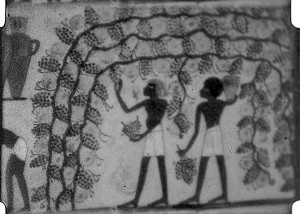
"The Tombs Of The Nobles, 400 ft., 16mm., is distinguished both in its subject matter and technical triumph over seemingly insuperable photographic odds. In it Mr. Hansen has achieved a clear and valuable record of Egyptian art and history as he found them presented on the interior walls of countless Egyptian tombs. Only by a careful placing and manipulation of sheets and mirrors in the cramped space of each tomb was Mr. Hansen able to cast sufficient light from the doorways onto the hundreds of paintings which he photographed. The film's continuity has been planned and edited in a simple, documentary style, adapted for use as an informal lecture subject. Its technical accomplishment seems unparalleled in the annals of amateur filming and has been well employed in recording subject matter entirely different from the general amateur picture." Movie Makers, Dec. 1931, 658.
"The Toilers, a 150 ft. Kodacolor reel made by Arthur G. Greaves, demonstrates the continuity possibilities of Kodacolor, a much neglected aspect of amateur color movies. Men at work — in the harbors, along the seacoast and inland, caring for flocks and harvesting grain — is the motif of the picture, relieved by a few glimpses of men and children at play. The picture is distinguished by beautiful photography of consistent quality and by a smooth succession of moving compositions in color. These qualities, combined with a clear continuity, give the film much more unity than is usual with Kodacolor reels. This is one of the all too few Kodacolor films that may be viewed as a subject possessing an artistic purpose as a whole, rather than as a series of separate scenes and sequences. Its chief color triumph is, perhaps, in the scenes of the harvesting against the background of fields of golden grain." Movie Makers, Dec. 1931, 658.
Total Pages: 299
 Amateur Cinema