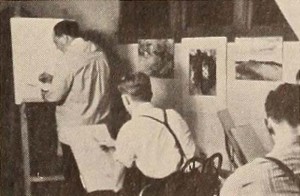
"Builders of Tomorrow, produced by the Cinema Laboratory of Western Reserve University and filmed by Dr. James E. Bliss, takes one into the Cleveland School of Architecture at Western Reserve and shows the embryonic architects at work. The students are pictured studying the principles of design, drafting and in art classes. Architectural models are expertly filmed and with lighting and treatment that, in several cases, make them indistinguishable from actual structures and streets. The entire picture is interior color and the lighting is ably handled throughout." Movie Makers, Dec. 1938, 621.
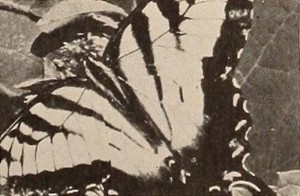
"Technically superb macroscopic work marks the great part of the footage of Swamp Song, a color story of the insects found in the marshes and woods of the countryside, filmed by R. H. Unseld. Perfect focus and precise exposure distinguish the studies of insects, and it is not unlikely that they are the best of their type that have yet been filmed with an amateur camera. It is unfortunate that the story motif of this picture — a father and son wandering through the woods in search of insect types — is not better integrated with the extraordinary macroscopic footage. Nor is the technique of the titling on a par with the rest of the film. But the macroscopic insect scenes are truly astonishing, and such highlights as the invasion of a termite colony by a roving band of ants and a series of ultra closeups of butterflies are without parallel." Movie Makers, Dec. 1938, 621.
"Working still in the same lyric mood which inspired In The Beginning and Consider The Lilies (place winners of earlier years), Fred C. Ells has turned this year to the Twenty Third Psalm for the theme of Still Waters. In it, to use his own words, he has tried "to bring to mind some of the beauties of the natural world, and to make the spectator conscious in some small way of the mysterious, wonderfully planned creation in which we live. The picture is pure lyric from start to finish, with no more continuity than a love song." Mr. Ells has, on occasion, been thrillingly successful in fulfilling this high charge, bringing to the screen some of the most stirring beauty it would seem possible to recreate. The cumulative effect of the relatively short study, however, is weakened by imperfect technique in the preparation of the Biblical title wordings." Movie Makers, Dec. 1938, 620.
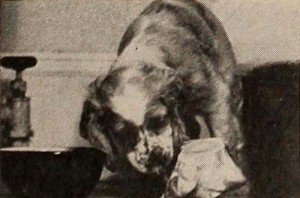
"Shadow's Bones is all about Frank E. Gunnell's cocker spaniel, Shadow, and his annoying habit, common to most dogs, of leaving bones in all manner of places, where bones should not be, such as bath tubs, magazine racks, beds and other localities which are not really canine cupboards. With brilliantly accomplished black and white 16mm. cinematography, Mr. and Mrs. Gunnell, as cameraman and "support" for the chief actor, Shadow, have done what is still too rare in home movies — they have found the humor of home life, and of themselves as a part of it. The plan of this tale is simple, direct and is provided with a genial finish. The direction and acting, especially in persuading the recently acquired household pet to go through his part of the performance with naturalness and zest, are excellent. This sets a new mark in interest that can be given to family records, and the interior lighting is beyond criticism." Movie Makers, Dec. 1938, 620.
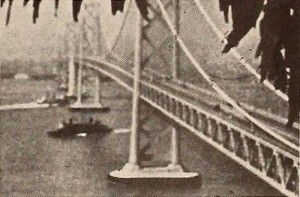
"To present, on 8mm. Kodachrome, where the problem of definition in distant shots is made more difficult by the greater screen enlargement in projection, a serious and satisfying architectural study of a structure that extends not a few hundred feet into the air, but thousands of feet horizontally, is a task that calls for skill in movie making. Raymond O'Connell, in San Francisco — Oakland Bay Bridge, has exhibited that skill and has to his credit, in this film, a definite accomplishment. The study is rendered comprehensible to the audience, at the very outset, by the use of a model of the bridge, which is introduced in the course of the picture, with excellent effect. In several instances, one passes from a shot of the model to another of the actual structure from the same angle, and so easily that it is possible to forget the cinematic labor put forth in finding a vantage point for the camera to show exactly what was needed. Of especial merit are shots of the changing pattern of the cables, made from a moving motor car, which provide a fine essay in abstract design." Movie Makers, Dec. 1938, 620.
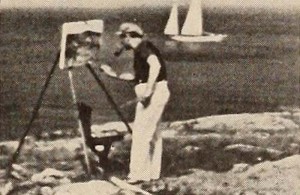
"New England Holiday is the kind of travel film any movie maker should be proud to produce. Replete with human interest and a warm feeling of good fun, this two reel record is distinguished by a wealth of splendid compositions and natural camera treatment. Albert F. Watts has lavished on such typically New England subjects as Gloucester harbor, the fishing fleet or a clam bake the sensitive feeling of an artist for line and mass and the alert understanding of cinematics of a genuine movie maker. Smoothly integrated sequences have been edited with unerring suavity and liveliness, comprising a whole which is both vital and lovely to look at. The production is fundamentally weakened only by a selection of title wordings considerably less spirited and effective than the films which they accompany." Movie Makers, Dec. 1938, 620.
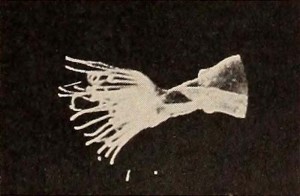
"The eagerness of a movie maker to use a new cine camera is the clever introduction and leitmotivof Movie Bugs, an exceedingly well photographed picture by Dr. Frederick W. Brock. The picture tells how the movie maker protagonist gets in touch with a science teacher and how the two of them construct a support for the camera for use with it in filming through a microscope. The succeeding shots of hydrae and paramecia and other microscopic organisms are beautifully filmed, and the picture infers the obvious conclusion that any university zoology department should be equipped to make such studies. Clean cut interior lighting and a well knit story distinguish this fine filming job." Movie Makers, Dec. 1938, 620.
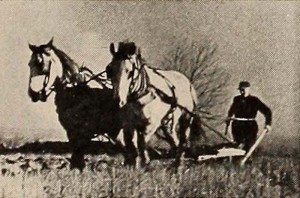
"Charles A. Ferrie, jr., an urban movie maker, has gone back to the land for the beauty and charm of Mother Earth. Here, in carefully filtered and unfailingly well composed shots, he has caught the moist freshness of newly turned soil, the delicate loveliness of waving grain, the quiet dignity of men going about the homely tasks of the farm. His method of subject matter treatment has been to study these things from the outside, as a sensitive spectator, rather than to involve them (and the spectator) in a story told against such backgrounds. Mr. Ferrie's photography is consistently good and often striking, while his sequencing adds much of interest and inspiration to an essentially pastoral subject." Movie Makers, Dec. 1938, 620.
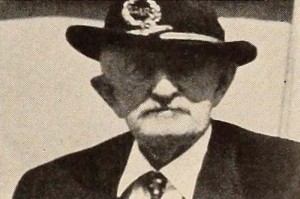
"Charles O. Barr, jr., in Long Remember, has done an extremely difficult thing admirably. This is a Kodachrome record of the recent last meeting of Union and Confederate veterans of the American Civil War on the battlefield of Gettysburg, in Pennsylvania. Because the persons of chief interest, the veterans themselves, were unable to contribute motion to any real extent, Mr. Barr's problem was to avoid using movie footage for still photographs, and yet not to offer an incomplete record of the interesting and historically important gathering. Aided by title wordings that were both dignified and exciting, the maker of this film managed to give to it a sweep of action that, without them, would have bogged down badly. There was motion, of course, in the parades, but these, of themselves, would have been trite fare, had they not been related to the battlefield by shots of watching veterans and by a whole series of admirable angled shots of the statues and markers on Gettysburg field. It is noteworthy that what might have been the dull portions of the record — the construction, housing and victualing arrangements — were given very intelligent, brief handling." Movie Makers, Dec. 1938, 619-620.
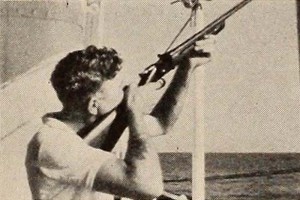
"Frances Christeson, experienced cinematographer and artist of cine devices, gives us in Log of the Timber Rush the movie diary of a holiday voyage. That the freighter, in which she had booked passage, stripped its gears and was stalled somewhere in the Pacific Ocean, well off the coast of Mexico, upset her film plan but did not stop her. It became part of an amazing personal and movie making experience. But before the misfortune at sea and the long delay of weeks, waiting for help and repairs. Miss Christeson had filmed the loading of the Timber Rush with affectionate attention to detail and the use of fascinating cine symbols. She also had captured sequences of gorgeous quality, framed through ship's gear and depicting the beautiful, lazy clouds of the tropics and the life aboard the vessel. When the gears were stripped and the long period of inaction came, the camerawoman had, as she puts it, "the job of filming nothing happening." She does that as well as possible, and the result is a delightful sea picture marred only by the doldrums of fate." Movie Makers, Dec. 1938, 619.
Total Pages: 299
 Amateur Cinema