"A competent example of a well-planned film of a holiday for two." BFI National Archive.
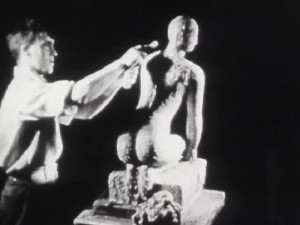
"Filmed by Norman McLaren and Willie J. MacLean, [Seven Till Five] shows a day in the life of the Glasgow School of Art." National Library of Scotland Moving Image Archive.
"The film opens with pictures of Belgrade, the capital city of the country, and shows many aspects of the city. From Belgrade we are shown the passage of the mighty Danube eastward to the sea, and pause for a time at Nish, the birthplace of the Emperor Constantine. We see the happy home life of Her Majesty Queen Marie, and the independent existence of the sturdy peasantry, benevolently watched over by the Government, which preserves their interests. From the happy hours of country life we turn once more to a city, the cathedral city of Zagreb, the Rokavitza Monastery, the aerodrome at Zemun, and then again to midsummer days by the sea in the mountain lakes of Plitvitxa. [p.35] The motive around which the whole is composed is the Y.M.C.A, a strong and important organization in Jugo-Slavia, enriching the lives of its countryfolk and serving those homes are in the town" (IAC Bulletin, Apr. 1934, 34-35).
"‘I practiced the additive two-colour process introduced some two years ago, and applied to the small 9.5mm film. In front of the camera lens a revolving plate containing a red and green screen is mounted in such a way that one picture is taken through the red and the following through the green screen, and so on. By cameras like the “Nizo” an interchangeable plate is mounted in front of the stop permitting one to take with the same camera both ordinary and coloured pictures. The speed for taking and projecting the film should not be less than twenty-four pictures to the second, in order to assure a correct melting of the colours of the screen. The film must be panchromatic and the colour of the screens in accordance with the film used. In the beginning when there were no panchromatic films on the market I practised the copying method. However, since the introduction of the first class reversible panchromatic films I practice the reversing method.
As regards exposure I am of the opinion that good results may be obtained in all sorts of weather. I never use a stop less than f.2. My lens is a Meyer Plasmat 1.5. The Adriatic sea films I sent you were taken with stops 8 and 11. Of course great care must be taken in developing the film to obtain satisfactory results.
Projecting may be done by two methods: First, the projector may be fitted with a revolving plate containing screens as mentioned above, but of somewhat lighter colours. The method is simple, but has two drawbacks: (a) that the projector must be adjusted with a suitable screen, and (b) that the green screen cannot be regulated. Second, the film is coloured with suitable red and green colours. When making a film in which the blue colour prevails I use a blue-green colour (see my Adriatic sea film), others, as my film Botanic Garden with a yellow-green colour. It is true that this second method requires great patience. However, the results are far more satisfactory and a film coloured by this second method can be projected on any 9.5mm. projector, together with an ordinary film at the same time'" (IAC Bulletin, Jan. 1934, 14-15).
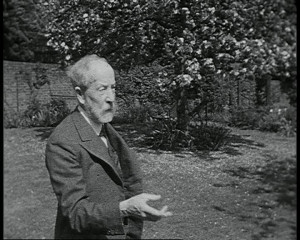
"Film footage of an elderly man, who due to the title placed on the film is likely to be Eunice Alliott’s father, Benjamin Hawes Allcroft Wilson ('Dad'), and shots of a woman named Violet, who is most likely Violet Rachel Caroline Hawes Wilson ('Violet'), Eunice Alliott’s younger sister." (EAFA Database)
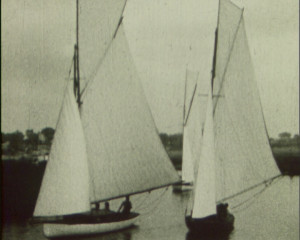
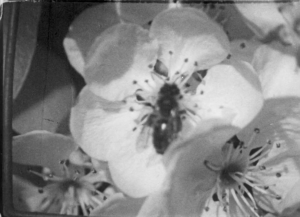
Documentary about bees, with impressive and detailed images. One of the best examples of the educational documentaries of the movement, which caught the attention of the Catalan Cinema Committee.
Total Pages: 299
 Amateur Cinema