"Apex Motion Pictures are busy on a story which entirely ignores the ordinary narrative channels: this production, they tell me, is right off the beaten track. In fact, I am told that this is a sincere attempt to produce the first real amateur story film, i.e. one in which the whole of the work is carried out cooperatively. This effort is to be issued as “Poor Jenny is Aweeping”, and Leslie Wood passes me the information that this film deals with a side of life which, though it affects everyone, has never, so far as he is aware, been handled in a book, play, or film. What is more, although A.M.P. claim to be the first with amateur talkies, they have now gone silent. Apex Publicity also states that Kurt Camerona, their cameraman, is playing the Rev. Cecil Teed, and is giving us something new in characterisation" (Head 1932: 21).
"noteworthy for having introduced yet another technical advance invented by Apex cameramen – “the dolly twist”, as it has been christened. The camera is turned over and over, gradually slowing down and remaining stationary, at the same time the dolly goes towards or away from the subject being photographed. Like all worth-while innovations, however, the shot was created to fit the peculiar demands of certain sequences of the film; it has not been dragged willy-nilly into the film simply for the novelty of the stunt. It is particularly valuable in films of the macabre genre" (HMHT 1933: 297).
"this is not just another murder mystery, but a drama of a battle of wits between two men" (HMHT 1933: 448).
"This film Documents the voyage of the Baden-Powells, and 650 Scouts and Guides, as they cruise Europe in the SS Calgaric visiting Scout and Guide groups in Europe, on an ‘Argosy of Peace’.
"short abstract animation featuring visual rhythms created by the tempo and movement of circular, triangular, and square objects. Mori’s Senritsu was a black-and-white animation with synchronized music accompaniment, and Shimizu noted how the film attuned the visual images to the rhythm of the music, describing that “this kind of valuable experiment will inspire commercial talkies, more than Mickey Mouse and Silly Symphony do.” - Noriko Morisue, "Filming the Everyday: History, Theory, and Aesthetics of Amateur Cinema in Interwar and Wartime Japan" (Yale University: PhD Dissertation, 2020): 99.
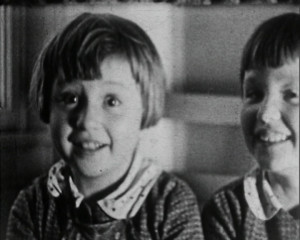
"Documentary. The holidays of two young children, Heidi and Erika, in the area of the Danube. Shots of the landscape, bathing, playing with animals, visits to the abbey at Melk and a castle" (EAFA Database).
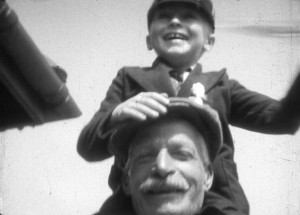
"Made by local amateur filmmaker Charles Scott, the film documents civic and public life in Norwich leading up to World War II and immediately following its conclusion. Beginning in 1933, Scott records acrobats, tightrope walkers and trapeze artists at the Norwich Carnival. The 1933 Armistice Parade features soldiers marching through the streets, halting at the eleventh hour. In 1934, Scott shows the Lord Mayor's Sunday celebrations at the Cathedral, as well as highlights from that year's Carnival. In 1935, Norwich celebrates the silver jubilee of King George V with decorations, parades, a military salute and an air display. January 1936 sees Norwich City Football Club taking on Chelsea in an FA Cup match at the newly built Carrow Road Stadium, with Scott capturing some of the action from his position behind the goal at the River End. Later that year, Scott returns to the Norwich Carnival once again, this time to catch an appearance by Hollywood starlet June Clyde. Norwich celebrates the coronation of King George VI with an extravagant street procession in May 1937. In 1938, with Britain gearing up for war, the Air Raid Precautions team practise fire-fighting and rescues, and test a new extension ladder. Following a break for wartime service, Scott returns to his film in 1946, documenting Battle of Britain Week by visiting the graves of servicemen and recording celebrations and parades in Norwich. Scott's film concludes with a visit to the home of prize-winning model engineer W.F.A. Way, who demonstrates some of his models on his garden track" (EAFA Database).
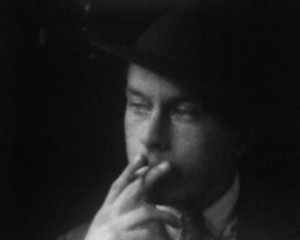
"On board the Cambridge Express, René Gade - 'Fresh from France' - travels to meet his cousin, a Cambridge don. To pass the journey, he gazes from the train window and puffs on his cigarette. Meanwhile, amidst the magnificent surrounds of King's College Cambridge, Gade's cousin - U. Wood, BA - is hard at work in the Old Lodge. Arriving at Cambridge, Gade disembarks from the train with a stumble. Later, with his car broken down on a country lane, Gade argues with the driver. A fiendish-looking passer-by offers to help, but steals the car. Nonplussed, Gade and the driver continue their journey on foot. Elsewhere, Archibald - the 'Archduke of Piffleheim' - is locked in an embrace with a young women, only to be startled by the appearance of Hecuba Brown, 'a pretty taking wench'. Succumbing to Brown's allure, he dumps his girl by pulling her leg (literally). Meanwhile, Gade and his driver spot a pair of young ladies walking down the lane. Following close behind, the pair make their move, grabbing a girl each and heading off in opposite directions" (EAFA Database).
Total Pages: 299
 Amateur Cinema