"The Model Anesthesiologist is a clam bake purely for fun by a group of the medical brotherhood who are having a sort of jam session in their own way with their own tools, and they are willing to let the camera record it all for posterity. They sing, they clown, and they poke holes in the back of some poor victim as they burlesque their workaday world" PSA Journal, Sept. 1966, 34.
"The Mannequin is another interesting bit of cinema which calls to our attention an inebriated fellow who, partly in his cups and partly in his imagination, sees beauty in a department store mannequin and tries to strike up an acquaintance" PSA Journal, Sept. 1966, 34.
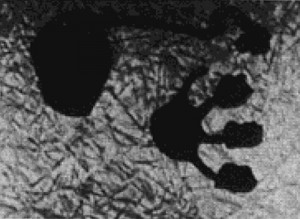
"The Leucocyte Story, besides being a Ten Best winner, was also awarded the MPD Humorous Film Award and the MPD Sound film Award. It is a little gem of animation that is universal in its appeal and expertly done. The symbols depicted by the animated clay globs are a joy to watch. Without sound the film would lose fully half of its appeal" PSA Journal, Sept. 1966, 34.
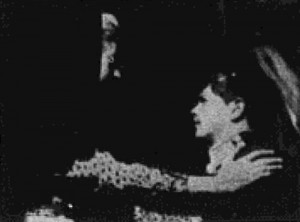
"Jamie which won the PSA-MPD Gold Medal for the best film in the Festival, the MPD Scenario Film Award, and the MPD Golden Scissors Award (for the best film editing) is an 18-minute black-and-white 16mm film with sound on magnetic stripe. It is a Civil War drama of a young Union bugler's act of kindness toward a wounded Confederate and the tragic consequences. Approximately 1500 feet of film were exposed, this being boiled down to the final 630 feet. Klobukowski spent a year on the picture, from its original concept through the writing, scripting, obtaining uniforms, shooting, editing, and finally adding the sound. The latter is all original, the music being especially composed for the film by Paul Bentzen and played by students and staff of Wisconsin State University at Stevens Point. Location areas were wooded sections around Stevens Point, Custer, and West Best, Wisconsin. Participants in the battle scenes were members of the North-South Skirmish Association, and the costumes were either originals or exact replicas furnished by members of that organization" PSA Journal, Sept. 1966, 34.
"Chronos is a deft little documentary that calls our attention to the matter of the time, how we are regulated and governed by the passage of minutes and hours, and how occasionally time traps us in spite of our attempts to elude it. the film also won the MPD documentary Film Award" PSA Journal, Sept. 1966, 34.
"Boomerang is an excellent example of 8mm filming at its best. The plot of this story film concerns a valuable necklace given to a married woman by her secret lover, and how she tries to get her husband to "find" it after she has tried to plant it in a most unusual manner" PSA Journal, Sept. 1966, 34.
Presumably a documentary or travelogue about Hatley Park and Hatley Castle, the Edwardian estate and mansion built in 1906 for James Dunsmuir, the Lieutenant-Governor of British Columbia. In 1966, when this film was made, the estate was home to Royal Roads Military College.
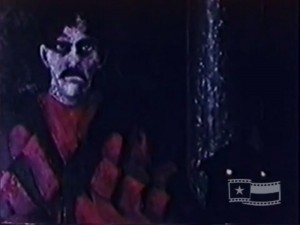
"Manos: The Hands of Fate is a 1966 low-budget horror film written, directed, and produced by El Paso native Harold P. Warren, who also starred in the picture. In the film, a vacationing family gets lost while driving through the Texas desert. Stopping at a mysterious lodge for the night, the family finds themselves captives of a polygamous pagan cult. Shot in Warren’s home town and cast locally, the film premiered at the Capri Theater in downtown El Paso on November 15, 1966, and received largely negative reviews. As Betty Pierce of the El Paso Herald-Post wrote, “A real high point came when the wife, Diane Rystad, was compelled to deliver the line, ‘It’s getting dark,’ at the moment when the El Paso sunshine was glowing its brightest.” Widely recognized as one of the worst films ever made, the movie nevertheless achieved cult status after its appearance on the television comedy series Mystery Science Theater 3000 in 1993" Texas Archive of the Moving Image.
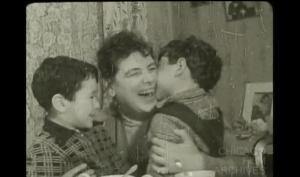
"A group of children learn in school that tomorrow will be “Woman’s Day”, the equivalent of our “Mother’s Day”, then the humorous story unfolds in a delightful and charming manner of how two small boys decide to celebrate this occasion. An amateur film made by a Russian filmmaker and distributed by the Society of Amateur Cinematographers (SAC). All title cards are in Russian." Chicago Film Archives
"A film by CBC Montreal video technician Robert Lachapelle about a little boy who steals a classmate's pen, suffers pains of conscience and finally confesses to his teacher" The Ottawa Journal.
Total Pages: 299
 Amateur Cinema