"The newsreel begins with the departure of the ocean liner -'Britannic'- on its maiden voyage from Liverpool to New York; 28th June 1930. Further scenes include an item on the Liverpool and Manchester Railway Centenary Exhibition held in 1930 at Wavertree Park - visitors are seen wandering around the various exhibits, which comprise of both old and new locomotives." (NWFA Online Database)(br>
"The grand rail exhibition at Liverpool's Wavertree Park on 20th September 1930 marked the centenary of the Liverpool and Manchester railway. In this fascinating glimpse of a significant event in railway history, enthusiasts admire the gleaming locomotives, which include North Star and a replica of the Rocket as well as more contemporary models from the LMS, LNER, GWR and Southern rail companies." (BFI Player)
"Two popular subjects make up this short amateur film - cricket and aircraft. After scenes of bi-planes, we visit the Ashes 4th Test at Old Trafford in July 1930. After the toss between captains Bill Woodfull and Percy Chapman, the crowd applauds cricketers onto and off the field. This test match fell foul of the Lancashire weather and had to be left drawn, rain stopping all play on the last day." (BFI Player)
"West Virginia, the State Beautiful is organized as a series of scenic vignettes taken during an auto trip eastward on Route 60, known as the Midland Trail .... This route, first proposed by George Washington in 1783, had been upgraded for automobiles in the 1920s and is portrayed here as a source of civic pride. Rev. Snodgrass probably screened his 75-minute travel documentary for church and civic groups. The five excerpts included here begin with the start of the tour in the border town of Kenova, whose name is laid out in an intertitle (“KEN. O. VA.”) to drive home its derivation from the first letters of the states the town touches: Kentucky, Ohio, and (West) Virginia. In Huntington, Route 60 runs down busy Fifth Avenue and past the International Nickel Company, opened six years earlier and rightly labeled in the titles as the world’s largest nickel alloy plant. Farther east in the higher Appalachians are glimpses of sheer “LOVER’S LEAP” cliffs (before the Hawks Nest Dam was built in the 1930s) and lumber-industry trains geared for the steep hills. Rev. Snodgrass closes with a homemade sing-along slide for the state song, “The West Virginia Hills.”" —Scott Simmon
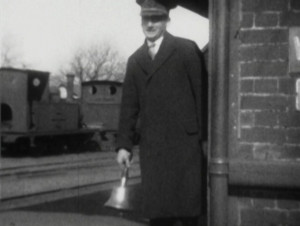
"A locally made film of the Southwold to Halesworth narrow-gauge railway." (EAFA Database)
"[...] Interesting 16 millimeter study of fishing, ranging from deep sea thrills off the Florida coast to an expedition into the Canadian wilds." Photoplay, Nov. 1929, 67.
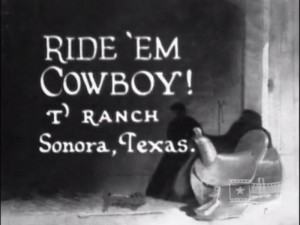
"Produced by Edwin S. Mayer, this 1929 amateur film documents life and work on the T-Half Circle Ranch near Sonora. Ranch hands first herd cattle for branding and de-horning. Then, they turn to working the sheep, sorting them into separate classes before shearing wool. Later, the ranch hands battle a prairie fire on the property. In addition to outlining ranch operations, Mayer also introduces his family and colleagues. At the conclusion, Edwin and his wife Minnie join another couple to explore Carlsbad Cavern in New Mexico. The cave is now the primary attraction of Carlsbad Caverns National Park. Please note, this film contains a racist joke regarding African Americans. The Texas Archive of the Moving Image does not condone this language, but presents the film as it was originally created, because to do otherwise would be the same as to claim this discrimination never existed" Texas Archive of the Moving Image.
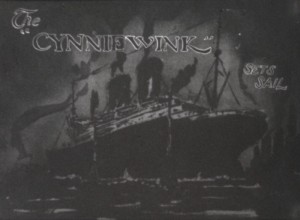
Amateur film documenting the wedding of S. Winston Childs and Cynthia (Cheney) Childs. The film shows guests gathered in formal attire; eventually the bride and groom exchange vows, share the wedding cake, and depart from the ceremony.
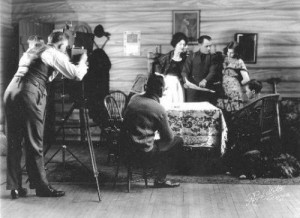
"A Race for Ties" tells the story of a sawmill owner, Joe Atwood, and his race against a large timber company, headed by U. Cheetem, to sign an exclusive contract for railway ties. In addition to a plot driven by one of the region’s staple industries (the lumber industry), the film highlights the scenic nature of the region" - Michel S Beaulieu, Women Film Pioneers Project.
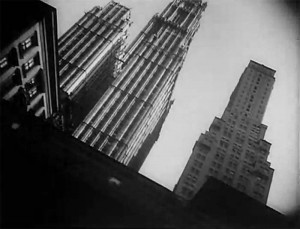
“The hard-edged graphics of 'Skyscraper Symphony' stand in contrast to other New York 'scenics' produced during the 1920s. Composed of skewed perspectives, Robert Florey’s camera looks straight up the domineering concrete behemoths. And it is hard to determine if the film mimics symphonic form as the title suggests or whether it advances a new methodology in musical-visual shot progression that reflects the alien structures depicted.” —Bruce Posner via Light Cone
Total Pages: 299
 Amateur Cinema