a sogg. lungh. norm."/feature-length fiction
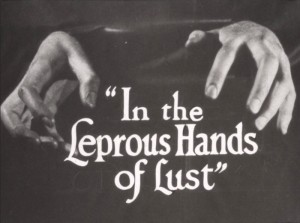
"The story is a burlesque of the anti social activities of a vice ring. The film contains some excellent interior lighting and is remarkably well edited." Movie Makers, April 1931, 224.
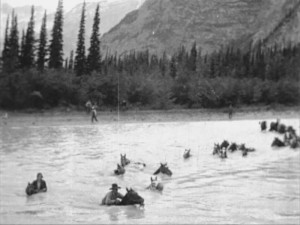
"Shows an expedition through northeastern British Columbia by Mary Gibson Henry, Pennsylvania botanist and plantswoman. Mrs. Henry was interested in the legendary "Tropical Valley" of northern B.C., where the warmth of hot springs supposedly fostered vegetation not otherwise found in the region. The film was shot in the summer of 1931, during the first of four such journeys she made in the period 1931-1935. Mrs. Henry was accompanied by her husband, Dr. J. Norman Henry; four of her children; topographer Knox McCusker (of the Dominion Topographical Surveys Branch); Dr. B.H. Chandler, a surgeon friend; and outfitter S. Clark, as well as various wranglers. The second and third reels of this three-reel film show the party of 16 travelling by pack-train, crossing rivers, caching food, and fishing, as well as some camp scenes. At an encampment of "Grand Lake Indians" on the Tetsa River, they engage Charlie Macdonald, the chief's son, to guide them to Toad Hot Springs on the Toad River, but they do not proceed north to Liard Hot Springs. On the return trip south, stops include St. Paul's Lake, Henry River, and Lake Mary and Lake Josephine [named after the Henry's daughters]; these place names do not seem to have become official. Following the Peace River, they arrive at Hudson's Hope (having travelled 800 miles in 79 days), and continue down river to Taylor Flats." (BC Archives)
The title given above is a supplied title based on the film contents. The actual title of the film is unknown, since it survives as reels 2 and 3 of 3 -- and the actual title and credits (if any) would likely have been at the start of reel 1.
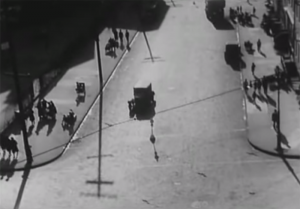
An avant-garde city symphony film set in the Bronx, New York.
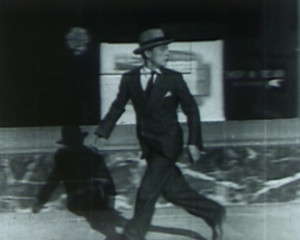
"Amateur filmmaker, cinema historian and railway engineer H.A.V. Bulleid mixes slapstick and romance in this portrait of the extra-curricular life of a Cambridge student. When our intrepid undergraduate first arrives in Cambridge, he forgets the name of his college and loses his ticket, leaving him struggling to reach his lodgings. After a dream-filled night spent sleeping on the streets, he arrives at a lodging where everything costs that little bit extra. Rarely in college, he spends his days stealing bicycles and chasing women until he finds one he wishes to marry. With the courtship in full swing, her father says they can only marry if the undergraduate earns £20 in a single day; an ultimatum with inflammatory consequences" (EAFA Database).
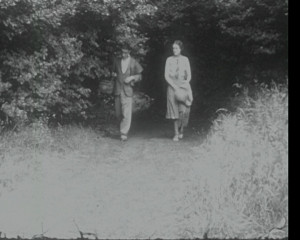
"After alighting at Langport East railway station and following a long walk, a young man and his fiance check into the Anchor Inn at Little Langport, noted for its fishing. The man's fixation with angling, his fiance's slow mastery of the technique and the romantic threat of an attractive, ace woman angler are the obstacles in their relationship. Humorous intertitles typify the era's social manners" (EAFA Database).
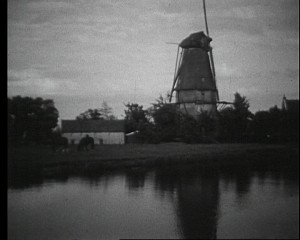
"A four reel film recording details of a motor tour undertaken by Eustace and Eunice Alliott through six of the twelve Dutch provinces" (EAFA Database).
"Mr Alliott responded by projecting yet another film, in colour, recording a visit to Holland, in which there were some excellent shots of Dutch scenery, including the gorgeous tulip fields. There were also many happy portraits of peasants and children in their quaint national costume." (Anon, Photographic Journal, 418)
[Information included on the EAFA database suggests that the film was partially shot using prismatic film which, when using red, blue and green filters on a Kodak A projector, a colour experience is possible. This includes the scenes of: Volendam, Marken, Alkmaar (lively cheeses), Sneek, Veere, Domburg etc.]
"In the late 1931 through early 1932, a heated debate developed among several amateur filmmakers in the Kansai region over the question of inserting portions of existing films in an amateur film production. The debate emerged when a 9.5mm amateur production, Otsukai, was disqualified from an amateur film competition sponsored by a Kansai-based newspaper company, Osaka Mainichi Shimbun (Daimai), after the film had once been selected as one of the winners of the contest. As a representative of Daimai, Kitao Ryōnosuke, who was not only a journalist but also a small-gauge filmmaker himself, explained that the film was excluded from the competition because the author, Takeuchi Kichinosuke, did not notify Daimai in advance about the insertion of a portion of an existing work. According to Kitao, even though the use of existing films would not be considered a form of plagiarism, Otsukai violated the competition guideline, which declared that a submitted film “must be one’s own creation.... Takeuchi, after providing the details of how and why he employed part of a film by one of his friends named Tanaka Yoshitsugu, raised a question concerning how to interpret the idea of “one’s own creation.” Drawing upon Soviet filmmaker Vsevolod Pudovkin’s montage theory, Takeuchi insisted that “one’s own creation” in filmmaking stemmed most fundamentally from montage editing, rather than from other formal or stylistic components including shooting with a camera.” - Noriko Morisue, "Filming the Everyday: History, Theory, and Aesthetics of Amateur Cinema in Interwar and Wartime Japan" (Yale University: PhD Dissertation, 2020): 65-66.
Total Pages: 299
 Amateur Cinema