Visitors at a party receive a message from beyond that informs them, "There is a devil here!" and chaos follows. ‘Just before he died, the photographer of this film, Jack O' Hea, saw an article by Tony Rose, FACI, about the very first year of the Ten Best Competition and so this 'lost' film was rediscovered. It was made in 1934, just two years after Kodak had introduced the 8mm gauge. Music and 'devilish sound effects' were added by Jack O'Hea in 1978. These were revised and re-tracked for the IAC Library by the late Leslie Germany, FACI. The story, by John Burke, relates how the visitors at the Blackmores' party (one of whom is played by the director, Stanley Comber) receive a spirit-message that: 'There is a devil here!'. They link hands round the table and the hostess is attacked’ (EAFA Database).
"This story of a loaf of bread begins with the plowing of the ground. It continues thru discing and harrowing. Then come fields of waving wheat; the harvest and the threshing; the journey to the grain elevator and the flour mills. Scenes in a modern bakery follow and from there the bread is sent to the retail store. Children eating bread and jam are representative of the 'ultimate consumer'." Educational Film Catalog, 1937 edition, 80.
"B. Fredric de Vriew of Rochester, N. Y., for his picture 'Hunting With a Camera Instead of a Gun.' This picture was made practically in its entirety at the zoo." American Cinematographer, Feb. 1936, 73.
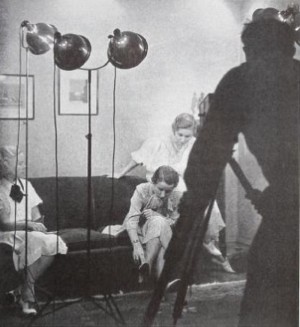
"In Chicago, the Cinema Players have recently completed a one reel, 16mm. comedy, Ten Easy Lessons, the first major production from this new group. The story was directed and photographed by George W. Colburn, ACL, and presents in leading roles Jules Brunner, Louise Byrne, Rudolf Heinkel, DeEtta Kenny, Greta Brunner, Charles Byrne, Evelyn Heinkel and Evelyn Colburn." Movie Makers, Nov. 1935, 476.
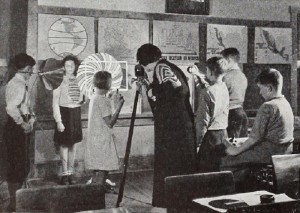
"Mrs. Anne Filut of Milwaukee, possibly entered the most ambitious undertaking to be viewed by the judges. Eleven reels of 8mm film on 'Creative Work in Fractions,' in which she clearly shows the principles of her subject and the fundamentals of the work she is teaching, taken in the class room with the children themselves as the actors. She was given honorable mention." American Cinematographer, Feb. 1936, 73.
"J. F. Hollywood, ACL, built his 8mm. film, Opera Night, around a child's dream and which involved magic. The tricks were accomplished by stopping the camera, holding the action, making the desired change in the subject and starting the camera again." Movie Makers, Dec. 1935, 527.
"Joseph F. Hollywood of New York City entered 'Opera Night,' shot entirely indoors with some trick stop action built around his children. A deserving effort that receives honorable mention." American Cinematographer, Feb. 1936, 73.
Total Pages: 299
 Amateur Cinema