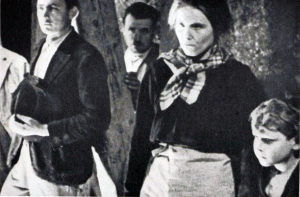
"a sogg. lungh. norm."/Fiction feature film
"Sacrificarsi, realizzato da Arrigo Colombo; aiuto direttore Ottorino Caramazza; scenografia di Brando Savelli, operatore Elio Luxardo. Come il precedente film di Arrigo Colombo, Alta Tensione, anche questo Sacrificarsi e a carattere episodico; il centro dell'azione e stavolta una miniera, che e stata completamente ricostruita nelle proporzioni necessarie allo svolgimento della trama. Il sacrificio è quello di un operaio; e il momento in cui lo trasportano con le gambe penzoloni dal carrello, fuori della galleria, di fronte agli sguardi della moglie e del figlioletto, e il momento più felice del film, in cui si riconosce che ormai Colombo ha raggiunto alcune qualità che per taluni aspetti possono essere definite professionali; Colombo ·mostra in più punti la sua abilita, e questa forse lo tradisce talora, specie quando egli perde il filo del racconto principale per illustrare motivi di contorno; ma in ciò forse egli e stato indotto dalla mancanza di un movente drammatico del soggetto che fosse giustificato da uno schema più complesso. I personaggi sono ben descritti e sopratutto piace il bambino con quel suo sfarfallio in contrasto col lavoro delta miniera."
—Il Ventuno 28 (Review of the G.U.F. of Venice), May 1935
"Self-Sacrifice (Sacrificarsi), directed by Arrigo Colombo; assistant director Ottorino Caramazza; set design by Brando Savelli; cameraman Elio Luxardo. Like Arrigo Colombo's previous film, High Tension, Making Sacrifices is also episodic in nature; the center of action this time is a mine, which has been completely rebuilt to proportions necessary for the development of the plot. The sacrifice is that of a worker, and the moment in which he is transported with his legs dangling from the trolley, out of the tunnel, in front of the eyes of his wife and small son, is the happiest moment of the film, in which we recognize that Colombo has attained certain qualities that in some respects can be called professional; Colombo shows in several points his ability, and this perhaps betrays him sometimes, especially when he loses the thread of the main story to elaborate the backdrop and contextual events, but to this perhaps he was tempted to do so is due to the lack of a dramatic incident in the plot that would have justified the more complex scheme. The characters are well-described and especially likable is the child with his flickering that contrasts with the work of the mine."
—Il Ventuno 28 (Review of the G.U.F. of Venice), May 1935
"doc. turistico"/tourism documentary
"doc. didattico"/educational documentary
An industrial documentary about Tobacco farming.

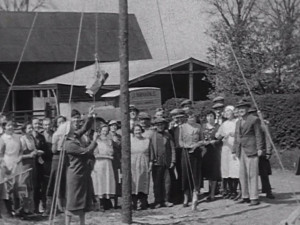
A film showing the Brooke family and their Jubilee Celebrations.
"The Yamamoto picture was a record of a hike over the hills and the countryside with a dog." American Cinematographer, Feb. 1937, 73.
"Film footage moderately edited with added intertitles, shot in Ceylon, Egypt, and Italy by oil explorer and geologist Walter Link during his personal vacation, records various tourist destinations. Landmarks include: the beach and harbor at Colombo, Sri Lanka (Ceylon); the Sphinx, pyramids, Mosque of Mohamed Ali and Egyptian Museum in and around Cairo, Egypt; Villa San Michele in Capri, Italy; and St. Peters and the Coliseum in Rome, Italy. Footage consists mainly of sights and structures, and features little interaction with local inhabitants," Human Studies Film Archives, Smithsonian Museum.
Total Pages: 299
 Amateur Cinema