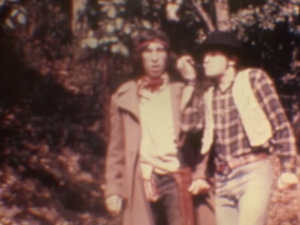
"El título venía del juego de palabras con "West/Oeste" que da origen a "western". Alegaba la posición sureña de México en relación con el viejo oeste estadounidense y por eso se llamaba Sur. Al inicio de la película, sobre el título, una voz en off se aseguraba de explicarlo "Sur: Un western de acá de este lado"" (Vázquez Mantecón, 2012).
"The title is a game with the words "West/Oeste", that originate the term "western". It pleads the southern position of Mexico regarding the old United States west, and that is why it was called Sur [South]. At the beginning of the film, above the title, an off voice makes sure to explain it "South: A western from this side"" (Vázquez Mantecón, 2012).
"EL TERCER SUSPIRO. Separa de un grupo de paseantes en la Alameda a un joven que al aceptar la invitación a subir a un auto que le hacen tres desconocidos (identificados con el movimiento revolucionario de 1910, mediante un montaje de fotografías de la época), durante el paseo por el Periférico se ve acometido por una serie de evocaciones imaginarias. Primero se le ve huir del coche saltando a un paso de peatones, y ser acosado a través de casas derruidas. Al regresar al tiempo presente uno de los hombres le pone la mano en un revólver. Después se ve en un lugar desierto, penosamente sostenido en pie por un aparato ortopédico, mientras una marea creciente lo empieza a cubrir. En ese punto desciende del coche en marcha y se coloca en el centro de la carretera, amenazando con el arma a algo que se aproxima; pero antes de que se produzca el disparo evoca un encuentro amoroso. Esta acción se repite varias veces antes de disolverse en las imágenes de un lago que ahora lo ha cubierto todo"(Garmendia en Vázquez Mantecón, 2012).
"THE THIRD SIGH. Separates a young man from a group of pedestrians in the Alameda, when he accepts an invitation by three unknown men to get into a car (the men were identified with the revolutionary movement of 1910 through a photographic montage of the time), during the ride through Periférico, he is undertaken by a series of imaginary evocations. First he is seen running away from the car, jumping to a crosswalk, and being harassed through demolished houses. When coming back to the present, one of the men puts his hand on a revolver gun. Afterwards, he is seen in a desert place, shamefully sustained by an orthopedic device, while a rising tide starts to cover him. At this point he descends from the moving car and goes to the center of the highway, menacing with his gun something that is approaching; but before the shot is produced, a loving encounter is evoked. This image is repeated several times before dissolving into images of a lake that has now covered everything" (Garmendia in Vázquez Mantecón, 2012).
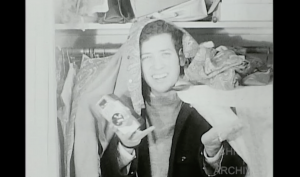
"This collaborative student film follows a confused young man throughout his day, as he navigates various environments (church, neighborhood streets, parties, etc), never seeming to fit in. Beatles songs featured prominently throughout." Chicago Film Archives
"Hacía un alegato sobre lo que sucede al otro lado de la tranquilidad de la vida burguesa. Se alternaban imágenes de placidez doméstica de la clase media con escenas de la guerra de Vietnam y las rebeliones estudiantiles de la época. Al final de la cinta, sobre la fotografía de un mitin en Tlatelolco, una pregunta: "saber, darse cuenta, ¿cuándo?" "(Vázquez Mantecón, 2012).
"It was an allegation about what happens at the other side of the bourgeois life tranquility. Images of middle class house placidity were alternated with scenes from the Vietnam war and the students' rebellions of the time. At the end of the film, over the photography of a political rally in Tlatelolco, a question: "to know, to notice, when?" " (Vázquez Mantecón, 2012).
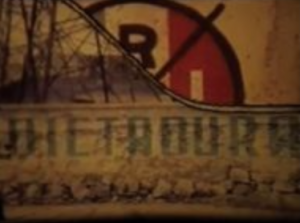
"La película realizaba un montaje lúdico al yuxtaponer los mensajes políticos oficiales escritos en las bardas de la ciudad con imágenes o textos que los ironizaban o alteraban su sentido. El título viene de un juego de palabras con el fraseo de las sílabas "Mé-xi-co" / jí-ca-ma", que solían usarse entonces como porra en los partidos de fútbol de la selección nacional" (Vázquez Mantecón, 2012).
"The movie had a playful montage by juxtaposing official political messages written in walls around the city with images or text that ironized them or altered their meaning. The title comes from a word game that played with the phrasing of the syllables "Me-xi-co / ji-ca-ma", a popular chant during the national team soccer games of the time" (Vázquez Mantecón, 2012).
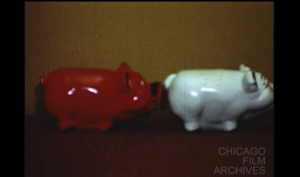
"A stop-animation film set to the song “Close to You” by The Carpenters. It was made by a Chicago high school student as a hobby back in 1971. It went onto win an award from the “Young Chicago Filmmakers Festival” that same year." Chicago Film Archives
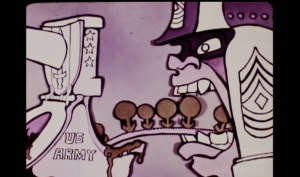
"University of Illinois Chicago (UICC) animated student film about being drafted to the Vietnam War." Chicago Film Archives
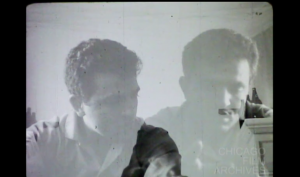
"Columbia College student film about a young man receiving and responding to his Vietnam draft card." Chicago Film Archives
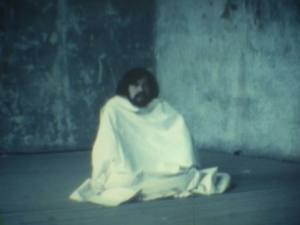
"Two Visual Arts students of the San Carlos Academy find themselves embroiled in contradictions, spiritual inclinations and concerns about the political and social conditions of Mexico, which puts them in a quandary about what stance to take in the Student Movement of 1968." Ambulante.
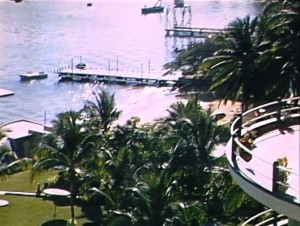
"General scenes around Acapulco; Bay, ships, beach, poolside, city scenes, landscape, cliff diving, traditional dance and crafts." UC San Diego Library.
Total Pages: 299
 Amateur Cinema